
























«MY HEART HAS KINDLED THE UNQUENCHABLE FIRES»…

In historically difficult times for the Armenian people, the sober-minded intellectuals of the Armenian nation sought ways to strengthen «the foundations of life». In such a period — as a means of struggle — many Armenian figures of the 19th-20th centuries strove for the rebirth of the National spirit — extolling strength, manliness, the spirit of victory…
In Armenian literature the «pagan movement» takes shape, which emphasizes the necessity of casting off medieval religious impositions and of returning to the national sources.
As Charents writes —
«My heart has kindled the unquenchable fires —
Ancient dreams and fiery longings»…
The paths of the searches stretched toward the Light of the distant centuries of the Homeland:
«A distant longing was burning my heart,
Your boundless distances of light were calling».

«The Armenian literary-social milieu of the early 20th century was imbued with national aspirations and with searches for new artistic form and content, which had their direct and powerful influence on the literary process in general and on creators — in particular. It is precisely in these conditions that in Western Armenian literature one of the interesting phenomena of our literature has its beginning — the «pagan movement», which, being closely connected with the similar world literary movements of the period, in particular — the French and the Belgian, at the same time manifests its national content»,- writes Marat Tadevosyan in his article «The national image of Armenian literature in the system of various artistic methods» («The national particularities of Armenian literature» Yerevan, 2003) and continues:

«To harmonize the past with the present: this was the aesthetic and ideological credo of the participants in the movement.
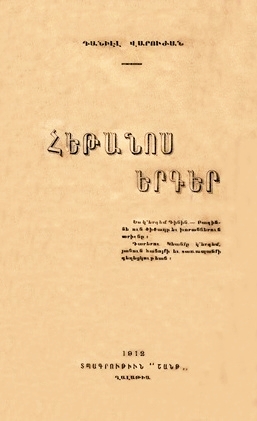
Besides D. Varuzhan’s «Pagan Songs», the moods characteristic of the «pagan movement» were expressed in L. Shant’s drama «The Ancient Gods», in R. Zardaryan’s prose work «The Glorification of the Altar», in H. Siruni’s «Toward the Temple of the Miracle» and V. Tekeyan’s «The Wonderful Resurrection» books, as well as in individual poems of Siamanto, R. Sevak, Aharon, L. Esajanyan and others. In 1914, edited by D. Varuzhan and. H. Siruni, the yearbook «Navasard» was published in Constantinople, a considerable part of whose artistic and scientific-philological materials was devoted to the pagan past.
As contemporaries note, the literary-social atmosphere was saturated with «paganism» («the national», K.A.), which was the prevailing mentality of the time (as is attested if only by the titles of literary works and of individual periodicals — «Pagan Songs», «The Ancient Gods», «The Glorification of the Altar», «Navasardian Prayer to the Goddess Anahit», «Navasard», «Mehyan» and so on).
A decade later — here is what H. Siruni writes:
«Varuzhan had just offered to people the imperishable beauty of his «Pagan Songs» and opened a new line in people’s souls.
Another small group of believers was already digging the foundation of a «Mehyan». And all, all felt a thirst for the Unknown Beauty and called it into their souls. And all believed that this beauty came from the distant centuries.
We wanted to bind Armenian literature, which was becoming estranged, once again to the native soil and to its untold beauties.
We wanted to rekindle in our souls the sacred Fire with which our ancestors once lit their altars. We wanted to lend an ear to the tale sung by the centuries and to torment our soul in order to interpret its mystery. We wanted to tear out – and cast away from our hearts the alien flowers, and, purified, repentant, await the new dawn, with throbbing heart and open arms». («Navasard», Volume I, Issue I, Bucharest, 1923, p. 3).

Having different artistic levels, worldviews and. individual temperaments, «the pagans set themselves aesthetic, ideological, moral, historical-cognitive tasks that were not alike at first glance. Nevertheless, despite all the differences of worldview among the participants in the «pagan movement», it had certain common national and social roots.
In the national sense the meaning of that movement was to inspire the present generations with the heroic episodes of the past, to give them lessons of strength and endurance. For the salvation of the people the national spirit must be restored, which, in the opinion of many intellectuals, had manifested itself precisely in the pagan centuries of our history, and afterwards was distorted and destroyed under the yoke of foreign tyranny and under the influence of the Christian preaching of submission.

«In the pagan movement, especially in Varuzhan’s poetry, the social subtext of the new artistic searches was also expressed very definitely. The past was set against contemporary bourgeois reality — the reality of the «golden calves», which belittles man and deprives him of the influence of will, aspirations and feelings. This inevitably called into being a romantic, extra-historical view of the past, since in the latter Varuzhan and the other «pagans» wanted to see and glorify what they sought and did not find in the present — the freedom of the individual and the heroic spirit, the unfettered development of his spiritual and physical powers, the simplicity and purity of human relations». (Ed. Jrbashyan, Aesthetics and Literature, Yerevan, 1983, p. 262).

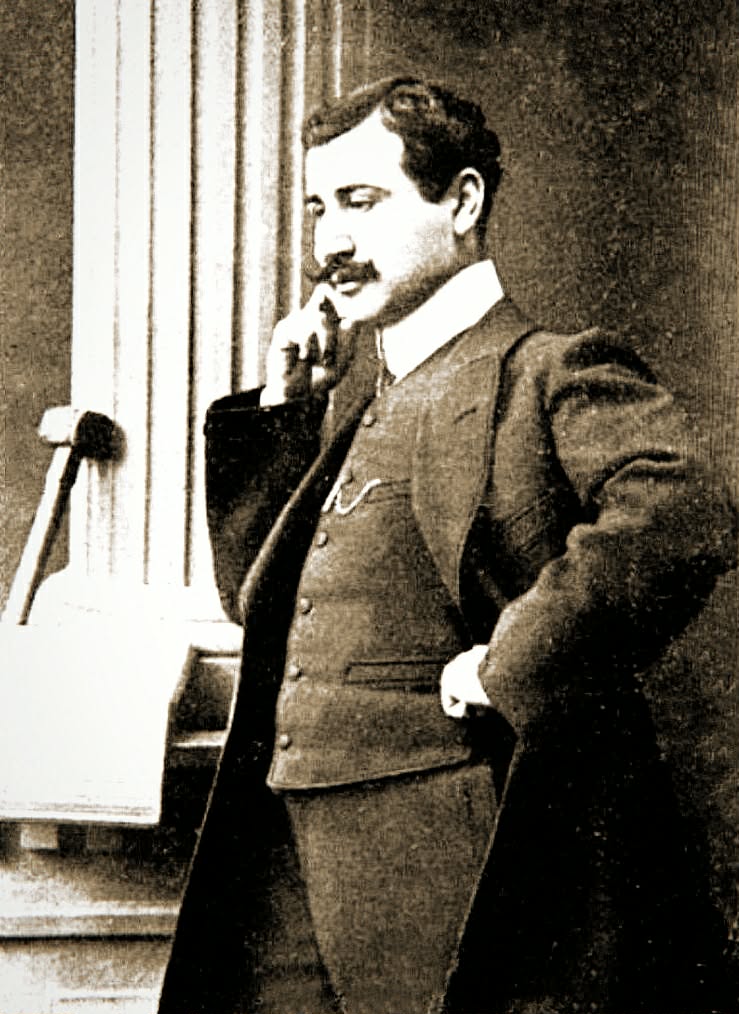
«The pagan movement» did not arise suddenly, although contemporaries consider the years 1912-1913 the beginning of the «pagan» movement. It is true that it became a literary current and took its final shape only in the 1910s, but years before that creators were already turning to «poetic paganism». This concerns above all D. Varuzhan, who as early as 1905 writes:
«Pagan life attracts me day by day; if it were possible today — I would change my religion and would embrace poetic paganism with love» (D. Varuzhan, Letters, Yerevan, 1965, p. 131). «I have the «nostalgie» not only for our heroic ages, but for those of all mankind. When will paganism return, and the ancient victories, to win which heroes were needed, and not diplomacy?» (D. Varuzhan, Letters, p. 151, 152).
In the centuries that followed paganism the character of man has been corrupted — of the man «mighty and incorruptible like wine», «in place of virtuous valour treachery reigns today».
One must be renewed both as a man and as an Armenian («Where has classical Armenianness gone, one must seek them in the corpses of ruins» (Ibid. p. 187) – this is the subtext of the poet’s worldview.

The depiction of pagan life and spirit becomes for Varuzhan a literary programme and goal.
«I worship the past… in spite of the futurists — I shall found the school of the worshippers of the past»,- he proclaims. Already in 1907 several poems of the collection are created («Abandonment», «Blessed art thou among women»). In 1909 the cycle «Flowers of Golgotha» is also outlined. «Now I have undertaken to prepare a new volume drawn purely from lived life, with somewhat more analytical, more profound and psychological songs» (Ibid., p. 172).
In 1911 among his «works to be published» D. Varuzhan also mentions «Pagan Songs», which testifies that it was already essentially ready for printing»…
… «It is for the present and from the positions of the present that D. Varuzhan turns to the «mighty» pagan period, to historical and mythological heroes and figures — striving to revive the chivalrous spirit — strength and beauty. By this he wanted to respond to the spiritual and intellectual demands of his people and of his epoch, to make the past serve modernity.
D. Varuzhan grounds and interprets anew the ideal of paganism, which in his work is a complete system, as much aesthetic as philosophical-ideological. The depiction of strength and beauty, of «the struggles of the irons and of man» was directed toward the discovery of the ideal of man and of the beautiful, which the poet’s literary opponents were unable to see.
As a consequence of the fundamental opposition of «Life and dream» (T. Chyokyuryan), dissatisfaction and disillusionment with the present arise. That is why in «Pagan Songs» the anti-philistine and anti-bourgeois orientation was natural and logical. In the poem «The Concubine» Varuzhan evokes the pagan past thus:
«Glory to the mighty way of life of the chivalrous ages,
Where the Beautiful and drunken Strength were worshipped…
Glory to you forever — o curly-haired knights, just-hearted,
Beneath whose armour-clad breasts there beat
A heart forever self-sacrificing — for the weak, for the oppressed,
And for beautiful women, for the myriad treasure of their body».
In «Pagan Songs» Varuzhan brought the glorification of manly strength, the cult of feminine beauty (and of the beautiful in general), the worship of light and of feminine nudity, instead of philistine, unnatural, painted and false manners — the unfettered enjoyment of worldly life; he depicts the suffering man and mankind, the beauty of suffering and of pleasure»…