«ARMENIAN PERSONAL NAMES» (Part A) (H. ACHARYAN)
The history and culture of a given nation are reflected in personal names, surnames, place names.
The study, the elucidation of the origin of the names and surnames of the Armenians, who over millennia, dictated by the political situation, «travelled a certain road» with various nations, reveals numerous genealogical pages — with the layers of the influences undergone.
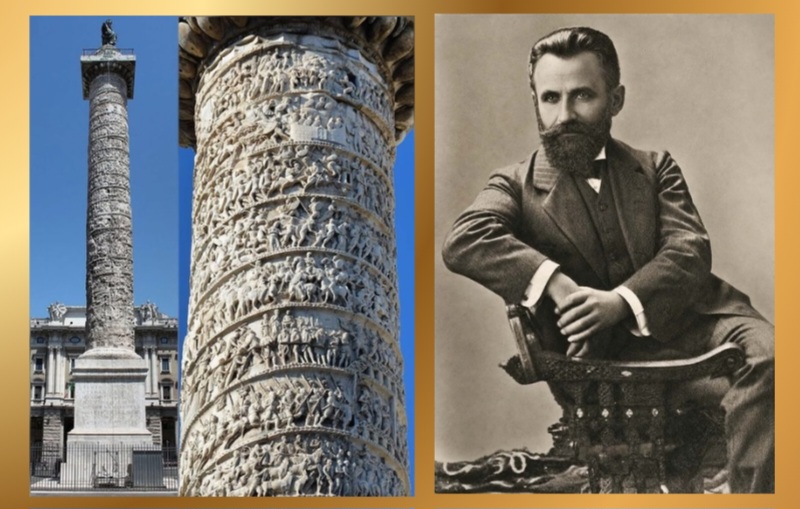
An excerpt from Hrachya Acharyan’s article «Armenian personal names» — below (Part A, the continuation — with the next publication)…
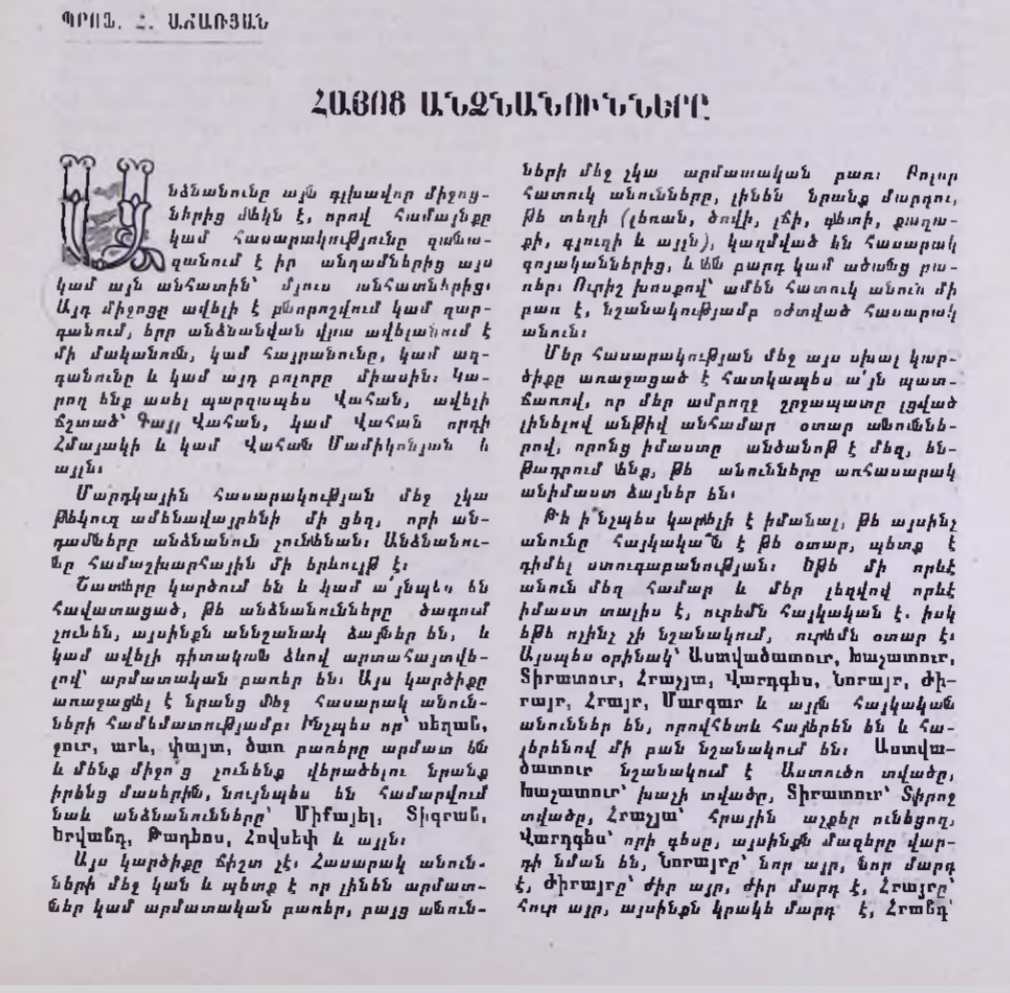
«The personal name is one of the principal means by which the community or society distinguishes this or that individual among its members — from the other individuals: This means becomes more defined or develops when to the personal name is added a nickname, or the patronymic, or the surname – or all these together: We can say simply Vahan, more precisely — Gayl Vahan, or Vahan son of Hmayeak, or Vahan Mamikonean and so on:
In human society there is not a single tribe, even the most savage,
whose members do not have personal names:
The personal name is a universal phenomenon:
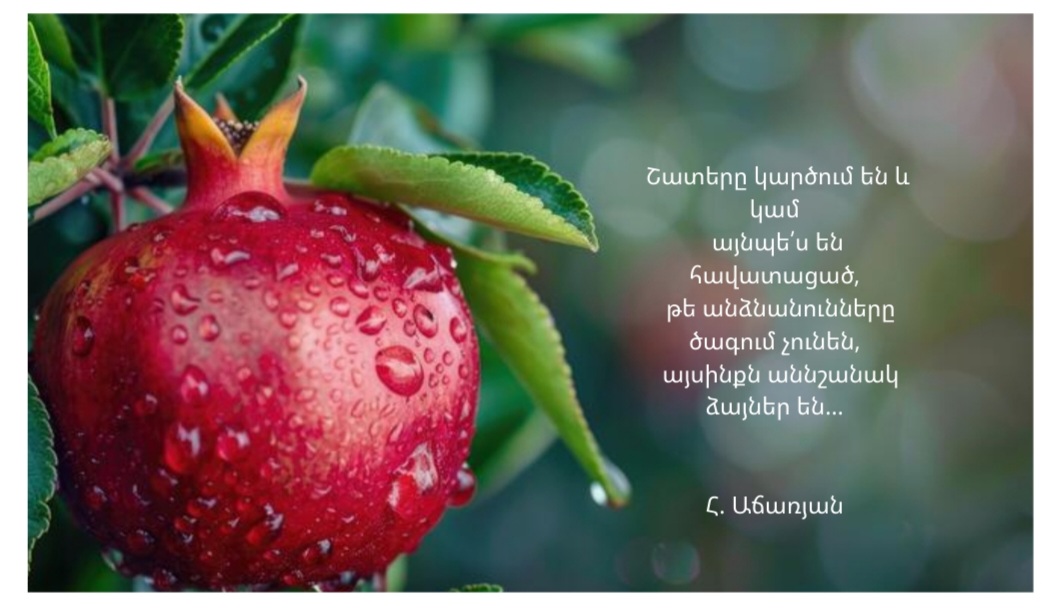
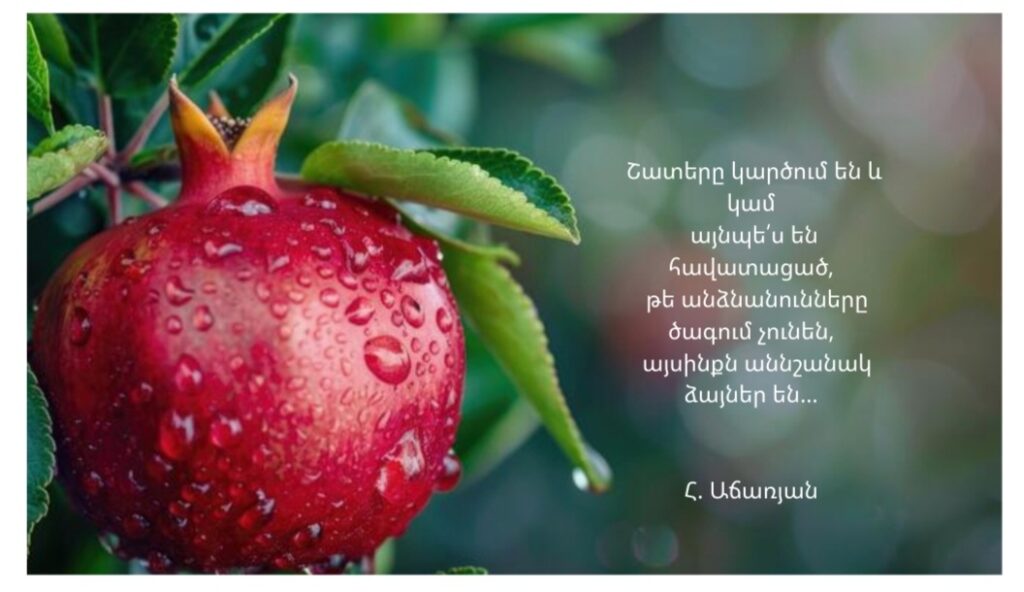
Many think or are so convinced that personal names have no origin, that is, they are meaningless sounds, or, expressing it in a more scientific way — they are root words: This opinion arose among them by comparison with common nouns: Just as the words table, water, sun, wood, tree are roots and we have no means of reducing them to their parts, so too are considered the personal names — Mikayel, Tigran, Eruand, Tadeos, Yovsep and so on:
This opinion is not correct: Among common nouns there are and must be roots or root words, but among names there is no root word: All proper names, whether they be of a man or of a place (of a mountain, a sea, a lake, a river, a city, a village and so on), are formed from common nouns, and are compound or derived words: In other words — every proper name is a word, a common noun given with a meaning:
In our society this wrong opinion has arisen especially for this reason, that our whole surroundings being filled with countless, innumerable foreign names, whose meaning is unknown to us, we suppose that names in general are meaningless sounds:
As to how one can know whether such-and-such a name is Armenian or foreign, one must turn to etymology: If some name gives some meaning for us and in our language, then it is Armenian; and if it means nothing, then it is foreign: Thus for example — Astvatsatur, Khachatur, Tiratur, Hracheay, Vardges, Norayr, Zhirayr, Hrayr, Margar — and so on are Armenian names, because they are Armenian and mean something in Armenian: Astvatsatur means given by God, Khachatur — given by the cross, Tiratur — given by the Lord, Hracheay — having fiery eyes, Vardges — whose ges, that is hair, is like a rose, Norayr — is a new man, a new person, Zhirayr — is an agile man, an agile person, Hrayr — is a fire man, that is a man of fire, Hrand — fire is there, there — in the heart a fire is kindled, Margar – is a prophet, a foreteller of the future, and so on:
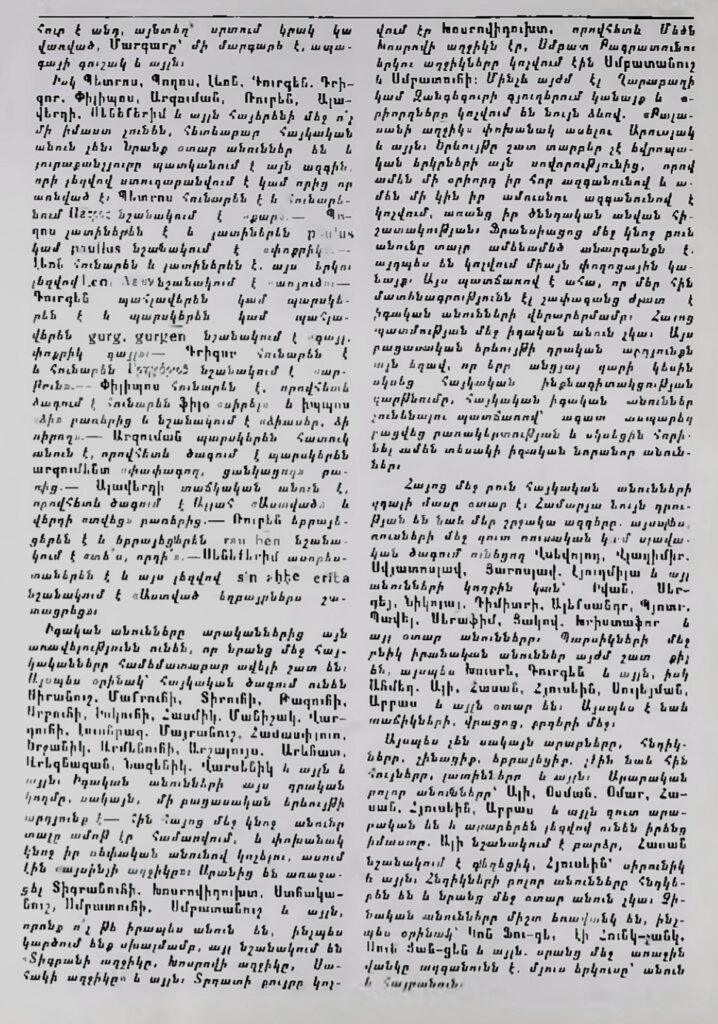
While Petros, Poghos, Levon, Gurgen, Grigor, Pilipos, Arzuman, Ruben, Alaverdi, Senekerim and so on have no meaning whatsoever in Armenian, consequently — they are not Armenian names.
They are foreign names and each belongs to that nation in whose language it is etymologized or from which it was taken: Petros is Greek and in Greek Petros means «stone»… Poghos is Latin and Latin paulus or paullus means «little», Levon is Greek and Latin; in these two languages Leo, Leon means «lion»: Gurgen is Pahlavi or Persian and Persian or Pahlavi gurg, gurgen means «wolf, little wolf», Grigor is Greek and Greek Grigorios means «wakeful», Pilipos is Greek, because it comes from the Greek words philo «to love» and hippos «horse» and means «horse-lover, loving horses»:
Arzuman is a Persian proper name, because it comes from the Persian word arzumend «longing, desiring», Alaverdi is a Turkish name, because it comes from the words Allah «God» and verdi «gave», Ruben ben is Hebrew and in Hebrew rau means «see, son»… Senekerim is Assyrian and in this language sin ahhe eriba means «God multiplied my brothers»:
Female names have this advantage over male ones, that among them the Armenian ones are comparatively more numerous: Thus, for example, of Armenian origin are Siranoysh, Makruhi, Tiruhi, Taguhi, Srbuhi, Iskuhi, Yasmik, Manishak, Varduhi, Lusntag, Mayranoysh, Hamaspyur, Erjanik, Armenuhi, Arshaloys, Arevhat, Aregnazan, Nazenik, Varsenik and so on, and so on:
This positive side of female names, however, is the result of a negative phenomenon – among the ancient Armenians giving a woman’s name was considered shameful, and instead of calling a woman by her own name, they said «the daughter of so-and-so»: From this arose Tigranuhi, Khosrovidukht, Sahakanoysh, Smbatuhi, Smbatanoysh and so on, which are not really names, as we mistakenly think, but mean «Tigran’s daughter, Khosrov’s daughter, Sahak’s daughter» and so on:
Trdat’s sister was called Khosrovidukht, because she was the daughter of Khosrov the Great; the two daughters of Smbat Bagratuni were called Smbatanoysh and Smbatuhi: Even now in the villages of Karabakh or Zangezur women and maidens are called in the same way. «Balasan’s daughter», instead of saying Arusyak and so on:
The phenomenon is not very different from that custom of the European countries, by which every maiden is called by her father’s surname and every woman by her husband’s surname, without mention of her birth name: Among the French giving a woman’s own name is the greatest insult; only street women are called so: This is why our old literature too is exceedingly stingy with regard to female names:
In Armenian history there is no female name: The positive result of this negative phenomenon was that when in the middle of the last century the awakening of Armenian self-consciousness began, owing to having no Armenian female names a free field opened for word-formation and they began to compose new female names of every kind:
Among the Armenians a considerable part of the genuinely Armenian names is foreign: Almost in the same situation are also our surrounding nations; thus, among the Russians, beside Vsevolod, Vladimir, Svyatoslav, Yaroslav, Lyudmila and other names of purely Russian or Slavic origin there are — Ivan, Sergey, Nikola, Dmitri, Aleksandr, Pyotr, Pavel, Serafim, Yakov, Khristafor and other foreign names:
Among the Persians native Iranian names are now very few, thus — Khusrev, Gurgen and so on, while Ahmed, Ali, Hasan, Huseyin, Suleyman, Abbas and so on are foreign: So it is also among the Turks, the Georgians, the Kurds:
Not so, however, are the Arabs, the Indians, the Chinese, the Hebrews; nor were the ancient Greeks, the Latins and so on:
All Arabic names — Ali, Osman, Omar, Hasan, Huseyin, Abbas and so on are purely Arabic and have their meaning in the Arabic language; Ali means «high«, Hasan means «beautiful», Huseyin — «pretty» and so on:
All the names of the Indians are Indian, and among them there is no foreign name:
Chinese names are always trisyllabic, as, for example — Kon Fu-Tsi, Li Hunk-Chank, Sun Yan-Tsen and so on; among these the first syllable is the surname, the other two name and patronymic:
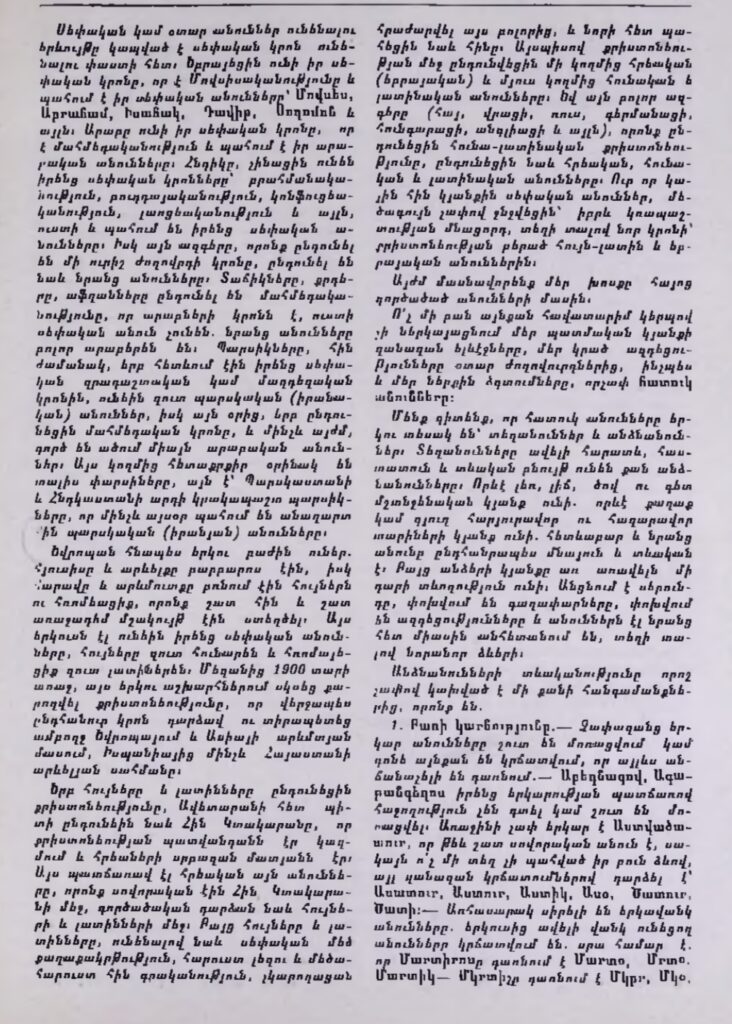
The phenomenon of having one’s own or foreign names is connected with the fact of having one’s own religion: The Hebrew has his own religion, which is Mosaism, and keeps his own names — Movses, Abraham, Isahak, Davit, Soghomon and so on:
The Arab has his own religion, which is Mohammedanism, and keeps his Arabic names: The Indian, the Chinese have their own religions — Brahmanism, Buddhism, Confucianism, Laotseanism and so on, and therefore they keep their own names:
And those nations which accepted the religion of another people, accepted their names too:
The Turks, the Kurds, the Afghans accepted Mohammedanism, which is the religion of the Arabs, so they have no names of their own; their names are all Arabic:
The Persians, in ancient times, when they followed their own Zoroastrian or Mazdean religion, had purely Persian (Iranian) names, while from the day when they accepted the Mohammedan religion and until now, they use only Arabic names:
In this respect an interesting example is given by the Parsis, that is — the present-day fire-worshipping Persians of Persia and India, who until today keep the pure old Persian (Iranian) names:
Europe anciently had two parts; the north and the east were barbarian, while the south and the west were held by the Greeks and the Romans, who had created a very old and very advanced culture: Both of these had their own names, the Greeks — purely Greek and the Romans — purely Latin:
1900 years before us, in these two worlds Christianity began to be preached, which finally became the common religion and dominated in all Europe and in the western part of Asia, from Spain to the eastern border of Armenia:
When the Greeks and the Latins accepted Christianity, together with the Gospel they had to accept also the Old Testament, which formed the pedestal of Christianity and was the sacred book of the Jews: For this reason those Jewish names which were usual in the Old Testament became current also among the Greeks and the Latins: But the Greeks and the Latins, having also their own great civilization, a rich language and a very rich old literature, could not renounce all this and together with the new kept also the old:
Thus, in Christianity were accepted, on the one hand — Jewish (Hebrew) and, on the other hand Greek and Latin names: And all those nations (Armenian, Georgian, Russian, German, Hungarian, English and so on), which accepted Greco-Latin Christianity, accepted also the Jewish, Greek and Latin names: Wherever there were names proper to the old life, they were wiped out to the greatest extent — as remnants
of idolatry, giving way to the Greek, Latin and Hebrew names brought by the new religion — Christianity:
Now let us particularize our discourse about the names used by the Armenians:
Nothing represents so faithfully the various ups and downs of our historical life, the influences we have undergone from foreign peoples, as well as our inner aspirations, as proper names:
We know that proper names are of two kinds — place names and
personal names: Place names have a more lasting, stable and enduring character than personal names:
Any mountain, lake, sea and river has an eternal life; any city or village has a life of hundreds and thousands of years; consequently their name too is in general permanent and enduring: But the life of persons has a duration of at most one century:
The generation passes, ideas change, influences change and the names too disappear together with them — giving way to ever new forms»…
To be continued…