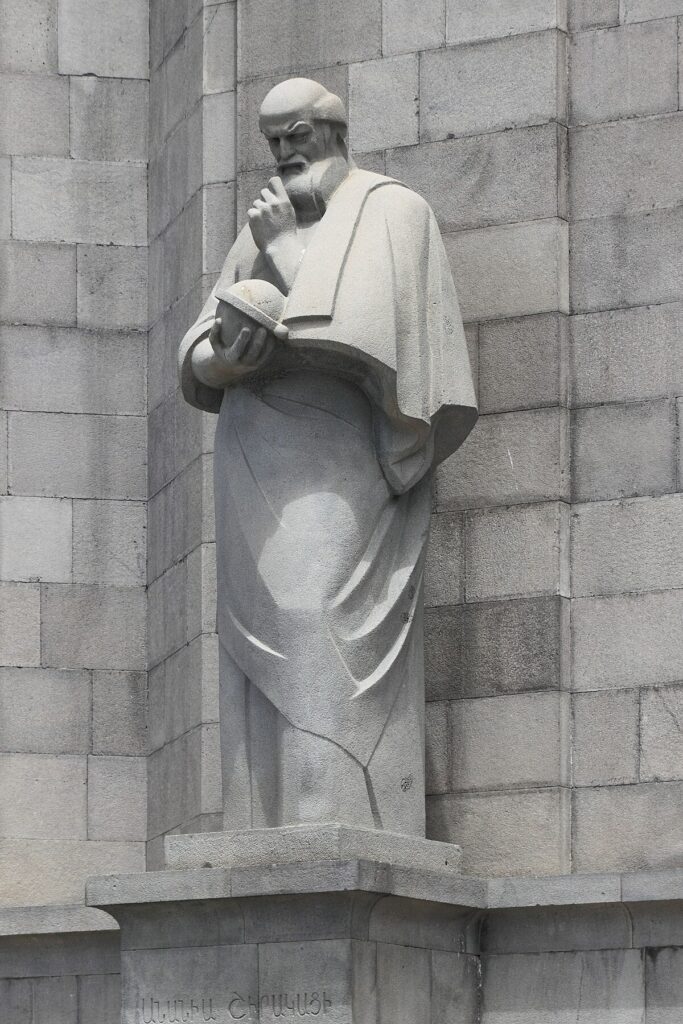







«FESTIVE PROBLEMS» (ANANIA SHIRAKATSI)
The fragments of the history and culture of the past reach us, in their overwhelming majority, in a damaged form — in pieces, often with writings difficult to read…
By the deciphering of these barely discernible relics some episodes are restored — thanks to the painstaking work of specialists, and from the slumber of centuries the faded witnesses of times gone by arise. In them ancient Armenian resounds, they tell of the way of life of people, of the level of education, of the worldview, of the manners of the time…
Studying the folio numbers of three pieces of hard parchment of unequal workmanship, their script — the erkatagir letterforms of the capitals, the lines of writing, the shades of the pigment (the writing material — the ink), the distinguished historian, manuscript scholar and source scholar Artashes Matevosyan concludes that the fragments are parts of one and the same manuscript.
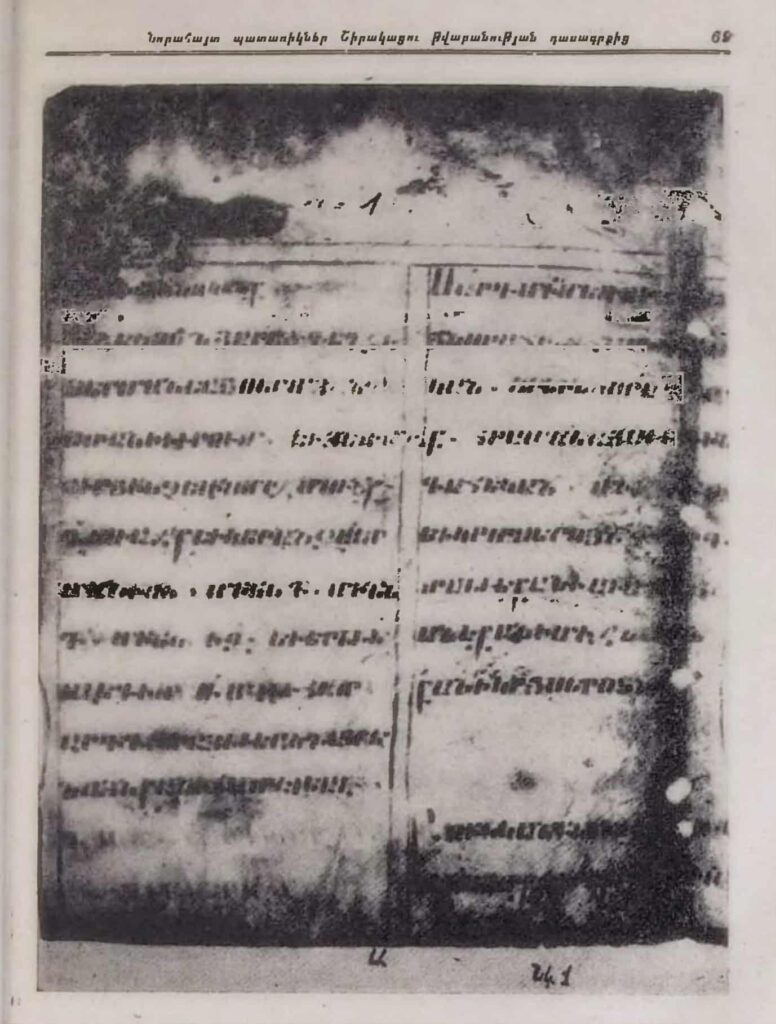
«The examination shows that they were parts of one and the same manuscript. Later that manuscript was used as a flyleaf — being cut and adapted to the dimensions of the manuscript to be bound.
For that reason the first fragment lost not only the margins, but also part of the text. Worse is the state of the second and third fragments. Of the flyleaves there remained a thin strip attached to the manuscript.
The first fragment of the scrap was detached from the manuscript earlier, while the others — recently, from manuscript № 4954 of the Matenadaran (copied in the second half of the XIII century). Hence, the parchment manuscript of which these fragments were parts was already «aged» in that century and was used as a flyleaf.
Now let us examine the fragments of the scrap one by one, after which it will become possible to make palaeographic, textological and philological
observations»…
«…What problems are these, who is their author?
Anyone familiar with the «Questions», or problems, of Anania Shirakatsi will notice the identity of those and of these problems»…
The two-column text in erkatagir and in scribal hand, of 14 lines — with six holes made for sewing, is from the «Festive Problems», the author concludes (A. S. Matevosyan,
«Newly found fragments from the arithmetic textbook of Anania Shirakatsi»).

For the purpose of teaching logic — the development of reasoning, numerical calculation, computation, since the most ancient times the sages of the Ancient world, as well as the Armenian Kurms, elaborated and applied various means of education.
Thanks to medieval manuscript books some versions have been preserved of short problems intended for testing the knowledge of table-companions and for amusement during feasts and merry gatherings, which are known under the name «Festive Problems».
«I write for you also festive problems, for when you make merry over food and drink and wish to speak amusing and laughable words» (Anania Shirakatsi, Writings, p. 233, quoted from the above-mentioned study).
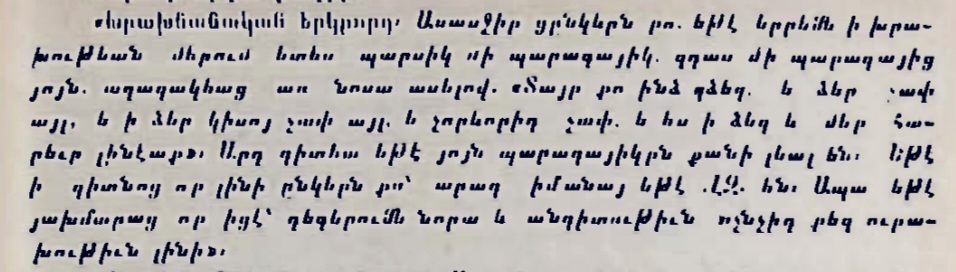
In the part of Shirakatsi’s arithmetic called «On Questions and Solutions» are the 24 arithmetical problems with examples taken from the events and the everyday conditions of the time — with their answers.
A. G. Abrahamyan in his article «Anania Shirakatsi, an Armenian scholar of the seventh century» writes:
«For us, as a specialist in the ancient period of the history of the Armenian people, it is pleasant to speak about Armenian authors in general, but among them there is one, one closer to us, whom we love to the point of worship – that is the eminent scholar of the seventh century, the renowned son of Shirak, Anania Shirakatsi. In the course of more than twenty years of study of Shirakatsi’s writings, the more closely we have become acquainted with Shirakatsi’s scientific heritage, the deeper we have gone into the depth of the questions he raised, the more his charm has grown and deepened in our eyes»…

… «We must also say that in the dark medieval reality, some thoughts and views of our enlightened author did not find wide acceptance in conservative circles, and for that reason Shirakatsi’s writings were not copied and were left without attention.
As early as the 11th century the famous scholar Grigor Magistros, in his letter to Catholicos Petros Getadardz, complains that the works of Anania Shirakatsi, which the author had collected with great toil, with wanderings and roaming, from diverse books rich in content, have been left without attention and are hidden «under the bushel»».
«… The «Six-thousander» had long been known in Armenian studies, but remained undeciphered.
Various legends had been created around the «Six-thousander»: it was considered an astrological book and some mysterious magical meanings were attributed to it. In old times even the opinion had currency that this text, in general, cannot be deciphered: whoever tries to decipher it may go mad.
For quite a long time we were occupied with the deciphering of that text. We persistently continued our researches on the «Six-thousander», until we finally deciphered it.
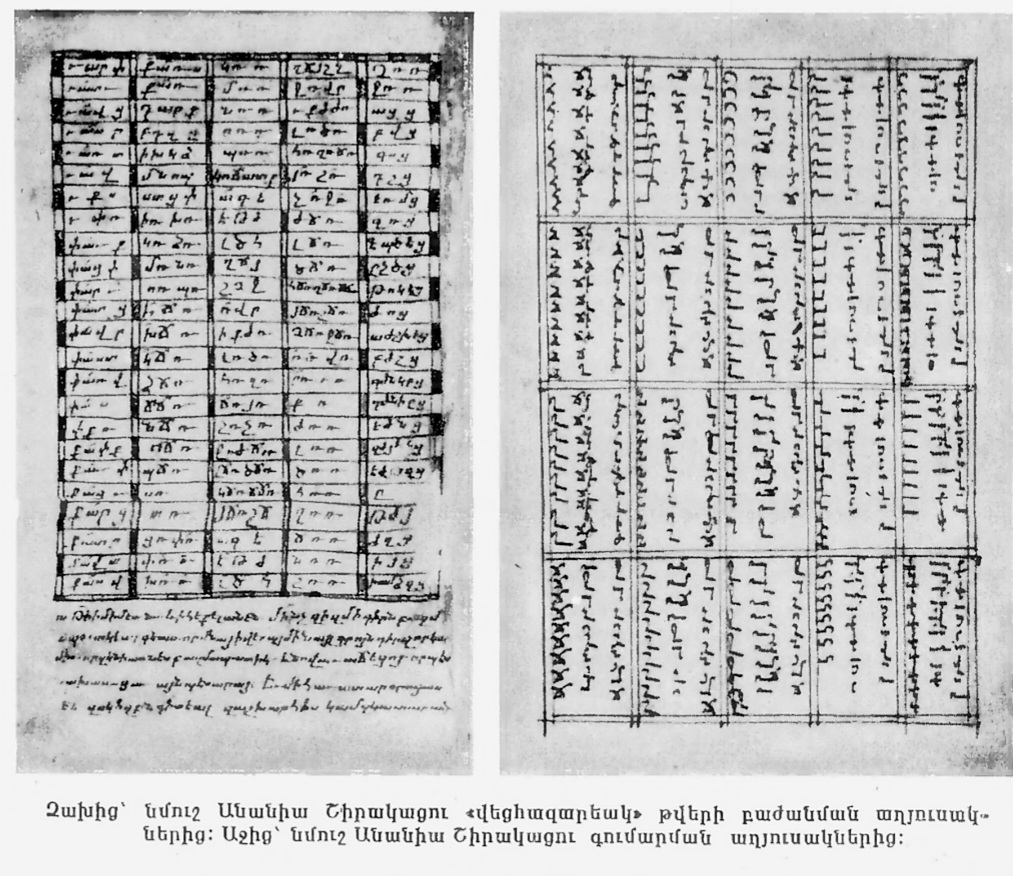
From the deciphering it became clear that Shirakatsi’s «Six-thousander» is a mathematical text, his arithmetical operation of division.
It was called «Six-thousander» because it is the number six thousand (6.000) that is divided by all the letter-numbers of the Armenian alphabet — by the old Babylonian sexagesimal system. Let us give a little table:
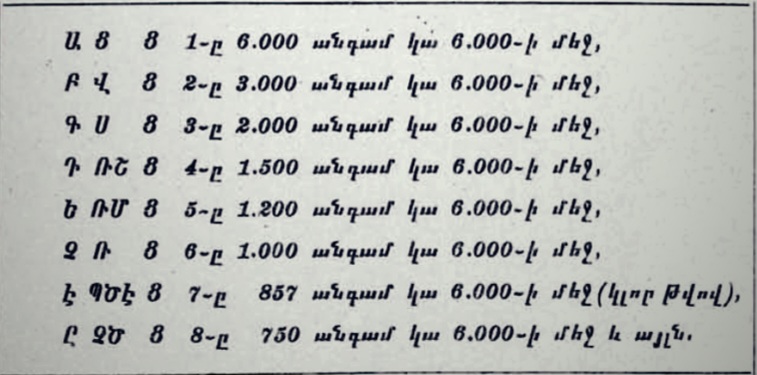
The difficulty of the deciphering had arisen from the fact that in the Middle Ages our copyist scribes — not understanding the meaning of that work, had mercilessly distorted it, but now it was not difficult to restore, once the meaning of the text became clear.
Shirakatsi’s «Six-thousander» was followed by his 24 arithmetical problems, which, as we said, were known in Armenian studies before us and had been published.
After these arithmetical problems Shirakatsi set out his nine joyful problems, or, as he himself named them — the «Festive Problems».
We consider it necessary to give here in translation one of those problems of his, so that you may imagine their character:
«Tell your companion that a Hun (the name of one of the ancient peoples) was my poultry-keeper for 100 years and ate 100 eggs a day.
Find out how many eggs he ate in all.
If your companion knows reckoning well, he will at once say — «He ate 365 byur (3.650.000) eggs», and if he is ignorant — then his torment over the numbers will give you joy»…

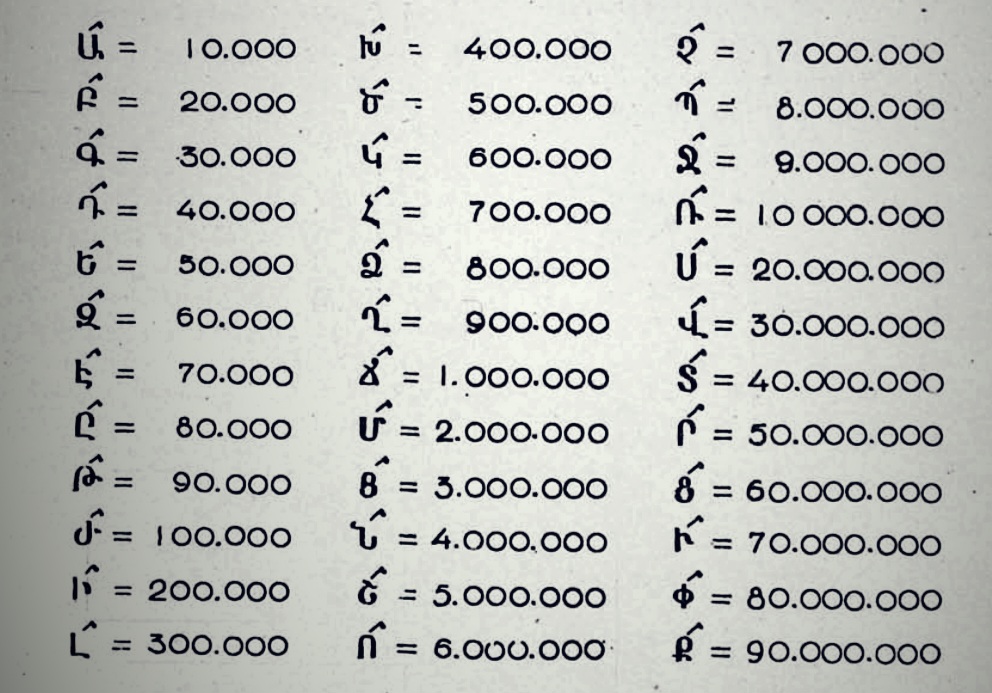
As a reminder let us add that «byur» is the special word used for ten thousand (10.000), as the «myriad» is among the Greeks, and in the «alphabetical» system of numeration, where instead of numbers the letters of the alphabet were used, large numbers were marked with a special sign placed with the letter, as, for example — ա՛ = 10.000 (one byur), ժ՛ = 100.000 (ten byur)…
Our grandfathers too had the custom of using such amusing problems to test the abilities of young people.
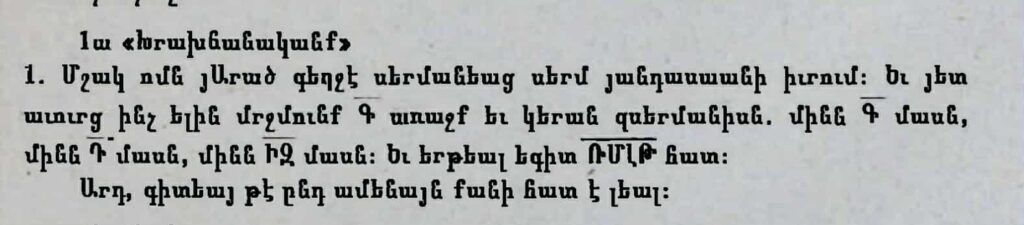
It is also interesting to know that the tables for teaching the art of computation — addition, subtraction, multiplication, have an address «from the living voice of the good teacher» to pupils «loving wisdom, longing for knowledge» — «a command to the pupils», introductions, titles, for example, «Preliminary exercise. First chapter of computation, which is called reception», «Advanced exercise. Second chapter of computation, which is called explanation», «although briefly I have arranged a few out of many»…