«ON QUESTIONS AND SOLUTIONS» (ANANIA SHIRAKATSI)
For millennia the Armenian Ancestors used skilful means to educate studious, sound-minded and «wisdom-loving» — philosophical generations.
They valued virtuous, just and healthy conduct, urged their children to strengthen their body and to enlighten their mind by persistent work, by special training. Like the writing «On Virtues and Vices», known in the Ancient world, (which is attributed to Aristotle), numerous philosophical works also attest that they offered praise to the beautiful, to nobility, to prudence and to courage, and censured the ugly — the abominable, the vicious…
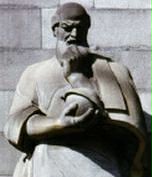
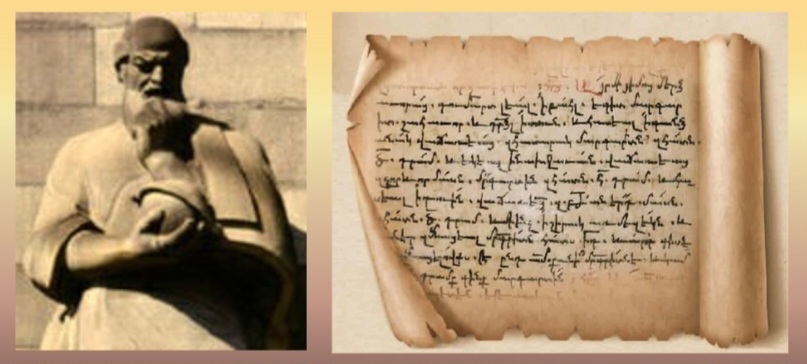
Continuing the traditions coming from of old — the renowned 7th-century computist («mathematician») Anania Shirakatsi also encouraged his pupils not to fear difficulties, to progress diligently and with unbreakable will.
As a figure devoted to the homeland and a skilful educator, he encouraged adolescents and young people to overcome every difficulty and obstacle for the sake of knowledge.
Using recreational problems with amusing content and various «questions» — he guided his pupils through the world of knowledge by excellent means — teaching from the simple to the complex.
In the small instructive arithmetical manual «On Questions and Solutions» Shirakatsi has left important information about historical episodes of his time — choosing as the material of his problems, for example, the rebellion of Zorak, of which he tells — as «heard from his father».
«Thus I heard from my father, that during the war waged by the Armenians against the Persians Zorak Kamsarakan performed great feats of valour — attacking the Persian troops three times in the course of one month:
The first time he slaughtered half of the army.
Pursuing — with the second attack he slaughtered a fourth part, and at the third — an eleventh.
The rest — 280 in number, fled to Nakhichevan.
Now — by the count of those remaining we must find out how large the Persian army was before the slaughter.
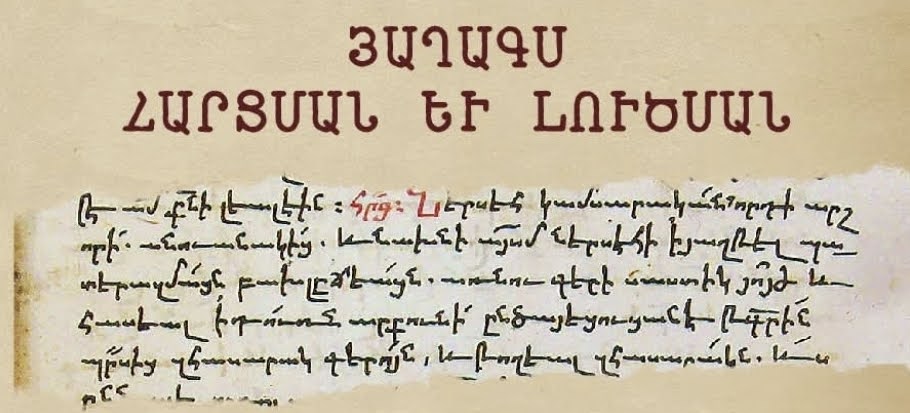
(In Grabar – Problem I .
Thus I heard from my father, that in the time of the wars of the Armenians with the Persians, great valour was shown by Zorak Kamsarakan; for within the days of a month he attacked the troops of the Persians thrice — and in the first he struck half of the army; and following after he struck in the second the fourth part of the army; and in the third the eleventh. And those remaining fled to Nakhchavan, in number CCLXXX.
Now we too must find out from those remaining, how many they were before the slaughter).
The questions also contain information about the life, the comings and goings of the medieval city, as, for example, when it is required to calculate the amount of the duties (toll) levied on a merchant passing through different cities. Thus, from problem XI (the 11th) we learn that after the payment of various «tolls» in three cities, of the initial 2376 dahekans the merchant had, 11 dahekans remain.
(In Grabar – Problem XI.
A merchant passed through three cities, and they levied toll in the first and took half and a third of his goods. And in the second city they counted whatever he had and took half and a third; and in the third city again they counted and took half and a third. And when he came home, there remained XI dahekans.
Now know, how many dahekans he had in all.
Solution of problem XI.
The merchant had MMCCCLXXVI dahekans).
In one of the problems one has to find how many cows, oxen, sheep and goats can be bought for the price of one noble steed (according to the solution of the problem the price of the horse was 616 dahekans).
(In Grabar – Problem XV.
I had a noble horse, I sold it and with the IV part of its price I bought cows, and with the VII part goats, and with the X part oxen, and for CCCXVIII dahekans I took sheep.
Now know, how many dahekans it comes to in all.
Solution of problem XV.
The price of the horse had been six hundred and ten and six dahekans).
The ninth problem –
During a hunt of the Kamsarakans at Gen they had caught many game animals and brought me a boar as my share of the game. Since it was enormous in appearance, I weighed it and it turned out that its entrails are a fourth part of its whole weight, the head — a tenth part, the legs — a twentieth, the tusks — a ninetieth, and the body — 212 litres.
Now — find out how many litres the whole boar was.
(In Grabar — Problem IX.
There was a hunt of the Kamsarakans at Gen and they had caught much game; and they had a boar brought to me as my share of the game. And because it was huge in appearance, I weighed it and the entrails were found to be the IV part of the whole weight; and the head the X part, the legs — XX, the tusks — XC, the body — CC and XII litres.
Now know, how many litres in all the boar was).
Let us wish «skill in the sciences and in craft» — to the present and future quick-witted, clear-minded sons of Armenia…