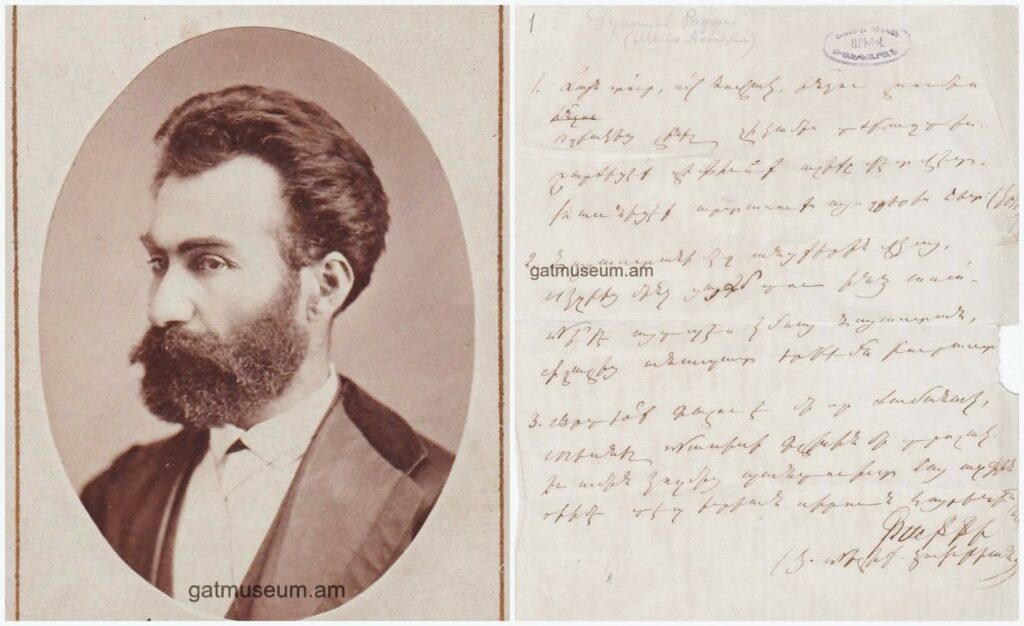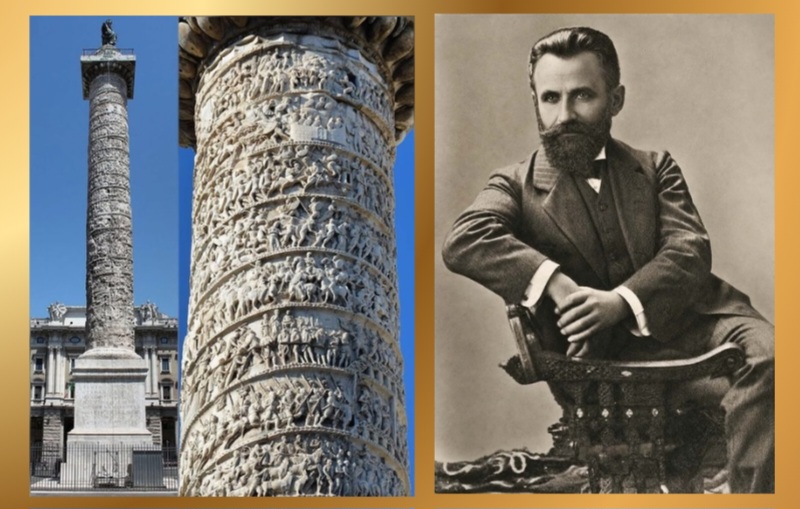









«SELF-DECEPTION» (RAFFI)
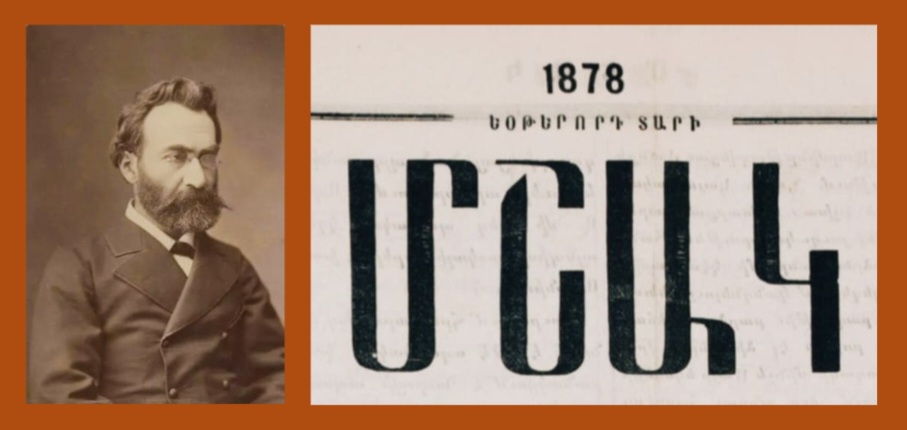
An article written with a sober, clear-headed and critical gaze, which sounds extremely topical in our times, though it was written in the year 1878 — by Raffi’s pen…
SELF-DECEPTION
«Know thyself!»
Self-deception!… it is a very simple word, but in it are hidden all the miseries of man: You see that one is a fool, but he thinks he has brains: Another is timid, he thinks he has the heart of a lion: A third has learned nothing, but imagines himself a genius: A fourth is an evildoer, but considers himself a model of virtue: — All this comes from self-deception:
Self-deception has only one eye and it sees everything from the good side; its other eye is blind to seeing ugliness, deformities and vices: And for this reason the wretch who finds himself in such a pitiful condition is always content with his state, because he sees no shortcomings in himself: And therefore he always remains motionless; he has no striving towards progress and no demand from life; — he considers himself filled with everything:
Self-deception is moral suicide; it is a deadness in which all human passions are at rest…
The opposite of self-deception is self-knowledge; its father is envy, and its mother — discontent: It is satisfied with nothing: It has much, but always thinks it has little: It always looks upward, strives to rise: It has grasped the general human perfections, it is acquainted with high and sublime ideas, and comparing itself with the perfected whole, finds itself very small and small…: That is why it is always discontented: It repeats with Socrates: «I know only one thing, that is, that I know nothing»: In that saying lies all the sublimity of self-knowledge:
Blessed is the man who feels thus: From here comes persevering labour, it is this that inspires man towards incessant progress, it is this that gives birth to geniuses, to craft, to science and to the welfare of the world:
Discontent with one’s condition — is a noble stimulus that leads towards its improvement:
Such characters as appear in individuals, the same appear also in whole peoples and nations: Because the whole is made up of parts; whatever the parts are, that the whole is too:
There are nations that are very content with their state, think they have everything and do not see their shortcomings: There are also nations which, the further they go, the more they produce, the more they perfect themselves, — the more discontented they are:
Let us speak about ourselves:
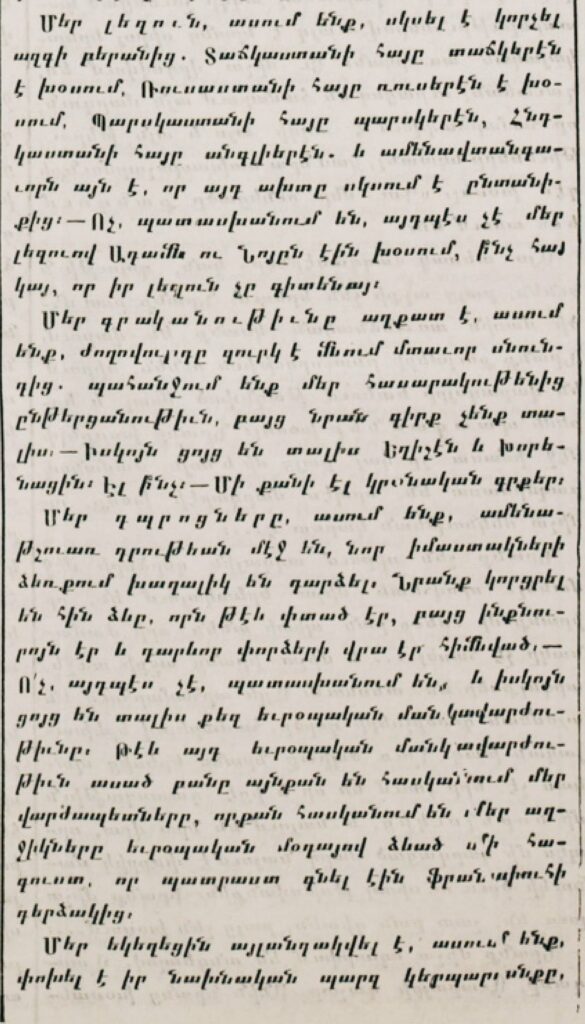
We are in a state of complete self-deception:
The family, the foundation of nationhood, has begun among us to rot, to become deformed, – on the one hand extravagance, on the other immorality day by day destroy in it whatever is good, whatever is noble: It has lost its patriarchal simplicity, and from the new, so-called European education — has appropriated only the bad sides: — No, they say, it is not so; the one thing the Armenian can boast of is his family sanctity, in which thrift, the virtuous harmony of the members and so on reign:
Our language, we say, has begun to be lost from the mouth of the nation; the Armenian of Turkey speaks Turkish, the Armenian of Russia speaks Russian, the Armenian of Persia Persian, the Armenian of India English; and the most dangerous thing is that this disease begins from the family: — No, they answer, it is not so; Adam and Noah spoke our language; what Armenian is there who does not know his own language?
Our literature is poor, we say; the people remains deprived of intellectual nourishment; we demand reading from our society, but we do not give it books: — At once they point to Eghishe and Khorenatsi: What else? — A few religious books besides:
Our schools, we say, are in the most wretched condition, they have become toys in the hands of new sophists: They have lost the old form, which, although rotten, was independent and based on age-old experience: — No, it is not so, they answer, and at once they show you European pedagogy: Though our schoolmasters understand that thing called European pedagogy as much as our girls understand a dress cut in the European fashion which they had bought ready-made from a French dressmaker:

Our church has become deformed, we say, it has changed its original simple aspect, it has become a factory of ritualism, simony and unbelief: — You are irreligious, you are an unbeliever, they answer; one cannot speak against the sanctity of the church; there is no church as free as ours:
Our ecclesiastical government, we say, has become an administration of bashi-bazouks; arbitrariness reigns over order and canons; the unworthy advance, the worthy are oppressed: — At once you receive the same foolish answer, that you are speaking against religion, and along with it they add a few curses:
Our clergymen, we say, have become worthless labourers; their learning, their conduct do not correspond to the office they have taken upon themselves: They scandalize our people more than they give it a moral and spiritual direction: — At once they will show you Nerses the Great, Sahak Partev and Mesrop: And the present ones? — The present ones atone for their sins with the labour of the old ones…:
Our journalism, the monthlies and the quarterly reviews, we say, instead of awakening the people from its prejudices, instead of acquainting it with new and fresh thoughts, instead of leading it towards the right path — lead it further astray, numb it further in its immobility: — This is how the people must be educated, they answer you:
In short, everything goes well among us… You speak about economic disorder, about the irregularity of commerce, about the backwardness of agriculture, about the patriarchal state of craft, about the pitiful condition of the peasant — the labouring class, in a word, about everything that man needs,- you receive the same answer: everything is fine among us…:
All this comes from self-deception; all this comes from that one-sided view by which we see everything from the good side:
Self-deception has given birth among us to a kind of «patriots», to whom to this day neither our novelists, nor our theatrical stage, nor our journalism have paid attention: Their motto is contained in this principle: «Whatever is Armenian, that is good»:
This kind of «patriots» represents a perfected type in our society, who, it seems, belong to a separate shkola (school, K. A.), whose founder is unknown:
They do indeed love the nation, as a young man is in love with a maiden who does not know him at all, who has not heard even one word from his mouth, who has seen no favour from him, but he loves… Even the maiden’s follies are dear to him…:
They love… they are indignant… they are inspired… and every passion stays within their heart: They find the nation within the four walls of their room; outside they have no relation with it: As our imaginary lover has his beloved within his head:
To this kind of «patriots» «work» is unknown: But they consider they have done the nation a great good when they speak about it, and they speak always with their own kind; the stranger does not hear their voice: They do not have even that thing which is called desire; because to desire something one must demand something; but they have no demands either: They are satisfied with all that already exists, with what our forefathers left: And to do something new they are still waiting…
Their word – is praise: To praise, to be inspired; to rejoice in perfections the nation does not have, – that is the imaginary object of their love: And they are always indignant, they consider a traitor, an apostate the man who dares to notice this or that shortcoming of the nation, or to speak against its prejudice: «You are destroying what we have», – they say:
This kind of «patriots» exist, they are there, but they are not seen: They for the most part lead a private life: They have the character of the kurms, they love to remain hidden behind the curtain and sometimes to speak oracles: There is no meaning in their words, but at the same time they are many-meaninged, like the word of a prophet, which always needs interpretation…

They do not like to enter into national affairs, because they always imagine that they must do some «great» thing, the time for which has not come… and they always see obstacles before their eyes: Moreover they despise the work of the present-day activists, considering it child’s play: A silent smile never leaves their face: When they hear some reasoning from an upstart, they look on him as a developed man looks on the crooked and wrong babbling of a little child: They themselves are always silent, they know much, but do not speak…
They are always inspired by the past; Vardan, the field of Avarayr, Ani are the subject of their conversation: In Turkey and in the national constitution of C. Polis they see a great future, and they find the salvation of the Armenians in the Armenian church:
These «patriots» are the perfected type of their kind, who are considered geniuses: They are good people, but they are dangerous: Blind love is always harmful; because it always sees the good, it does not notice the bad:
But there is also a secondary kind, which is the false copy of the first: They are crafty people who under the patriotic mask hide self-interested aims: Such ones mix into affairs: They become — trustees of schools, treasurers of churches, guardians of rich orphans, executors of sums bequeathed for charitable purposes, incense-burners of the prelates, patrons of poor actors, permanent and hereditary schoolmasters in the same school, and sometimes editors of newspapers and journals: Among this kind of patriots are also those benefactors who have always robbed, plundered and in a thousand-and-one ways heaped up wealth by brigandage,- and in the end wish to pose as good men and cover their dirty past with a patriotic veil:
This kind of «patriot» loves the nation in order to rob it, as the vampire sucks the blood of its victim by numbing it: He will speak to you always in the Armenian language, he will try to stay far from foreign words, and always (but only in words) will express good wishes about his «dear» and «honourable» nation: «Ah» and « oh» never leave his mouth when he hears of the misery of the nation, and many times tears appear in his eyes when he reads «The Wounds of Armenia»: There is no measure to his anger when he hears enmity and abuse about the nation, and he hates all those who are not Armenian: — All this he does, but if he knew that they would give a few kopecks for the bones of Hayk, he would at once dig them out of the grave and sell them…
Reader, you have become sufficiently acquainted with the two types we have drawn – the rotten and the false patriots: Do you wish now that I acquaint you personally with one of them, and you may consider that you know them all, because all resemble one another with very little difference:
He is of the last kind:
Here we are entering his retreat; here works the nation’s eminent thinker: Facing a big writing desk, on a likewise big armchair he sits: He is a stout man, he speaks likewise in a stout voice; his cheeks are likewise stout and have a deep-red colour: It seems the patriot’s belly has always been full; he is very healthy, though the hair of his head has turned white:
Right opposite the writing desk (before the patriot’s eyes) in a black frame, hangs a mysterious picture, which represents a maiden with dishevelled hair, who is sitting on ruins: Around her are scattered broken sceptres, dust-buried crowns, shattered banners and various weapons: And she herself — the maiden, resting her chin on her hand, her beautiful head inclined to one side, sadly looks at the ruins of Armenia… A little way from this picture, to the right and left of the patriot, two other pictures in gilded frames hang from the wall: One of them is Hayk, and the other — Vardan Mamikonyan: Below Hayk’s picture the map of ancient Armenia is nailed on the wall:
On the writing desk many papers are laid, on which, so that the wind does not scatter them, is placed a brick-like thing; it is a lime composition decorated with mosaics, brought from the ruins of Ani:
In one corner in a big bookcase books with gilded Venetian bindings are arranged, as if stacked for show: The room is decorated in Eastern taste; carpets are spread, a takht is placed and mutakas are seen:
The patriot is silent; his much-troubled face shows that he is busy:
Behold! two little children like angels ran into the room: Calling «Papasha, papasha», one of them leapt onto his father’s knees and wrapped himself around his neck: And the other child tried and tried to follow his brother, but rolled onto the floor: The father lifted him and kissed him:
One of the children’s name is Levon, the other’s — Ruben: The father has done the nation a great service by reviving these historical names…
— Why do they not speak Armenian,- you ask the patriot.
— They are accustomed so with the mothers and the maids… and I have no time to occupy myself with them,- he answers.
The children snatch from the writing desk the latest issue of «Meghu», to take it and make themselves a «whirligig»: The father calls them to bring it back, but the little rascals disappear:
Reader, all this, I think, made a good impression on you; you saw the outward displays sufficiently attractive; now let us enter the patriot’s inside – into the heart:
I will begin the conversation; you only listen:
— You probably do not receive «Mshak»?- I ask.
— Is it really worth wasting money… – he answers in a contemptuous voice: — One can only spit on this newspaper and not read it:
— Perhaps you read it?- he asks at once.
— Yes, and with great pleasure:
— I did not expect that from you…
— Why?
— Honourable brother, what is left that it has not disgraced?- family, religion, church: It denied all the noble sides of our nation; there was no soot left that it did not smear on it: It disgraced us, disgraced us utterly…
— Why not disgrace, when there are things to be disgraced:
— Is that really permissible? Suppose there were shortcomings among us, is it really permissible to bring everything out into the public square?
— Only those foolish sick people act like this, who, hiding their pains, try to pose as healthy: By covering our shortcomings what have we built until today?
— At least we kept our honour: Foreigners did not understand our deficiencies:
— Foreigners are not blind like us…

He began to look for something among the papers:
— Here, I will show you the letter of Mr. Kovyan received from St. Petersburg… what honourable reasonings, what honourable reflection… Where has it got lost… Sasha!,- he called the servant.
— Do not trouble yourself; I have no need of the «honourable reflections» of St. Petersburg; without your reading it, I can tell what will be written in that letter:
He turns towards me:
— So, tell me please, must one not spit on such a newspaper, which denies our good sides, refutes and destroys everything, turns everything upside down: Whom does that please, who does not get angry?
— That is very natural; try telling someone blind in both eyes — you are blind; he will at once get angry, though you have stated an irrefutable truth:
He grew heated:
— It is disgusting… one must always praise, one must encourage, one must hearten; you only make people despair… you see everything in black colour… you deny life, strength in the nation…
— That old and rotten method of education has already shown its result: The journalism of the hos-hos of C. Polis followed that form until today; it always praised, it was always inspired, showing that they have everything, that everything is ready: But the circumstances showed what kind of people they prepared: The nothingness of the Turkish Armenians was revealed:
The patriot’s arrow, it seems, hit a stone; he stopped and began to think:
I continued.
— The same was done among us too until today; «whatever is Armenian, that is good».- this was the principle of our nation-lovers: — The Armenian merchant conducts his trade by cheating: — One must praise him, that is not theft, because the doer is Armenian: The Armenian family day by day decays in moral rot: — No harm; because it is the family of our nation, one cannot speak ill of it: The Armenian clergymen have become brigands: — One must praise them, because they are our spiritual fathers, the keepers of the tradition of our religion… Why should I lengthen my speech, you praised every refuse, every filth, every corruption, and you praise it, because it is the refuse of an Armenian…
— What harm did we do with our praises?
— The harm that you deceived the nation and, by eulogizing its follies, its worthlessness, gave occasion for worthlessness to remain forever worthlessness: You closed the nation’s eyes so that it would not see its deformity:
— And you, who censure, destroy, annihilate, what do you put in its place?
— We perform the office of the gardener: The gardener, when he mercilessly cuts the dried, rotten and superfluous branches of the tree, does not think to graft a new branch in their place; because he knows that the new one will sprout by itself, if there is life in the tree, if there is strength and it has a root in the soil…
The conversation is interrupted: The court attendant brings in a summons and has it signed:
— For what matters are you summoned?
— Again it is for that cursed will…
The patriot forgot the love too, the nation too, Vardan too, Hayk too: He stood up with these words.
— Excuse me, I must go to my lawyer: