«FAMOUS ARMENIAN CHAMPIONS OF THE PAST» (N. ADONTZ)

«Nakhamartik – vanguard-fighter, champion, general» — a brave, mighty warrior and proud defender, a valiant who rushes forward. Akhoyan — «a vanguard-fighter of the army, contending against the enemies, a resister», also — adversary…
«Akhoyanabar — valiantly, akhoyanayardzak — one who attacks as a champion, a forefighter, brave»:
Inspired «by a champion’s assailing flight», a few pages from the past — as set forth by N. Adontz — below…
FAMOUS ARMENIAN CHAMPIONS OF THE PAST
Personal bravery, physical strength, had an incomparably greater place in life in ancient times than at present. Bravery was heavenly, almost divine. Many of the great historical personalities owe at least their first successes to their arms rather than to their heads. The means and instruments of self-defence and combat were the wide-bowed or thick-drawn bow, the sling, the mace, the spear, the axe and the sword. Heavy armament, iron-clad armour, demanded such bodily strength, such a stalwart build, as the modern automatic rifle, the machine-gun and the other monstrous engines have no need of at all. The more mankind advances, the more the importance, the need of strength diminishes. The course of history can be characterized as a continuous transfer from bodily and physical might towards intellectual and spiritual strength. Arms give way to the head. Bodily bravery — the older it grows — remains the ornament of past centuries, the more man looks with longing and yearns for the old bravery. The ancients are pictured as titans, invincible giants, enormous, huge-bodied (big-bodied), great-souled, stalwart, unlike an ordinary man.
(They) become an object of worship, are considered demigods, that is — half-gods, descended from gods (Dits, K.A.) and mortals. Heracles while still in the cradle strangled two dragons which Hera had sent to kill the newborn child. The name is connected with the root «hero», Latin — «serv», which means to keep, to watch, rend – harua–haurna-servare – giant: Our Vahagn too is a dragon-reaper.
The ancients glorify bravery, they create types of heroes and consider bravery a divine gift. Bravery also gives immortality — heroes sometimes ascend to heaven and as gods join the company of the other gods.
All ancient nations have a god of bravery and heroes who are types of bravery. The Greeks — Achilles, Troy — Hector, the Persians — Rostam, the Armenians — Tork (the older god of our bravery and our very forefather is Hayk).

Our ancestors too greatly valued bravery. Hayk is the forefather of the Armenian nation, the embodiment of the Armenian nation. The comely, stalwart, brave-curled, bright-eyed and thick-armed Hayk was brave and eminent among the giants. Bel marches on Hayk with giants vying with heaven-reaching stature. Movses Khorenatsi drew this image of Hayk — basing himself on the description of the strength of the Armenian leader, of his personal bravery. The princely houses of the Mamikonyans, Bagratunis, Syunis, Amatunis and Artsrunis gave such figures as are truly heroes. I would like to present a few historical figures whose bravery was not only bodily, but linked with fearlessness and superhuman daring.
Bodily strength without spiritual valour is a dead strength.
It is this that moves the bodily, giving it spirit — doubles it.
The persons to be mentioned below are not great figures of history, (they) did not leave a brilliant trace behind them. And yet — they are types of heroism, because, despising death with manly valour, going out into the arena of single combat — they crowned with glory the people that bore them and nourished them. I must pay a meagre tribute of respect to those who brought honour to the Armenians as single-combatants. In the formidable Byzantine army, among thousands, among tens of thousands, suddenly an Armenian rushes forth against the enemy — as one able to accept the single combat.
Here they are — Artavan, Artavazd, Anzalas, Hovhannes Guzes, who are attested by foreign historians (Note.- He alludes to the famous Byzantine historian Procopius of Caesarea).
- Artavan Arshakuni, a general of Armenian origin in the Byzantine army, the son of Hovhannes Arshakuni: At first he fought against Byzantium; in 539 he killed the Byzantine generals Akakios and Sittas, who had marched on Western Armenia: Thereafter he served Emperor Justinian I…
- Artavazd (? – 542), a general of Armenian origin in the Byzantine army: He distinguished himself in the Italian campaigns waged against the Goths (541-542) and, especially, during the siege of the city of Verona: He accepted the proposal of the Gothic warrior Valaris to fight him in single combat and killed him:
- Anzalas (Enjugh), an Armenian warrior of the Byzantine army: In the year 553, during the battle that took place near the city of Toscana, he accepted the challenge of a brave fighter named Kokkas from the army of the Goths and killed him in single combat:
- Hovhannes Guzes, a general of Armenian origin in the Byzantine army, the son of Tovma, comes of Armenia: He distinguished himself in the wars waged in the year 551 for Lazica and Colchis: In single combat he killed a brave Alan of gigantic body and secured the victory of the Byzantine army:

- ARTAVAN (548)
- SMBAT BAGRATUNI, SON OF MANUEL (590)
In 590 Emperor Maurice tried to send the Armenian nakharars to Thrace. But the nakharars of the Armenians rebelled and wished «to withdraw from the service of the king of the Greeks and to set up a king of their own».
This was done with the following aim, «that they too might not have to die in the regions of the Thracians, but to live and die upon their own land» («History of Sebeos», edited by G. V. Abgaryan, Yerevan, 1979, p. 92).
The emperor sent royal envoys to Armenia with an edict, but Smbat Bagratuni, son of Manuel, killed one of them. The Byzantines arrested Smbat and took him with seven (other) persons to the capital. They tried him and decided to throw him into the kyunik, that is — the circus (note — the «kyunik» was an open-air circus arena, on which chariot exercises, bullfights and other contests took place). Smbat was «a man of enormous body and handsome appearance, and of tall and broad stature, and of powerful and lean body» (Sebeos, p. 92). He had been renowned as «mighty and warlike» in many wars. (Smbat) had such strength that, passing under «densely forested cedars and mighty trees» — mounted on a stalwart mighty steed, he would raise his hands, seize a bough of the tree and, squeezing the steed’s back with his loins and legs — lift it up off the ground. Those who saw were terrified and greatly astonished.
They stripped Smbat and left him only in his drawers, then they threw him into the kyunik, «that he might be food for the beasts» (Sebeos, p. 93). First they let loose on him the bear (this and all following emphases are the author’s – P. H.). Smbat shouted loudly and went at the bear, struck it on the forehead with his fist and it died on the spot. The second time they let loose on him a bull. Smbat seized the bull by the horns, again with his cry cast terror on the bull, tormented it — twisting its neck and breaking its horns.
The bull, weakened, retreated and took to flight. Smbat, running after it, «seized the hoof of one of its hind legs», the bull’s hoof was torn off and remained in Smbat’s hand. The bull fled with one foot «bare». (A similar feat Khorenatsi attributes to Trdat (III the Great) — saying that a Greek wrestler in old times «tore off the hoof of an ox», while Trdat with one hand «seizing by the horns» two wild bulls, «tore them off along with a rebellious crushing») (Movses Khorenatsi, «History of the Armenians», Tiflis, 1913, p. 218).
The third time they let loose on him a fierce lion. When they let loose the lion, Smbat deftly seized it by the ear and sat on its back.
Then he put his hand to its windpipe and, squeezing, strangled the lion.
The crowd, raising cries of acclaim with enthusiasm, shouted and appealed to the emperor to pardon the Armenian prince. And Smbat, tired, was resting, sitting on the lion. The empress and the emperor took pity on him, granted pardon and sent him to the baths. Here they washed Smbat, clothed him and took him to the palace. Later Smbat became the victim of slander and was exiled «to distant islands» (Sebeos, p. 93), then the emperor ordered him to be transferred from there to Africa — giving him the office of military tribune.

- SMBAT VRKAN KHOSROV SHNUM BAGRATUNI (607)
The king of the Kushans in the land of the Hephthalites (Turkestan) encamped against Smbat with a great formation. The Hephthalite sent an envoy to Smbat.
- What profit is there in entering the war thus in a confused throng and exhausting our troops? By what shall my bravery and yours be known? Come! let only you and I fight in single combat. I from here, and you — from there, come out as champion, «that today my bravery may be known to you».
Smbat answers: «Behold, I am ready to die».
For a long time they attacked one another and fought in sight of the two armies.
But they could not overcome one another, because they were of giant strength (and not «sakavazavrk», as it is printed; see K. Patkanyan’s edition, p. 67) and solidly armed. At last Smbat succeeded in thrusting the spear, piercing the coat and firm (not vertevamur) and solid armour’s strength and (the king of the Kushans) knocked him to the ground:
And the troops of the Kushans «when they saw their king — were terrified and turned and went in flight» (Sebeos, p. 103).
- BASIL THE MACEDONIAN (circa 820-886)
- ASHOT BAGRATUNI (973)
After the death of Gagik Shahnshah of Ani his two sons — Hovhannes-Smbat and Ashot quarrelled. Ashot receives troops from Senekerim, king of the Artsrunis, and moves against his brother. At that time a Georgian prince was with King Hovhannes-Smbat as ambassador.
He, boasting, asks that the king of the Armenians allow him to go and take Ashot alive and put an end to the bloodshed. Hovhannes-Smbat says: «Ashot is a mighty man; how do you think to bring him before me?» The Georgian answers: «I will take him alive from his horse». But King Hovhannes-Smbat warns the Georgian: «Do not despise the lion’s cub, until you see». The Georgian prince swooped like an eagle on Ashot — shouting: «Who is Ashot, let him come forward!» Ashot grew enraged like a leopard and the Georgian — while he wanted to strike with the spear, Ashot with the speed of lightning drew his steel sword and so struck the helmet that he rent the Georgian’s iron-clad body, split it in two down to the breast and «threw him to the earth together with his waist» (Matteos Urhayetsi, pp. 13-14).

- VASAK PAHLAVUNI, PRINCE OF BJNI (1021)
The king of the Delums (the Daylamites – P. H.) came and devastated the province of Nig. Vasak, sparapet of the Armenians, went out against them with his son Grigor. Vasak could not wait until the troops gathered. He went ahead with five hundred men. From the army of the foreigners came out a champion — a black Abyssinian, who was called «Seven Wolves», who like «a black cloud thundering, emitting flame from his armour» — called Vasak to single combat. Vasak’s subordinates were terrified, for «such a man had not yet been born on earth». Vasak calmed them and said: «I will go out against him and give him the same gift that David gave to Goliath». The Abyssinian came at him beast-like, to take Vasak on his lance. But Vasak hastened and with his steel sword so struck the Abyssinian’s head that his helmet was split in two, and «the parts of his body fell to the ground» (Matteos Urhayetsi, pp. 13-14).
- HASAN AND CHNCHGHUK (1042)
Hasan and Chnchghuk were the sons of Prince Khachik of Vasparakan.
They had just returned from Thrace, where they had fought against the enemies of the empire. During their absence Prince Khachik and his younger son — the fifteen-year-old youth Ishkhan, had fallen victim during the attacks of the Muslim tribes of Salmast.
To take revenge they bribe a Kurd and send him to Salmast — to spread the news that Prince Khachik’s estate is undefended, «why do you sit idle» — many flocks of sheep wander masterless. The Kurd did just so. The foreigners raided Vaspurakan with 15 thousand:
Hasan and Chnchghuk had 5.000 soldiers.
Like «a wounded beast» — Hasan, attacking the enemy army, calls out: «Who is, where is that man who killed my father — Khachik, let him come forward!» And behold, a black man of the foreigners came out and cried in a mighty voice.
«It is I who killed the lion Khachik, and behold, his war-horse, his garment, his standard and his sword are in my hand». Hasan — seeing his father’s belongings, began to weep and, drawing the sword from its sheath, swooped on him like a lion and, striking, cut him in two pieces, threw him to the ground and snatched the (father’s) horse and standard.
In like manner Chnchghuk too called out: «Who killed my young brother — Ishkhan, let him come out into the arena, that I may see him». A brave Persian came out and said: «It is I who killed your brother Ishkhan; behold! his white horse, his bright standard and his sword». Chnchghuk came at him like lightning, slew him with one blow and, taking his brother’s horse and standard — turned back.
The Armenian troops, enthused, attacked the enemy, «put them to flight and slew of them four thousand men» (M. Urhayetsi, p. 92).

- THE SONS OF PRINCE HABEL OF THE FORTRESS OF ARKNI — HARPIK, DAVIT, LEVON
AND KOSTANDIN (1052)
Slanderous and treacherous men went (to Emperor Constantine Monomachos and accused the Armenian princes living in the province of Paghin of Fourth Armenia, that they «are disobedient to your commands and wish to rebel against you». The Byzantines devastated the entire province. They wished also to arrest the four brave and mighty sons of Prince Habel, lord of the great fortress called Arkni — Harpik, Davit, Levon and Kostandin. The eldest of the brothers — Harpik, fell victim to treachery; the others were taken captive to the capital.
The emperor and all the Greeks were amazed — seeing their terrible appearance («the dreadful sight of their forms»), for with their stalwartness they surpassed all the Greeks («they were dreadful in appearance and with their shoulders they were taller than the whole house of the Greeks»). The emperor, having regard to their handsome, stalwart appearance, subjected them to no bodily punishment, but ordered the brave, mighty and eminent princes Davit, Levon and Kostandin to be exiled to an island: (The brothers remained in exile until the year 1056, when Empress Theodora «with great magnanimity released them to their paternal land, to the fortress of Arkni», M. Urhayetsi, p. 122).
- SADUN ARTSRUNI (1256)
(Mongol) To Hulavu Khan, governor of Armenia, Georgia, Iran and the Near East on behalf of the Great Khan Mangu, comes a man «of the Mughal nation» (Mongol), very enormous, of tall stature, broad-shouldered, his neck «like a buffalo’s», his hands ungainly like a bear’s. He ate a sheep every day. He had brought a letter from Mangu Khan and a priceless kapa.
In the letter it was said: «if there be found with my brother Hulavu Khan a bavka (wrestler) who will throw this wrestler to the ground, let the kapa be his! And if this bavka wins, let them clothe him with the kapa and send him back to me with a great embassy and with honour.
Hulavu called all the chiefs of his troops and asked whether they knew any man, Tatar, Armenian or Georgian, who could fight in single combat with Mangu Khan’s bavka. But among the Tatars no such one was found, for «whoever saw that man — all feared his enormous stature and his sight». And the Armenian and Georgian princes said that there is only one man who can be a remedy; it is Prince Sadun of the Artsrunis, but he is not here, «but is at his home». Sadun «was of tall and comely stature, very strong from childhood» («History of the Tatars by Vardan the historian», Jerusalem, 1870, p. 47) and experienced and trained in single combats.
The khan sent a man after him. Hearing the command, Sadun was very saddened, because he had never fought in single combat before the khan, and the opponent was enormous and strong. Sadun first went to Gag — «to the all-reaching Saint Sargis» and made a vow and a sacrifice, then set out for Hulavu. When the khan saw Sadun, his vigour and his tall stature — he rejoiced greatly. He ordered that the two wrestlers live together for nine days, that each day they eat a sheep and drink a skin of wine.
When the appointed days had passed, (the khan) ordered all the chiefs to assemble before him and, calling the two wrestlers, ordered them to fight. The combat lasted three hours — from 3 to 6 o’clock in the daytime, and the wrestlers could not overcome one another. But Sadun with a mighty clash threw down the champion of the Great Khan Mangu and rose greatly in the eyes of Hulavu Khan. The khan wrote a yarlik («iarlakh») «and to forgive him up to nine offences» («History of the Tatars», p. 49).

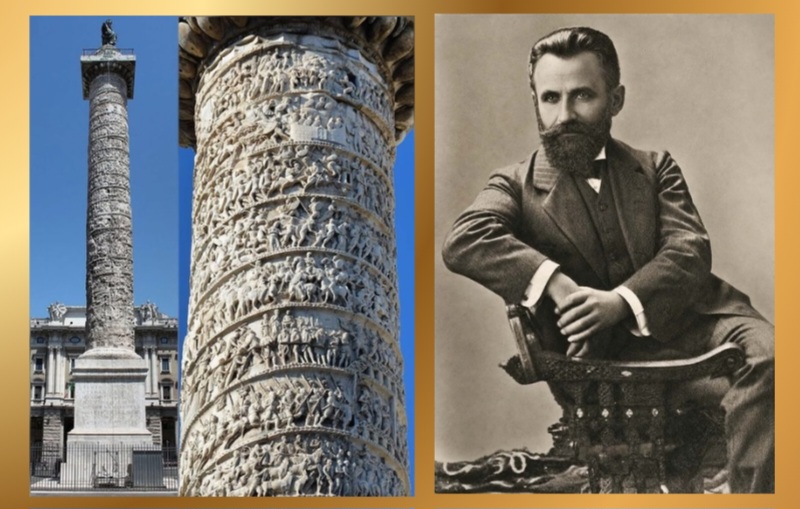
In the photo — N. ADONTZ in the year 1912 at Ani — with N. Marr, H. Orbeli and the other members of the expedition (photo by A. Vruyr)