
























«JESUS OF NAZARETH» (M. TERPETEREAN)

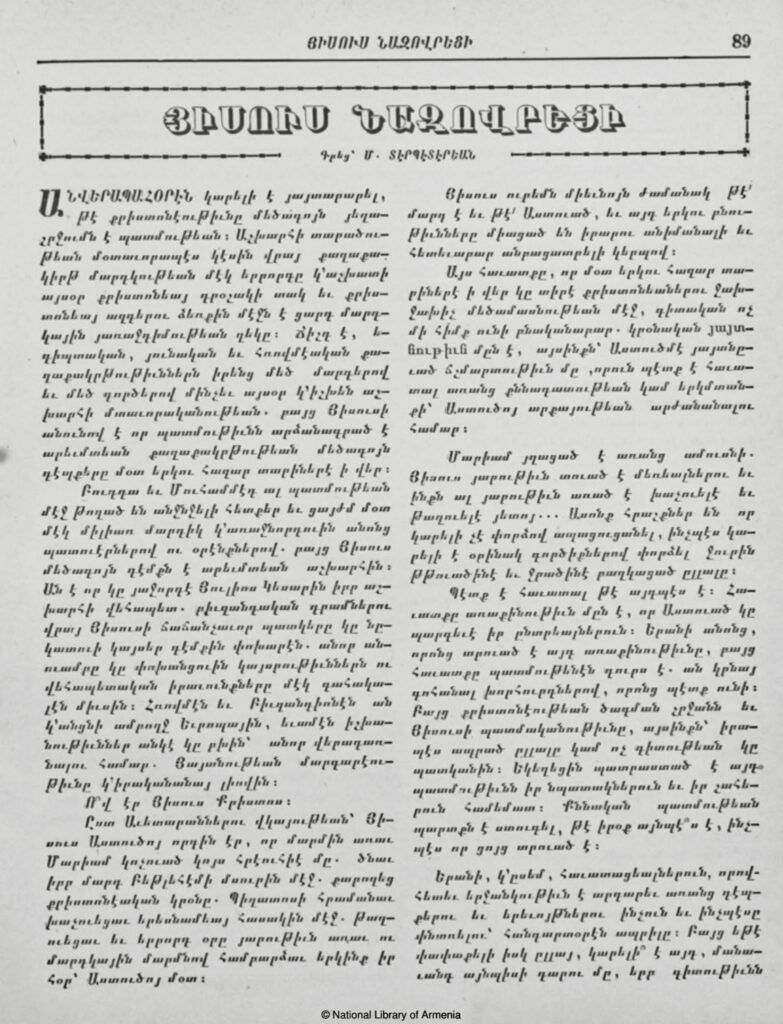
In the April 1929 number of the magazine «Hayrenik» there was published M. Terpeterean’s article «Jesus of Nazareth», which we present below.

IT MAY BE DECLARED without reservation that Christianity is the greatest revolution in history. Over approximately half the surface of the world, one third of civilized humanity labours
today beneath the Christian banner, and the helm of human progress is thus far in the hands of the Christian nations. It is true that the Egyptian, Greek and Roman civilizations, with their great men and their great works, hold sway to this day over the intellectual life of the world; but it is in the name of Jesus that history has recorded the greatest events of Western civilization for close upon two thousand years.
Buddha and Muhammad too have left indelible traces in history, and to this day nearly one milliard of men are guided by their precepts and their laws; but Jesus is the greatest figure of the Western world.
It is he who succeeds Julius Caesar as the sovereign of the world: upon Byzantine coins the radiant image of Jesus is to be seen in place of the emperor’s countenance. In his name empires and sovereign rights are transferred from one occupant of the throne to another. From Rome and from Byzantium he passes to the whole of Europe, and all authorities issue from him in order to return to him: the prophecy of the Revelation is fulfilled completely.
Who was Jesus Christ?
According to the testimony of the Gospels, Jesus was the son of God, who took flesh of a virgin Jewess called Mary; he was born as a man in the manger of Bethlehem; he preached the Christian religion; by the order of Pilate he was crucified in his thirtieth year; he was buried, and on the third day he rose again and with a human body ascended into heaven to his father, God.
Jesus, therefore, is at one and the same time both man and God, and those two natures are united to each other in a manner incomprehensible and, consequently, inexplicable.
This faith, which for nearly two thousand years has prevailed among the overwhelming majority of Christians, has naturally no scientific foundation whatever. It is a religious revelation, that is to say a truth revealed by God, in which one must believe without criticism or hesitation in order to be found worthy of the kingdom of God.
Mary conceived without a husband; Jesus raised the dead, and he himself rose again after being crucified and buried… These are miracles which cannot be proved by experiment, as one can, for example, test with instruments that water is composed of oxygen and hydrogen.
One must believe that it is so. Faith is a virtue which God bestows upon his elect. Blessed are they to whom that virtue has been given; but faith lies outside history: it can content itself with the mysteries of which it has need.
But the period of the origin of Christianity, and the historicity of Jesus, that is to say whether he really lived or not, belong to science. The Church has prepared that history in accordance with its own aims and its own interests. It is the duty of critical history to verify whether things really are as they have been represented.
Blessed, I say, are the believers, for it is indeed a happiness to live tranquilly without seeking the «why» and the «how» of events and phenomena. But even were it desirable, is it possible, especially in such an age as this, when science is advancing gigantically in every field?

Apart from credulity and superstition, no proof exists, nor can exist, that demonstrates the immaculate birth of Jesus and his supernatural resurrection and divinity…
And without having any aim of anti-Christian or anti-religious propaganda, I desire that our intellectual youth too should know what contemporary historical critics think concerning Jesus, and what the prevailing opinion is regarding the historicity of Jesus.
Whoever believes that he knows a truth has not only the right but also the duty to communicate it to his fellows.
«It is from the collision of ideas that light bursts forth»,- says the wisdom of the peoples.
In order to give occasion to no misunderstanding, however, I must say beforehand that to reject the divinity or the historicity of Jesus does not mean to reject the existence of God. It is possible to be a sincere worshipper of God without believing in the divinity of Jesus.
The subject of this article is Jesus of Nazareth and not God the creator.
It is wrong, of course, to make anti-religious propaganda to those who do not possess the necessary scientific and moral equipment. Religion is a bridle for the ignorant common man who acts by instinct.
Faith is a lamp for the despairing man who gropes in darkness and uncertainty, and whoever desires to snatch that lamp from his hand has the duty of guiding him. To wrest away that lamp without replacing it with a guide of equal power means to lead the despairing common man astray in the darkness and to condemn him to perdition.
It is possible, of course, to object that the bridle of religion is not strong enough, and that murderers and evildoers have continued their exploits from time immemorial, and now more than ever.
Undoubtedly. But humanity is not composed solely of ferocious brutes who count hell, the gallows and the torments of prison as nothing. There are also honest men in countless numbers, for whom the moral bridle of religion is far stronger than any other restraining force. The vast multitude of the martyrs is a witness to those sentiments.
This article is for those who have moral strength and conscience enough to refrain from evil, not in order to escape punishment in any form whatever, but as a useful and fraternal member of the universal human family; and to do good, not in order to be found worthy of any earthly or heavenly recompense, but purely for the love of the good, that is to say for the supreme and irreplaceable personal pleasure that beneficence bestows.

This article is for those who, without prejudice or preconceived opinion, without passion or hatred, have goodwill and courage enough to study any question impartially and without bias, and to express the idea they have formed without reservation.
All religions have played their great and often important part in human history, and it is unseemly for any cultivated man to mock them or to bear himself insolently towards them. Respectful behaviour, however, must not prevent any honest man from studying freely, without exaggeration or extenuation and, above all, without bigotry.
The data of today’s documents are not sufficient to prove the existence of Jesus as a historical person. If, however, it should tomorrow be possible to prove the contrary, we must at once be able to yield before the stronger evidence. Today’s truth may tomorrow be declared a falsehood, and today’s falsehood may prove to be tomorrow’s truth.
Some say that it is of no importance whether Jesus existed or did not exist. The question is the existence of Christianity, which has been a fact for two thousand years. And yet, in my view, no honest man can remain indifferent to this question.
The denial of the existence of a person who dominated a period of two thousand years is a sufficiently grave matter for not only the Christian world but even non-Christian humanity to take a serious interest in it.
Let us pass on, then, to our subject.
Is there any undeniable proof of the historical existence of Jesus as a man? Doubtless thousands of Jews lived before Jesus, in his time and after him, under the name of Yeshoa, Yesua and so forth; but it is difficult to prove that the Jesus described in the Gospels, as the founder of the Christian religion, really lived and preached in Palestine or elsewhere.
There have been those who denied the divine origin of Jesus from the earliest centuries, and today it is almost impossible to find anyone sufficiently cultivated who sincerely gives credence to the miraculous birth or the resurrection of Jesus. But those who call the historical existence of Jesus into question have appeared only in the last centuries.

Ernest Renan is the best-known historian to have occupied himself with Jesus. According to him, Jesus lived as a man, and his extraordinary abilities and his boundless goodness were the cause of his being made a god in the eyes of the people after his death, like many heroes of legend; and the gospels are the miraculous biographies of the man Jesus.
Renan’s aim was to divest Jesus of his divinity and to place him at the summit of human perfection.
According to Renan, no man higher than Jesus has existed nor will be able to exist. His cult will always remain fresh upon the earth, and his legend will everlastingly draw tears from the most beautiful eyes.

Recently Henri Barbusse, the communist writer, has also published a work in which he defends the idea that Jesus was a revolutionary active in the time of the Herods who, endowed with an extraordinary genius, broke with the past and preached the greatest idea of the future: internationalism. The revolutionaries born before him and after him occupied themselves only with the Jewish people, whereas Jesus speaks to the unfortunate and the lowly of the whole world.
All the pre-Jesus religions,- says Barbusse,- had been revealed from heaven: an invisible and inexplicable god dictates his laws and his will to men, who are his children, his slaves. To this idea Jesus opposes the idea of the god-man, which every man can find within himself: every devout person can forge his own personal and inward god by his efforts towards the good, towards the beautiful and towards the true. By the collectivity of those individual gods the real god is constituted, whose will is the universal laws, composed of all the joys, the sorrows and the mysteries of man.
But, as with Renan, so too the chief object of Barbusse’s concern is the denial of the divinity of Jesus and not the demonstration of the historicity of the man Jesus. They do not occupy themselves with historical documents. For both of them the existence of Jesus is undeniable, since Christianity exists.
There are critics who conclude, from the various topographical and biographical particulars mentioned in the gospels, that Jesus was one of the leaders of the revolt that arose in the year 760 of Rome, the year 7 of the Christian era, at the time of the census organized by the order of Quirinius: a son of Judas the Gaulonite, who was seized by the hand of Pilate and put to death with all his partisans.
There are also many other critics who think that the gospels are wholly fabricated, and that Jesus is a legend like many another legend of history.

Following Prof. Mangasarian, I published a series of articles on this subject in the May and June numbers of «Yerkunk» in 1913, and if I am not mistaken that was the first Armenian publication to call the historicity of Jesus into question. A good while afterwards I learned that it had given occasion to many criticisms in the Armenian religious papers published at that time.
It is not surprising, of course; on the contrary, it is very natural that religious leaders should be disturbed on the occasion of any article that casts doubt upon the existence of Jesus, which constitutes the foundation of their religion.
What indeed will become of the prestige and the influence that the Christian church has enjoyed for nearly 2000 years, if it should be absolutely proved that the gospels are fabricated? If those millions and milliards of Christians who, though with different tongues and different manners, lived, laboured and suffered for his ideal, first upon the shores of the Mediterranean and by degrees over the whole world, had known the reality, had been aware that his virgin birth and his divine resurrection are legends…
History would assuredly have taken an entirely different course, and half our planet would present a different aspect today.
Incalculable are the material and moral sacrifices that have been made, and are still being made today, in the name of Jesus throughout the whole Christian world.
Beginning with the magnificent mediaeval Gothic cathedrals of Rome, Paris, London and so forth, each of which is the fruit of several centuries of sacrifice and labour, there is not the smallest village that does not have its church, its meeting-house, where multitudes of believers have gone and still go to open their hearts to the unknown and invisible son of God and to await from him, in the world to come, the requital of the injustices of this world.
Every dead person, prince or subject, wise or foolish, man or woman, has upon his grave the cross, the symbol of Jesus, as a witness of the covenant sealed with him, of the immortality promised.

On the other hand, it is in the name of Jesus that the greatest atrocities of history have been committed, and in his name that the greatest wars have been waged. In his name were carried out the horrifying crimes and persecutions of the Middle Ages against everything that was displeasing to the church.
In spite of the very great advances that have taken place in the social, the scientific and other fields, even today Jesus is the foundation of family life in civilized Europe and America. As soon as the infant is born it is baptized in his name, for the expiation of original sin.
The religious marriage follows upon the civil marriage, and burial does not take place without a priest.
Fortunately, science is already strong enough to make its voice heard, and the pyres of the Inquisition no longer threaten its pioneers.
With gratitude humanity ought to remember all those who in modern times, by their deeds, their words and their boldness, and often at the cost of their lives, bestowed this freedom upon us.
Intellectual bondage weighs more heavily upon men than political bondage.
Unfortunately, I have had no occasion to read the criticisms of my article in «Yerkunk», and I do not know upon what historical or scientific proofs they rest. I am sure, however, that their only weapon is blind faith.
It is impossible to argue with someone who can believe that a man can be born of a virgin, die, be buried and rise again and ascend into heaven…
While respecting those believers who are sincere in their thinking, let us examine the life of Jesus in the light of history and by the ordinary methods of critical history.
History too is a science, like chemistry or physics: it demands a certain preparation, at least elementary knowledge of the condition of the various peoples and countries and of the relations they had with one another.
It is necessary to transport oneself in mind into the environment in which the event occurred, and to take into account the time and the conditions with all their circumstances. Today, for example, only the common people still believe in the existence of demons or jinn, of witches or sorcerers. But there was a time when serious men too believed in them sincerely. Luther once hurled his inkpot at the devil,
who had come to disturb his labours…
It has rightly been said that our children of today know more than the philosophers of antiquity.

In order to follow our inquiries with understanding, let us briefly recall the political situation of the first centuries of the Christian era and the conditions prevailing in Palestine.
The whole of Europe, Asia Minor and Judaea lay under Roman dominion. Julius Caesar was succeeded by the emperor Augustus, who died in the year 14 of the Christian era.
He was succeeded upon the throne of Rome by Tiberius (14-37), Caligula (37-41), Claudius (41-54), Nero (54-68), Vespasian (69-79), Titus (79-81), Domitian (81-96), Trajan (89-117), Hadrian (117-138), Antoninus (138-161) and Marcus Aurelius (161-180).
Palestine was divided into three provinces – from north to south: Galilee, Samaria, and Judah or Judaea. Over it, with the consent and the help of Rome, there ruled as king of Judaea Herod the Great, who died 4 years before the Christian era, Herod Agrippa, until the year 38 after Christ, Herod Agrippa I (37-44) and Herod Agrippa II (52-69). Under their hand were the procurators who, as representatives of the emperor of Rome, discharged the office of judge and of tax-collector. Pilate, who tried Jesus, was a procurator.
Throughout Palestine and Syria the Aramaic vernacular was spoken, while the literary language was Greek, and it is in that language that the gospels are written, as well as many other religious and messianic works and revelations, all of them by Jews.
Hebrew was already dead and out of use outside the synagogue; three centuries before the birth of Christ the scriptures had already been translated into Greek, by the order of Ptolemy, at the hands of seventy Egyptian Jews upon the island of Pharos.
What are the methods of critical history for studying the authenticity of any historical event or person? – To collate all the documents – histories, chronicles, letters, inscriptions and so forth – and to arrange them in chronological order, giving precedence to contemporaries, and above all to those historians who have no interest of any kind in giving a particular colour to the event or the person under examination. To verify the events, where possible, by different sources independent of one another and unknown to one another, and to endeavour to explain the discrepancies, if there be any, and to determine which is the more worthy of credence.

And what, then, are the historical documents for the existence of Jesus? – The four gospels; the «Epistles of the Apostles» and the «Acts of the Apostles», called the «New Testament» and accepted by the church as authentic, for there are also many gospels and writings declared apocryphal, in the Greek and Latin languages, which came to light for mercenary purposes in the third and fourth centuries.
Let us say first of all that not one of the manuscripts that are today in our hands is an original: all of them are transcriptions of presumed copies, and the heading translated from the Greek original, marked upon the first page of the printed gospels, is an absolute falsehood, if original means written by the author.
The four authentic Gospels according to Matthew, Mark, Luke and John have as it were been set apart by a miracle from among many other gospels – the Gospel of the Infancy, the «Gospel of the Shepherd» and so forth – and, according to the church, were written by the apostles contemporary with Jesus himself or by their disciples.
These four may be reduced to two, because the gospels of Matthew and of Luke are variants (variante) of the gospel of Mark, written for different environments – Luke in Rome and Matthew in Syria. Those three, which are called synoptic (Synoptique), are often
almost literally alike and relate the same events. Thus we have only the gospels of John and of Mark as the object of our examination.
Now the Gospel of John is entirely worthless as a historical document: it is wholly a theological, mystical dream, a vision, a Revelation (apocalypse), like many others that existed among the Jews, written in the last days of the approaching end of the world and by the hand of men fired with the hope of the coming of the messiah. The author knows only the Word (logos), which is the light and the life; there is nothing tangible, nothing real in the Revelation.
The Word, in the language of Plato, signified the source of ideas. Philo of Alexandria, the Jewish philosopher, a neo-Platonist, presents the word as an outward manifestation, a reflection, of God. For the gnostic (gnostique) philosophers, on the other hand, the Word is an emanation of the ineffable God, which goes and chooses a human body as its dwelling while it is upon the earth. All the epic poets too have written in the same manner. In the Iliad Homer likewise gives a human body to the gods and goddesses of Olympus, every time they wish to defend some hero from death.
In order to give an idea of the style of John’s Revelation, let us cite a passage.
Revelation Ch. IV. «I saw that there was a door opened in heaven, and the first voice that I heard was like a trumpet, which said to me: «Come up hither, and I will show thee the things which shall be hereafter»; the spirit came upon me and I saw a throne which was set in heaven, and upon the throne one was seated, and he that sat was like in appearance to a jasper stone, while round about the throne there was a rainbow like unto an emerald; round about the throne there were four and twenty elders with white raiment and with crowns of gold upon their heads; from the throne there went forth lightnings and voices, and before it there were seven lamps of fire, which are the seven spirits of God; and round about the throne there were four living creatures, which had eyes before them and behind them; the first was like a lion, the second like a calf, the third like a man and the fourth like an eagle. Each one of the creatures had six wings and they never rested, but said: holy, holy, holy Lord God, who was, who is and who is to come».
A writing of such style and such content cannot pass through the crucible of critical method. A dream is not open to criticism. It is possible to dream all manner of absurd things, but a dream is not reality…
There remains, then, only the gospel of Mark as a document. But before proceeding to examine it, let us study that customary supposition that, since Christianity exists, Jesus therefore existed.

This is a very strong and logical inference, upon superficial consideration. Every effect has a cause, and since the religion exists, the hero of that religion must therefore have existed as well. But we must not forget that we are not in the physical and material world, but in the field of feeling and of conjecture.
To declare that humanity is incapable of creating or of imagining so perfect a being as Jesus is highly dishonouring to man. Were Osiris a pharaoh, Adonis a hunter, Demeter a peasant woman or Mithra a Persian prince, to begin with? Do not all poets create their ideal heroes in order to give body to some ideal of their own?
In order to grasp the Christian origin well, let us see what the religious condition was among the peoples living under Roman dominion in the first century of Christ.
The Jewish Jehovah was a national god, peculiar to Israel alone. Among the Greek-speaking elements of Asia Minor the intellectuals were tossed about among Stoic, Epicurean, Sceptic, Platonic, Pythagorean and other manifold and often contradictory philosophical ideas. The Greek and Roman mythologies had lost their charm, and Roman officials compelled the people to bow down before the images of the emperors, even during their lifetime.

All these confused conceptions, united with the practice of Egyptian, Chaldean, Assyrian and other manifold religious cults, formed a conflagration ready to burst into flame, which wanted only a match.
That match was kindled by the messianists: the apostles who preached Christianity were all of them messianists, fanatical Jews who preached not the God made man of the gospels but the Messiah promised by their prophets.
In order to grasp their ideas well, their origin must be recalled. Israel held the faith that the delights of the world had been created for it: Israel is the chosen people of Jehovah, and even
the apostle Paul himself, who preached to the heathen, let no occasion slip of declaring that salvation is from the Jews, because they are the first.
According to the Mosaic traditions, a bilateral covenant had been sealed between Jehovah and Israel which, beginning with Noah and with Abraham, had received its final form at the hands of Moses upon Mount Sinai – stamped upon tablets of stone by the very fingers of Jehovah himself:
the Torah (the law).
By putting that Torah into execution, Israel served Jehovah, who in return was himself to give to the seed of Israel the strength and the possibility of ruling the whole world. But when, at what hour, how and by whose hand…
These questions have been answered by the prophets at different times, with different conceptions and in different ways.
But the foundation is the same: the expectation of the coming of the Messiah – messianism.
God will fulfil his promise by the hand of his Servant, his son, his beloved, the messiah (anointed=Christ).
Beginning from the times of David the realization of that hope was discerned at various periods, but especially after the destruction of the kingdom, during the Babylonian captivity, that imperishable hope took
body beneath the pens of the greater and the lesser prophets. Before ruling the world, that Messiah was naturally to save Israel from its captivity, and that is the reason why Isaiah does not hesitate to call king Cyrus a Messiah – a Goy (heathen, non-Jew), an uncircumcised Persian who put an end to the Babylonian captivity. Since those days – perhaps until this very day – all the Jews, with their eyes turned towards heaven, await that saviour (Salvator, Soter) who is to be born of the seed of David in order to save them.

From the first period of the dominion of the Herods the messianic hope began to grow strong, and John the Baptist from the Jordan proclaimed that the kingdom of God was at hand. From 50 years before the Christian era until 150 years after it – from the emperor Augustus until Hadrian – Palestine was delivered to fire and sword on account of various insurrections. Many messiahs arose at once and with their adherents stirred up the people to revolt against the Romans.
The chief of the leaders of those insurrectionary movements are, beginning with the Maccabees: Ezekias, in the time of Herod the Great, 50 years before the Christian era; Judas the Gaulonite (Gaulonite), who founded the fanatical sect of the Zealots – his maxim was to call no mortal «Lord»: Jehovah alone is the lord, and it is sacrilege to name Herod or the emperor of Rome «Lord»; Judas and Matthew the Zealots, who in the year 5 of the Christian era shattered the golden eagles set up by the order of Herod the Great above the chief gate of the temple of Solomon; Theudas, who in the time of the emperor Claudius advanced as far as the Jordan with his soldiers; and Menahem, one of the sons of Judas of Gamala, who ruled Jerusalem for three days, until the arrival of the Roman legions. An Egyptian Jew reached as far as the Mount of Olives with his satellites, while later still, in the time of the emperor Hadrian, Bar-Kochba for several years together inflicted defeat upon the Roman garrisons, waging a perfect partisan warfare.
The Jewish people was divided into two groups – the messianists (Davidists, Christists), who were against the dominion of Rome and against the Herods, and the temple party, the rabbis, who preached prudence and tolerated the yoke of Rome, since the worship of their religion was free. These messianic and Christist sectaries, after the destruction of Jerusalem, were scattered together with the people into Asia Minor, Athens and Rome. Defeated in the political field, they laid the foundation of Christianity, which is Judaism adapted to the heathen. They are always the chief leaders, the shepherds, and all the Jewish writings are holy and sacred for all the Christists and likewise for the Christians who issued from them.

The chief difference of Christianity from Judaism is its universal, international character. Jehovah, who belonged to the Jews alone, is preached to the heathen. Long before the Christian era, Simon the Just, Jesus the son of Sirach, Hillel and, above all, Philo had discredited Judaic formalism and the divine monopoly. Rabbi Yohanan preached that mercy is more vital than the law.
Withdrawing by degrees from the Judaic monopoly, Jehovah was easily preached to the heathen.
The cult of a great dead man is different from a divine cult. The charm of a crucified man could not have upon his contemporaries the influence that was had by the God preached by Paul and by Peter, as
a new manifestation of Jehovah, as a spirit that revealed itself to its believers by visions and by miracles; the new description was already there in the Revelations. According to the apostle Paul, the death and the resurrection of Jesus are mystical, they take place in heaven and not upon the earth; those events are outside time and outside space – they are objects of faith and not historical events.
Christianity is not the work of one individual: its founders are the prophets who described the Messiah – John the Baptist, who proclaimed his imminent coming; Cephas (Peter), who saw Jesus upon the seashore and upon the
mountain of Galilee; Stephen the Protomartyr, who before dying saw him above the Sanhedrin; the apostle Paul, who met him in the desert of Damascus, and so forth.
But let us not confuse these founders of the religion with the God whom they preached. The gospels are the fruit and the consequence of these visions, of these beliefs, and not their point of departure.
It is possible to object that, since Peter, Paul, Stephen and so forth, who are Jews of bone and of flesh, saw Jesus, he therefore lived as a man. Yes; but all of them saw the risen Jesus. The man Jesus before his death – the son of man – has not been described by them.
They did not know, they did not see, the Jesus who was born of a virgin in Bethlehem and went to a wedding in Cana.
The difference, I think, is plain, and the apostle Paul in Galatians I. 16 emphasizes that difference, saying:-
«When God willed it, he determined to reveal his son to me, that I should preach him to the heathen»…
Between the heavenly-bodied Jesus and the earthly-bodied apostle there is, as it were, an everlasting appointment. Paul in Corinthians Ch. XII. verses 2-4 says:
«Behold the visions and the Revelations that I have had concerning the Lord – I was caught up unto the third heaven and heard words which may not be told»…
Let us grant his sincerity and banish from our minds every suspicion of hallucination (hallucination): could a real Jesus have raised him up to the third heaven?
In the apostolic epistles there are passages from which it may be inferred that Jesus really had a body; but it is a body of such a kind as is in all times and in every place: it cannot have been our body – that body is, in any case, not the body we understand, but an incorporeal body, if you will.
But when the primitive mystical period had passed and the believers multiplied, Jesus ceased to be a spirit, a phantom. The simple-minded and heathen believer did not grasp the ideas of a Jewish messianist. For him matter was needed, and the shepherds understood that they would imperil their position if they did not give way. The cruelties of the Herods, the authority of Pilate, the messianic revolutions and so forth were fresh memories, and since the Psalm said that the servant of God should be crucified, who could crucify him but the Romans?

When the material had thus been amassed – the Messiah, the cross and so forth – the writing of a gospel became very easy for any person versed in the Scriptures, and we shall see how closely the Gospels are bound to the Scriptures. The part of the match that kindled the conflagration of Christianity was performed by Peter, Paul, Stephen and so forth, who thought that they saw Jesus and made
their vision known to the people.
Before passing to the Gospels, let us examine the Apostolic Epistles, of which those of Paul, fourteen in number, are the most ancient.
According to the most certain researches, they are far more ancient than the gospels.
What do we see in the epistles of Paul?
The author makes not a single mention of a virgin-born Jesus; he does not know Bethlehem and its famous manger; the apostle Paul takes no interest in any event whatever of the human life of Jesus…
Let us reflect well, I beg: one of the founders of Christianity, not to say the chief of them, goes to Asia Minor, to Athens and as far as Rome to preach Jesus, and forgets to mention even once his virgin-born nature…
In all his letters he preaches love, and not once does he have occasion to mention that Jesus spoke thus upon love in such and such a place… Is it not astonishing that Paul does not once mention any one of the four gospels…
It is logical, I think, to infer that he does not mention them because neither the gospels nor the legend of the virgin birth of Jesus existed…
These epistles of Paul were probably written in the years 50-60 of the Christian era, and they are the earliest Christian documents.
In those epistles God and Jesus are identified with each other. In Thessalonians Ch. III Paul says:-
«God himself and our father and our Lord Jesus Christ prosper our way unto you».
The verb is in the singular, by which he means to say that God, who is the father, is at the same time
our lord Jesus Christ. The Jewish four-letter word «Yehveh», which is God, Jehovah, is expressed in the Greek translation of the Seventy by the word «Lord» (Kyrios).
Paul, who writes in Greek, uses the same word «Kyrios», «Lord», for Jesus as well as for God. To say «Lord» to anyone save God was sacrilege for the Jews, and Paul always says «lord» of Jesus, without any fear of uttering a forbidden word.
The prophet Zechariah in Ch. XIII verse 5 says:
«And my Lord God shall come together with all the saints».
And Paul writes in Thessalonians III. 13:
«At the coming of our lord Jesus Christ together with all his saints».
Jehovah, the Lord, the Kyrios according to the Greek, who had been revealed by means of the prophets to Jerusalem and to Israel alone – now, after the destruction of Jerusalem and the scattering (diaspora) of the Jews, is revealed to the heathen by means of the apostles and the evangelists.

As we have said, the Jews were forbidden by Jehovah himself to take his name upon their lips. Now how is it possible to accept that Paul could say «Lord» to a man, or attribute to him the creation of the world and of man? Either Paul did not exist, or Jesus did not. There is no third possibility.
For Paul the man Jesus does not exist, but the Lord Jesus, the God. He opens the Scripture, which says (the prophecy of Joel II. 32): «Whosoever shall call upon the name of the Lord shall be delivered»… and he writes in Romans X. 13: «Whosoever shall call upon the name of the Lord shall be saved»… The first is for Jehovah, the second for Jesus.
The prophet Isaiah writes concerning Jehovah, XLV 23:
«I am the Lord, there is no other saviour beside me; before me shall every knee bow and every tongue shall confess me».
Paul writes concerning Jesus, Philippians II 10-11:
«That at the name of Jesus every knee should bow and every tongue confess that Jesus Christ is Lord»…
In the times of Paul there were many men who had been made gods. The subjects of the whole empire bowed down before the image of the emperor Claudius himself. But what was permissible and possible for everyone was impossible for a Jew. It is impossible to imagine that the Jew Paul, the son of a Jew, grown up in the synagogue, could say «God» of a man… Every upright man must revolt against this supposition.
That later on Greeks and Syrians, who had no connection whatever with the Torah and with the synagogue, identified the man Jesus with the God Jehovah – that is comprehensible. But the first Jewish apostles were incapable of
committing that sacrilege: the Jew would endure every torment, but from his lips he could not pronounce the four letters of Jehovah, much less identify him with one born of a human womb…
Christianity was born when there were identified with Jehovah the Messiah of the prophets, the God-Servant of Isaiah and the Persecuted Just One of the Psalms, and thus there appeared the idea of a son of God who had died and risen again and who was to judge the world. But that vague spirit took body at the moment when, in a vision, it appeared as a man to Peter, to Paul, to Stephen and so forth.
Those visions of the apostles and the descriptions of them became the spark that kindled the conflagration of Christianity. Peter and Paul saw, or thought that they saw, an outward manifestation of Jehovah, as Abraham, Jacob, Moses and so forth had seen. It was later still that they gave that Jehovah a human body, and were by degrees compelled also to give him a place in history by fabricating miraculous and spurious tales.
Jesus was not a teacher of religion but the faith itself: he was not a Muhammad but the Allah.

Let us pass to the evangelists.
It is perhaps wrong to say «evangelists», because they are probably not the works of a single author. A Gospel according to John, according to Luke and so forth signifies that they are compilations.
The epistles of Paul display the author’s literary erudition, his vivid imagination and his brilliant mind, whereas the Gospels are often senseless, diffuse and incoherent compositions, full of numberless repetitions, contradictions and chronological errors: they are events moulded upon the Scriptures, often in a literal manner.
The passion, the death and the resurrection of Jesus are founded chiefly upon the LIIIrd chapter of the prophet Isaiah, upon the XXIInd, XLIst and XLIInd psalms and upon the prophecies of Zechariah.
Let us recall a few of them.
Zechariah IX 9. «Rejoice, O daughter of Zion, behold thy king cometh unto thee; he is just and a saviour, and riding upon an ass and upon a colt the foal of an ass»… «It is needful that the Son of Man suffer many torments and be rejected of the elders, and of the chief priests and of the scribes, and be slain, and rise again after three days».
Psalm XXII 1. «My God, my God, why hast thou forsaken me?»
XXII 18. «They part my garments among them and cast lots upon my vesture»…
Although the evangelists take the same events from one another, they often relate them in different ways and contradict one another carelessly. After saying of Jesus that he was virgin-born, when it comes to setting down his genealogy they write (Matthew I 16) – «Jacob begat Joseph the man of Mary, of whom was born Jesus, who is called Christ. Man signifies «husband» and not «betrothed», and Jesus, being the son of God, ought to have had no connection or relation whatever with the genealogy of Joseph… It is plain, I think.
If Jesus really preached that «render unto Caesar the things that are Caesar’s», Herod and Pilate had no reason whatever to condemn him.
On the contrary, they ought to have appealed to his help in order to extirpate the messianic Zealots and to keep the people quiet.
The Jesus who said «If they strike thee upon one cheek, turn the other» could not have driven out or expelled the hawkers of the Temple by force… But the aim of the authors of the gospels was not to write real history, but to have Jesus fulfil the prophecies of the Scriptures to the letter, «that the words might be fulfilled»…
Mark begins his gospel with the title «Beginning of the good news concerning Jesus the Messiah, son of God», and without mentioning any historical source or document. One who wishes to write a real history does not begin thus.
Paul in his First epistle to the Corinthians, 23-24, says that the Lord revealed to him that upon the night of his betrayal he took bread, and giving thanks he broke it and said – «Take, eat, this is my body, which is broken for you»; likewise also after supper he took the cup and said: «This is the blood of my new covenant»…
Paul learned this story in a vision from Jesus himself, whereas Mark relates literally the same thing as having taken place at the table of the supper.

There are many events which in the gospel of Mark are attributed to Jesus, and in the Acts of the Apostles to the apostle Peter. Let us recall one or two examples. Acts of the Apost. VIII 33-35. «Peter came and found there a man who had lain palsied for eight years. Peter said: «Jesus healeth thee; arise and make thy bed»; and he arose straightway…».
Mark II 3-4 and 11-12. «Jesus said unto the palsied man: «Arise, take up thy bed and go unto thy house, and he arose straightway».
Acts of the Apost. IX 36-42. «And in Joppa there was a woman named Tabitha, who fell sick and died – Peter kneeled down, prayed and said: «Tabitha, arise and stand»; and she opened her eyes and, seeing Peter, rose up and sat
upright»…
Mark V 38-42. «And Jesus, taking the dead child by the hand, said: «Talitha cumi», which is interpreted «Damsel, arise»; and immediately the damsel stood up and walked»…
It is beyond doubt that talitha and tabitha refer to one and the same event.
Let us speak also of the chronological and other errors of the gospels.
The census of Quirinius, at the time of which the infant Jesus is supposed to have been carried off to Egypt, falls in the year 760 of Rome, which is equal to the year 6-7 of the Christian era and not to the year 1.
It is in the VIth century of the Christian era that a Scythian named Dionysius the Younger arbitrarily determined that Jesus was born in the year 654 of Rome, and established the Christian reckoning, which afterwards, at the coronation of Charlemagne,
was put into execution by an imperial edict.
The birthplace of Jesus is Bethlehem, yet he is called «the Nazarene». Why? – He had to be born in Bethlehem, because he had to be descended from the tribe of David, and David was of Bethlehem. The prophet Micah wrote, II 2: «And thou, Bethlehem, out of thee shall come forth he that is to be prince of Israel». He is born of a virgin, because Isaiah VII. 14 says: «Behold, the virgin shall conceive and shall bear a son»… Jesus had to come out of Egypt, because the prophet Hosea says, XI 1-2: «And I called my son out of Egypt»…
A tale made to measure…

Where is the city of Nazareth? No village or city of that name is known at all until the VIIth century of the Christian era. The poor evangelist has fallen victim to his own ignorance. The prophet, in saying «Nazarene», meant to say «nazir», which signifies «dedicated, consecrated». According to the Mosaic law the firstborn (bekor-bokhor) were consecrated to Jehovah and became «nazir».
That word is written in Hebrew «Nzr» according to the Semitic alphabet, which is read «nazir, nazar, nazove» and so forth… If he was from the city of Nazareth, one ought to say «of Nazareth» and not «the Nazarene».
As we have said, the Roman geographers, who have extensive descriptions and topographies of the most remote villages of the known world, know no city by the name of Nazareth. It is in the VIIIth (8th) century that the church takes an interest in it and places it at the site of the present Nazareth – not forgetting to build the cave as well, in which Jesus was born…
According to the topographical particulars given by the gospels, Nazareth is identical with the city of Gamala, where Judas of Gamala, the founder of the sect of the Zealots, had been born.
According to Luke, Jesus was born in the manger of a stable. The evangelist John has no news of a manger. Mary and the child are found in a dwelling (mansio), while a cave exists only in the apocryphal gospels.
The birth of Jesus is a likeness of the traditions found among the Chaldeans concerning the birth of the Sun god. The Virgin is one of the twelve constellations of the Zodiac: upon December 24 (the solstice) Bootes
rises and, uniting with the Virgin, gives life to the so-called Sun god…
These are not history, but legend and allegory…
These proofs are strong enough in favour of the legendary character of Jesus. But there is also the mathematical proof. Imagine that not one Greek, Latin or Jewish historian contemporary with Jesus mentions the name of Jesus, or any one of the gospels.
No one knows Paul, who preaches the new religion, or Peter, who held the papacy for 25 years in Rome.
It would have been possible to forget Paul and Peter; but if the gospels are true, Jesus was not so insignificant a person as to escape the pens of the historians…
This silence of his contemporaries until the year 125-130 of Christ is indeed astonishing, especially if we bear in mind that in those times the Roman empire is at the summit of its power. Upon all the emperors there is the most detailed and extensive information, from different sources and in different forms. No event can pass unnoticed by Rome. Throughout the whole empire there are governors, procurators, consuls and so forth, who keep the great capital informed of the events that have taken place even in the most distant corners of the state.

Navigation upon the Mediterranean is more unsafe than in the time of the mediaeval corsairs. The Jews are scattered along all the shores of the Mediterranean, and in Rome alone there was a colony of ten thousand of them. In all the provinces Roman garrison legions watch over law and order, and Palestine in particular is occupied by considerable military forces, on account of the frequent messianic disturbances.
And in spite of all this, not one Roman historian mentions the Jesus of Palestine or the gospels containing his life and his doctrine. Do you not find this general silence astonishing?
In the third and fourth centuries of the Christian era the fathers of the church realized how unstable was the Jesus they preached, without the testimony of contemporary historians, and they embarked upon a shameful and unsparing literary forgery. They falsified all the literature of the first and second centuries at will, often very clumsily and in a manifest manner, adding favourable passages, striking out the unfavourable ones, altering names and dates and so forth and so forth, and above all fabricating false writings and attributing them to various well-known authors of the first and second centuries.
The most notable of these forgeries is the following passage in the book «Antiquities», written in the Greek language by the Jewish historian Flavius Josephus:
«In those times there appeared Jesus, a wise man, if it be possible to call him a man, because he wrought miracles, and many Jews and Greeks followed him – this Jesus was the Christ; by the denunciation of our chief men Pilate raised him upon the cross, but those who had loved him before did not cease, and he appeared to them alive upon the third day» …
All the manuscripts of Flavius that have come down to us contain this passage, but even the most fanatical of ecclesiastical critics hesitate to accept it as authentic. Renan says that «a Christian hand has been laid upon this passage».
The forgery is very plain: if this passage existed in Flavius, who wrote in the year 70-80, why was it not mentioned and cited by the Christian fathers until the fourth century, in their disputations with the heathen? What stronger proof than this could have been shown to the Jews – that their own great historian had believed in Jesus Christ?
Justinian, Clement of Alexandria, Tertullian and so forth have made use in their martyrologies even of writings declared apocryphal, and have forgotten to mention the passage of Flavius: all of them are silent
upon the subject. Origen (185-254) makes other citations from Flavius and yet forgets that famous passage, which would have served the cause he defended in the best manner.

What does this mean? – That in the third century of the Christian era that forgery had not yet been introduced there. It is Eusebius of Caesarea who for the first time mentions that passage in his ecclesiastical history (in the first half of the fourth century) and, according to all probability, the forger is himself, that bishop of Caesarea whose falsehoods are more than one, perhaps committed in good faith.
If Flavius wrote that «that Jesus is the Christ, that is to say the Messiah», then he too was a Christian. In that case how is his silence concerning the remaining parts of the life of Jesus to be explained?
Is it a possible thing that in his enormous works the Christian Flavius should not have had occasion to write anything more than those few lines concerning the god he worshipped?
Flavius, who describes in such detail all the happenings of Judaea from 50 years before the Christian era until the destruction of Jerusalem (70 years after the Christian era), knows only so much concerning Jesus. Let it suffice to recall the words of the Anglican bishop Warburton, that that passage of Flavius «is a stupid lie».
The silence of Flavius concerning Jesus is doubtless very significant and decisive; but let us admit for a moment that he forgot that great event or that he deliberately did not write of it. Contemporary with Flavius there was another Jewish historian named Justus of Tiberias, who likewise wrote two books entitled «The Wars of the Jews» and «Chronicle of the Kings of the Jews», which are lost. In the ninth century, however, the bishop Photius had those two books before his eyes and wondered in his simplicity that
there is in them no mention whatever of Jesus…

Pliny the Younger is the first heathen historian who, in his letter addressed to the emperor Trajan in the year 112, says that in Bithynia and in Pontus there were Christians who renounced their Christianity
and, imploring the mercy of the gods, bowed down before your image. They cursed the Messiah and confessed that, gathering at sunrise upon appointed days, they blessed the Messiah in turn, as God (Christ quasi deo).
Pliny grasped well the difference of the Christians from the other sectaries: they worship as a god the Messiah, who belonged to Jewish mythology and who, grafted upon the jealous Jewish Jehovah, is irreconcilable towards the other gods of the empire and towards the cult of the emperor… Pliny is a witness to the god Jesus, but not to the historical man Jesus.
The name «Messiah» is mentioned twice also in Latin literature, in two friends of Pliny: Tacitus and Suetonius.
In the «Annals» of Tacitus there is one line concerning him, mentioned on the occasion of the fire of Rome in the time of Nero. Tacitus says that Nero suspected the ill-famed sectaries called «Christiani», the author of whose religion, the Messiah – the Christ, was crucified by the hand of Pilate of Pontus.
These «Annals» were compiled in the years 115-117 of the Christian era, when the gospels had probably already been written and there were many Christians in Rome, and Tacitus had had occasion to know their traditions, of which that line is the echo.
There is one line also in Suetonius’s book «The Lives of the Caesars», which was written in the year 121 of the Christian era. Suetonius says that «the Jews, being the cause of frequent disturbances at the instigation of Chrestus, the emperor Claudius (41-54) drove them out of Rome».
Who is this Christ? – perhaps a common agitator, because there were many slaves and freedmen of that name in Rome: in the Latin inscriptions of Rome there are Christs mentioned by the dozen.
Perhaps also Christ is an adjective and the mention really concerns Jesus, although in that case the phrase «at the instigation of Chrestus» would seem meaningless with regard to a dead man who was absent.
The probable explanation is that in the time of Claudius the Jews who were in Rome were divided into two groups and often fought with one another: one group said that the Messiah had appeared, the other that he had not.
The Jewish family that gave hospitality to the apostle Paul in Corinth was likewise of those Jews expelled from Rome, who believed that the Messiah had appeared; so that if that mention of Chrestus by Suetonius really belongs to Jesus, that is the most ancient record of Christianity, even more ancient than the epistles of Paul.
These are the only three testimonies concerning the historical Jesus that are found in non-Christian authors, and those written in the years 120-130 of Christ; before that, nothing…

Pliny the Younger testifies that there were Christians in Bithynia who worshipped the Messiah as a god; Tacitus echoes the rumours current concerning a Jesus crucified by the hand of Pilate; and
Suetonius describes disturbances that occurred at the instigation (impulsore) of a Chrestus.
Are these sufficient to prove the historicity of Jesus? Neither biographical particulars, nor the testimony of an eyewitness, nor any definite information. The three testimonies together do not make up half a page, and they bear no proportion whatever to the revolution that a real Jesus would have brought about.
In vain too do we turn to the ocean of the Talmud, where the two or three mentions that are found there are mockeries of the Jesus-Christ described by the gospels. Those parts of the Talmud were compiled in the third and fourth centuries, and the name Jesus is written there in the Greek form and not in the Jewish Yeshua or Yoshua. The rabbi deliberately confuses Mary the Mother of God with the courtesan of Magdala and writes that Jesus is the child of Mary the Hairdresser. «magdalene» signifies «Hairdresser», and of Pandera the carpenter, who had grown up among Egyptian magi and had learned their craft…

Let us conclude: with regard to Jesus as a historical person, no undeniable testimony or document exists throughout the whole of the first century; he is unknown to the historians contemporary with him, whether Jewish or foreign.
Many Jesuses may have lived in those times, but the Jesus who founded Christianity probably did not exist.
The first Christians, beginning with Paul and with Peter, were Jewish messianists who preached Jehovah and his anointed servant, the Christ, as a new manifestation of him, in bodily form, if you will, but never mortal like ourselves.
Christianity was born with the incarnation of the messianic idea; that is to say, Jesus is not a mortal who was made a god, but a god who was by degrees made man by the people, and who has no place upon the earth.
Lambert has rightly said that in the Old Testament the prophets feel and speak under the influence of events that have occurred, whereas in the New Testament the events are accomplished precisely in accordance with those prophecies.

From the historical-critical point of view, the first century of the Christian era may be divided into four periods.
I. From 20 to 50 – for this period there is no document whatever: it is entirely in darkness and we must content ourselves with conjectures only. The faith in Jesus is probably born in Galilee, under the influence of dreams and of visions; Peter works miracles and utters prophecies. That faith is introduced into Jerusalem at the hands of James the brother of the Lord and reaches as far as the Jewish Synod – the Sanhedrin, which condemns Stephen the Protomartyr to death. Being expelled from Jerusalem, the new sect goes as far as Antioch and Rome; from Antioch it spreads into Asia Minor and from Rome into Macedonia and Greece. This first period, the dawn of Christianity, is very faint, and it will probably never be possible to know under what form Jesus was represented.
II. This period, which is the time of the epistles of Paul, 50-55, is more luminous. In Salonica, in Corinth, in Rome and so forth there are already groups of believers who used to hold sacred assemblies.
We have already seen that the Jesus of that period is a theological and mystical idea which has issued from the data of the Scriptures. The gifted Christian prophet Paul directs those assemblies and presents to them the Messiah who, laying aside the divine form, is visible to the enthusiastic believers in the bodily appearance imagined by David and by Isaiah. Satan is vanquished, and the risen Messiah saves humanity from Sin and from Death.
III. This period is dark again, from 55 to the year 80. The believers multiply, rites make their appearance – baptism, the cup of the supper and a hierarchical order. It is in this period that a notable event occurs: in the year 70 of the Christian era Jerusalem is destroyed at the hands of Titus, and the Jews are crushed. Therefore the Jews are dishonoured and forsaken by Jehovah. It is his son who must take the work in hand in order to reconcile the Jews with Jehovah. Salvation is from the Messiah.
In this period the precepts, the commandments and the revelations of the new religion are composed. To the heavenly history of the Son of God there are attached – without yet being united with it – the earthly relations of the Spirit Jesus, exactly like that which the prophets imagined.
The IVth period, from 80 to 120, is the period of the formation of the gospels. Rome, Antioch and Ephesus are the leaders of the movement and in open conflict with the Roman authority. The messianic mystery is established by history: it passes from the lyrical state to the descriptive, and the more it spreads, the more it takes on a popular colour in order to be intelligible.
It is not easy for a beginner to grasp a religious mystery: he needs tales and commandments, and from that is born the gospel of Mark… The unnarratable epic of Paul is turned into artificial traditions which are supposed to have taken place in Palestine, half a century before the destruction of Jerusalem. The mysterious Son of God is presented as a victim of Pilate, and Jesus becomes material by degrees.
In the second century the gospels are already mentioned as martyrologies, and the man-god has his history, thanks to the united efforts of mystical Greeks and despairing Jews.

It is necessary also to refute in two words that commonly accepted prejudice that Christianity is the source of morality. This is an absolute error.
In the New Testament there is not a single moral precept or sublime idea that is a novelty. «Love thy neighbour as thyself» is verse 18 of the XIXth chapter of Leviticus, which says: «Thou shalt not take vengeance nor bear a grudge against the sons of thy people, but shalt love thy neighbour as thyself; I am the Lord»… Hillel, the great rabbi, expanded and expounded this principle in a far more beautiful manner than the Gospels, and long before Christ.
The Lord’s prayer «Our Father» is a dry and insipid imitation of the beautiful prayer of the Stoic Cleanthes. The golden precept «Do not unto another that which thou wouldst not have others do unto thee», in its positive and consequently more sublime form, was preached by Confucius several centuries before Chrestus.
Many of the precepts of the gospels are literal copies of the commandments of the Holy Scriptures. The novelty preached by Christianity is: «if they strike thee upon one cheek, turn the other». But I do not know what great morality there is in encouraging the wicked and the impudent, the unjust and the deceiver.
This is meekness or humility wrongly understood, and it is unworthy of a free man.
Jesus grants the kingdom to a robber who said to him upon the cross: «Lord, remember me when thou comest into thy kingdom».
It is no matter how those words befit the mouth of a robber; taking the moral part alone into account, one is compelled to infer that according to that doctrine it is possible to do the basest deeds and, while working evil a whole lifetime long, to be found worthy of the kingdom of heaven by coming to faith at the last moment of death…
According to an honest understanding, this is not morality but the denial of morality.
For religion faith alone is needful, the deed has no importance; whereas for us it is the deed that is important, and it is by the deed that a man must be judged.

Jesus, after his betrayal, in the garden of Gethsemane is afraid, turns pale, sweats and says that he is sorrowful even unto death (Matt. XXVI, 38); he beseeches God that, if it be possible, those afflictions be spared him, that that cup pass from him… Are such dispositions befitting a real hero, a son of God appointed to save the world…
Socrates drank the cup of poison far more philosophically and with far more composure, and later on countless Christian martyrs faced death far more bravely – for the love of that very Jesus…
The man of the East is more inclined to bow his head to violence than the man of the West. The East is the cradle of despotic gods, whereas the West is the cradle of republican ones. The religious form of government of the East is despotism, that of the West is the republic. This is the reason why Christianity, in passing into Europe, caused the glorious Greek and Roman civilization to vanish throughout the whole thousand-year period of the Middle Ages.
It is wrong also to think that monotheism originated with the Jews: long before Abraham the pre-Zoroastrian Persian religion preached Ahura Mazda as the sole god. The Jehovah of the Jews is their own particular god, as Zeus is of the Greeks, Jupiter of the Romans and Baal of the Phoenicians. Jehovah is the father, «abba», and the Jews are his sons, «bar», whereby all the Jews are sons of god, «barabbas».
These particular gods must not be confused with the universal god of Plato, of Cicero or of Seneca, who is the «theos» or the «deus». The Jews, alongside Jehovah, worshipped also other gods – El, Elohim, Adonai, of whom Jehovah was jealous. The commandment «Ye shall worship no other god beside me» is explicit, and the word «Elohim» is already plural and signifies «gods».
One of the differences between the Old and the New Testaments is also the idea of the Trinity, although in the Old Testament too the spirit of God is often mentioned in an indefinite manner. The idea of the three persons of the New Testament probably has an Indian origin and has been expressed in such confused forms that the ecclesiastical fathers of the following centuries have been subjected to great
difficulties in explaining and formulating it.
If Christianity is really the deification of a dead man, as Renan says, it is very unworthy of the respect it has enjoyed, in spite of its wide reach. Judaism and Islam have taken care not to deify Moses and Muhammad: it was not worth making such great sacrifices, and carrying those sacrifices even to martyrdom, in order to replace the deification of the emperors of Rome by the deification of one of its subjects.
«O ye believers of the Holy Scriptures, carry not the just precepts of your religion to excess: Jesus is the son of Mary, and God is one».
Thus is it inscribed in letters of gold upon the front of the mosque of Omar, built upon the site of the temple of Jerusalem.
It cannot be denied that this is a just reproach cast at the Christians by the Muslims and the Mosaists.
And as for us Armenians, whether the preaching of Gregory the Illuminator was favourable or unfavourable, that too is a debatable question, the care of whose elucidation I leave to the Armenian historians. If, however, we owe our letters and our literature to Christianity, is not our martyrology of so many centuries, on the other hand, due to it as well – a martyrology which has not yet found its end…