





















«MEMORIES»… (H. TUMANYAN)
«…Imagine that it is twenty years that you have been acquainted with a notable man, and for that they consider you twenty years old, whereas you are 50 or 60 years old.
Something of this kind is what is usually said — that it is 35 years that the Armenian Question has existed, because it is 35 years that it has been placed before European diplomacy, and that too they count from the day of the Treaty of Berlin.
A fundamental error, which, by limiting people’s thinking within the frame of these 35 years of time and events, becomes the cause of many errors.
Yet if we free ourselves from that great error, if we look at the question over a greater extent, we shall easily recognize its character as well, and we shall more successfully approach the possibility of its reasonable and natural solution.
For European diplomacy, yes, it is 35 years that the Armenian Question has existed, but for us too it is not so, is it, it is not 35 years that it has existed», – Hovhannes Tumanyan wrote in the article «The Armenian Question and Its Solution», which was first published in 1913, in the January issues of the Tiflis daily «Horizon».
Always bound by his cultural and public activity to the Armenian nation — 2 years before occupying himself, in 1915, with the care of Western-Armenian refugees and orphans, he was analysing «the Armenian Question» and sounding the alarm.
«… And so the Turkish-Armenian people with its question has likewise been one of the unhappy victims of the conflict of the European states, and unconditionally the unhappiest.
The unhappiest, because it was in the heart of Turkey, in the most difficult and most dangerous place, and Turkey was to let it go only with its last breath.
And she — Turkey — has resorted, resorts and will resort to the most monstrous means to put an end to that people together with its question, to close once and for all the matter of the Armenian’s fatherland and national rights»…
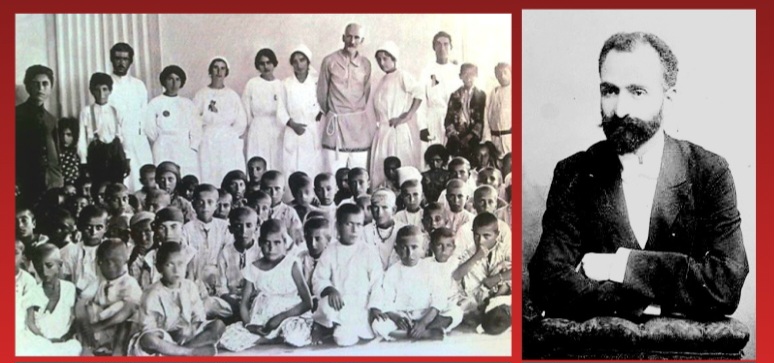
In the nightmarish days of 1915 he was selflessly trying to save the Armenian refugees who had escaped from the claws of the «man-eating beast», who by the paths of suffering had reached Ejmiatsin.
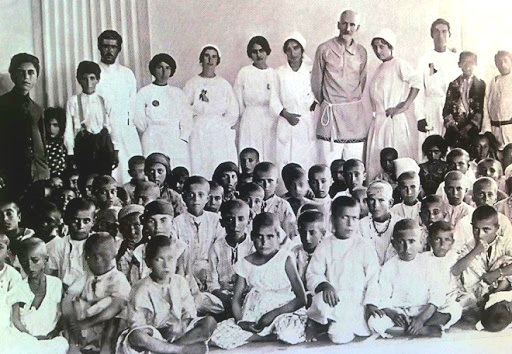
«In August of 1915 Hovhannes Tumanyan had asked Catholicos Gevorg the Fifth to permit the veharan to be used temporarily in order to give medical help to the sick, suffering thousands of children of the refugees, to save the helpless Armenian little ones from the epidemic.
Having received a refusal from the Catholicos, the next day Tumanyan has the closed doors of the veharan opened, and with his daughter and the poet Hovhannes Hovhannisyan, dressed in white smocks, they gather hundreds of sick children by cart and in the veharan the work of treating them begins»,- one of those orphans who had reached Ejmiatsin from Pesandasht, S. N. Aslanyan, remembers («Pesandasht Was Besieged», p. 258).
«It was the night of August 19. The unforgettable heavy night of the Ararat plain…
My father, in a black cloak, the cap on his head, came hurriedly out of the room — to shelter the refugees in the buildings, he was running from point to point, from tent to tent… from one dying person toward another dying person.
He was giving orders, commanding, cursing, reproaching, smiling, caressing, growing angry.
One day, in the pouring rain, he ran, he forcibly opened the newly built patriarchal veharan, which until then had been inviolable. The refugees poured inside. The angry Catholicos reproaches the poet, saying.
- You know , that I am the Catholicos of All Armenians…
Tumanyan answers. - You know , that I too am the Poet of All Armenians»: (From the memoirs of H. Tumanyan’s daughter — Nvard Tumanyan).
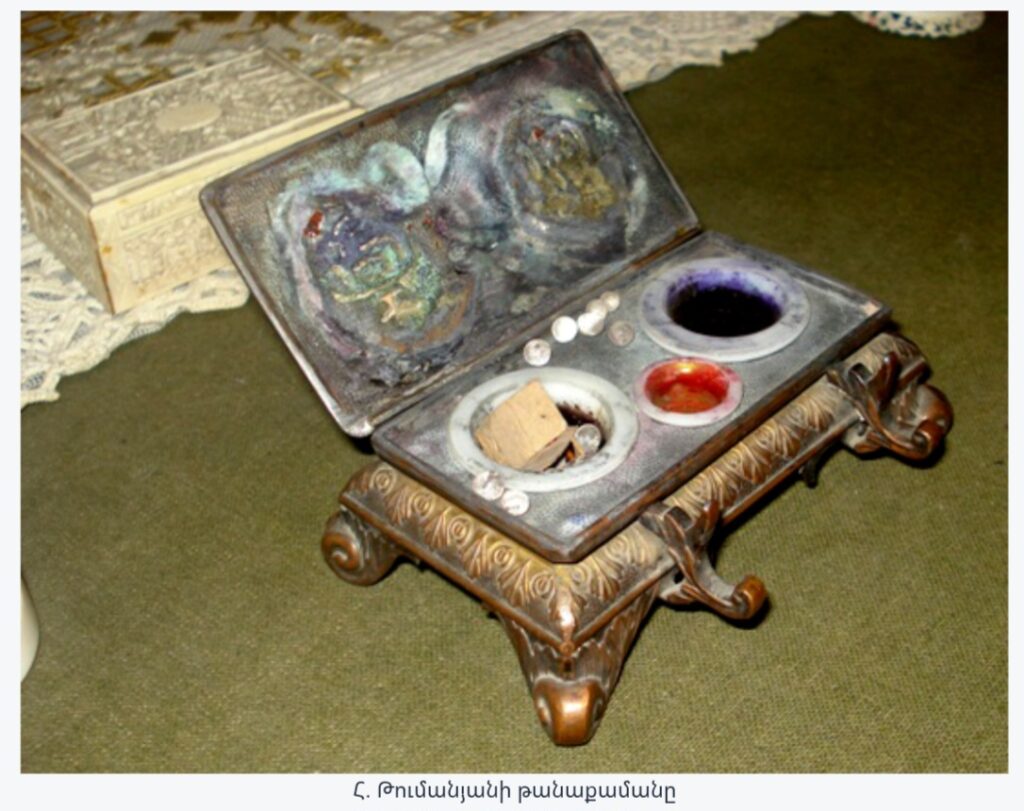
MEMORIES FROM THE EJMIASTIN ORPHANAGE (H. Tumanyan)
«The Ejmiatsin orphanage was not truly an orphanage, but a shelter for little children, because children who had parents were also received. It was a refuge where children snatched from the claws of death by starvation were gathered, poured in, temporarily, until they should arrive from our cities and take them away. It was not an orphanage, just as many of our present-day orphanages are not orphanages, but the name stuck and it remained an orphanage.
I shall not be mistaken if I say — beginning from the end of July, in the course of a month and a half, as many as ten thousand children entered the Ejmiatsin orphanage and came out from there, while the number of those remaining inside was 3500.
I too am one of them, who was among these children, but when today I sit down and try to recall, it is as if I have not seen them — the children. I have not seen them, I have not known them one by one. It was terribly, terribly hard to speak with them and to make them speak… If I have spoken and made them speak, even that was very little, by chance…
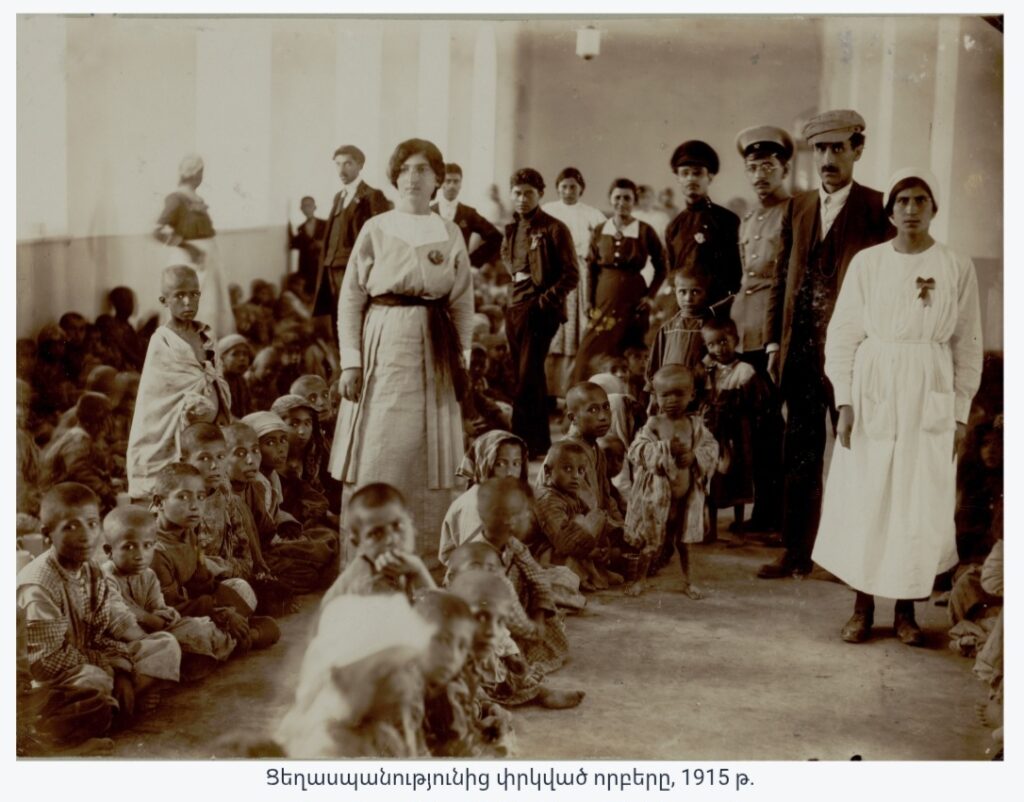
Yet continually before my eyes is their multitude, their puny, hungry and naked multitude, which was standing in the wood waiting — until they should empty the seminary…
It is already empty…
And at the giving of the sign, under the hot midday sun, raising clouds of dust, greedily it took a current toward the seminary…
Then before the entrance of the seminary…
Behold the forest of the ossified arms and hands of thousands of mothers, which, as if bent by a gigantic storm, in a widespread dull noise and turmoil, from every side are pushing forward countless, numberless childish skeletons, skeletons that were still breathing…
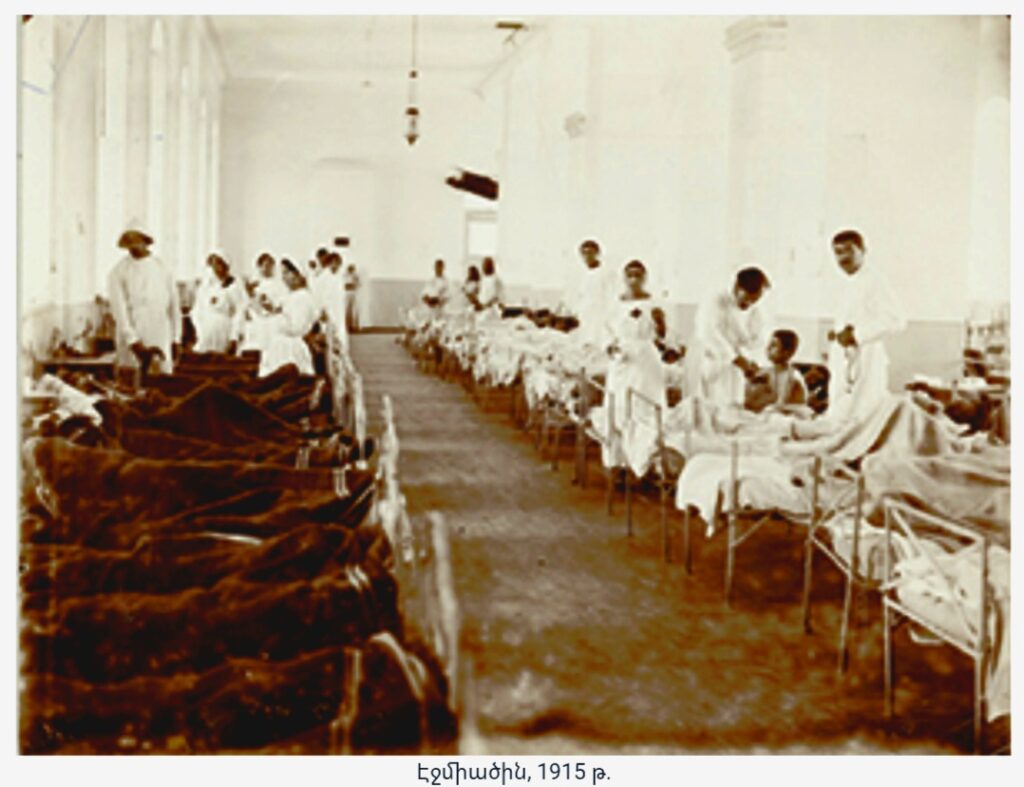
I remember those dense-dense and long rows of childish skeletons, when for feeding they were seated by the supervising ladies and young women, who, like liberating spirits, were continually circulating over them, dressed from head to foot in white shirts, the ladies and young women paled, wasted, from pain and from the unbearable heavy air and smell…
Sitting silent in dense-dense and long rows — their many-thousand eyes were staring unblinking toward the doors, from where they would bring in the pails of tea, coffee or food…
For the greater part of the day they were scattered on the bare floors, in the long antechambers or in the spacious courtyard, they could not remain on their feet, their thin shins and childish feet were hurting, the feet that had fled a few hundred versts, that had covered a few hundred metres of road…
I remember also that good day, when for the first time the supervisors complained that they had already become mischievous, that it had become difficult to manage them, when for the first time we saw how the gaps between the school benches piled in the antechambers had filled or they had climbed upon them and some are singing merrily in a group, some, astride the benches, are playing at horse, and some are making jokes, shouting, shouting again, joyfully-joyfully…
And all our eyes too filled with tears of joy…
I remember how thereafter pair by pair, in school order, stretched in long columns, singing innocently, with their old schoolmistresses and schoolmasters, they were walking in the avenues of the seminary, while the death-bearing sledges, howling «dead!… dead!…», were gathering the dried corpses of their mothers dead of starvation, mothers who would come, curl up exhausted near their children — under the walls of the orphanage or, like mown hay, fall in a group under the trees of the grove…
At last — behold also the long rows of vans and sledges, which filled them, dressed in red and white blouses, and carried them, scattered them toward various cities…
And who knows, even now in those various cities when they are asked whether they have a mother, they answer — «yes», and they still have the names of their mothers written down, without knowing that there were not even so many buriers to be found in Ejmiatsin as would arrive in time to bury the mothers of many of them»…
Overcoming the pain of the bleeding — old and new wounds of the «Stricken Fatherland», Tumanyan sheds his Light — with hope and faith.
«And poets, who have not defiled their lips with a curse,
Shall praise your new life — with new songs, with new word»…