
















«THE MYSTERY OF THE MOUNTAINS»
Culture is the product of a certain level of the historical development of man and, in general, of society, which reflects the worldview, the way of thinking, the way of life, the value system, the traditions, the conduct of the individual or of a given community, of a nation…
Nature, the environment greatly influence the formation of human thinking and condition the character of culture.
The multi-millennial culture of the Armenians, the festive-ritual system are anchored on the foundations of the national perception of the world.
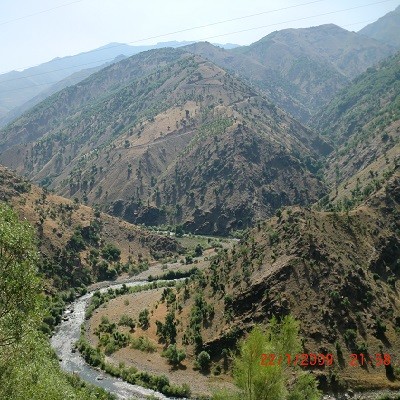
Among these mountains, with its traditions,
A simple people lived with love,
And its soul was clear and majestic
Like its mountains, its springs. (Tumanyan, «Anush»)
For the world-building villager, the peasant who feeds the world, Nature with its visible and invisible forces is a whole living system, of which he himself — man — is also a particle.
He converses with Nature — with the spring, the mountains, the rivers, listens to the talk of the breeze… «You are the work of my great-grandfather Krmants Kristopor, o spring» (Sero Khanzadyan «With My Father and Without My Father», p. 224).
Many Armenian writers have depicted their native village with its surrounding mountains and gorges, with its inhabitants living a life of their own…
The reflection of the inner world of the Armenian is found in memoirs as well as in artistic prose, in the documentary descriptions of eyewitnesses…
A number of stories with autobiographical passages were created by the Armenian public figure and historian Karo Sasuni (1889-1977), born in the Khulb district of Sasun — immortalizing the inhabitants of the patriarchal village of his childhood…
«The summits of the mountains are close to the sky,
And the mountain people — to the Creator». (K. Sasuni)
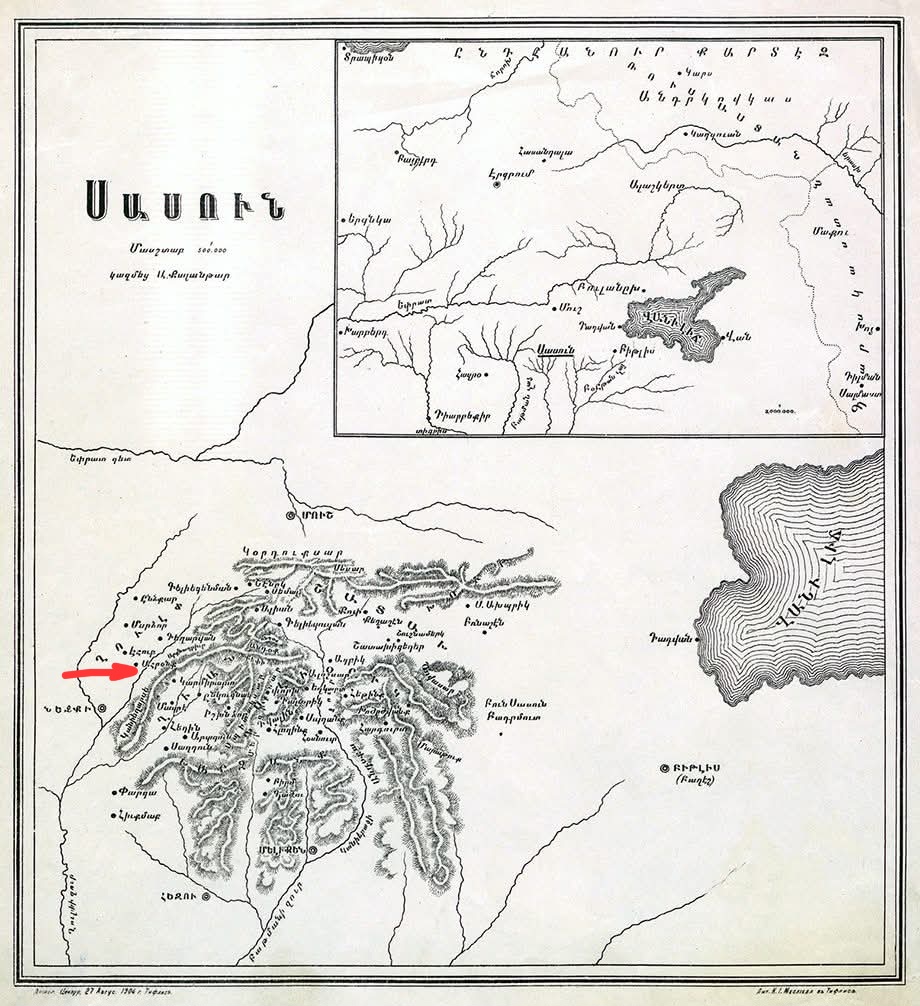
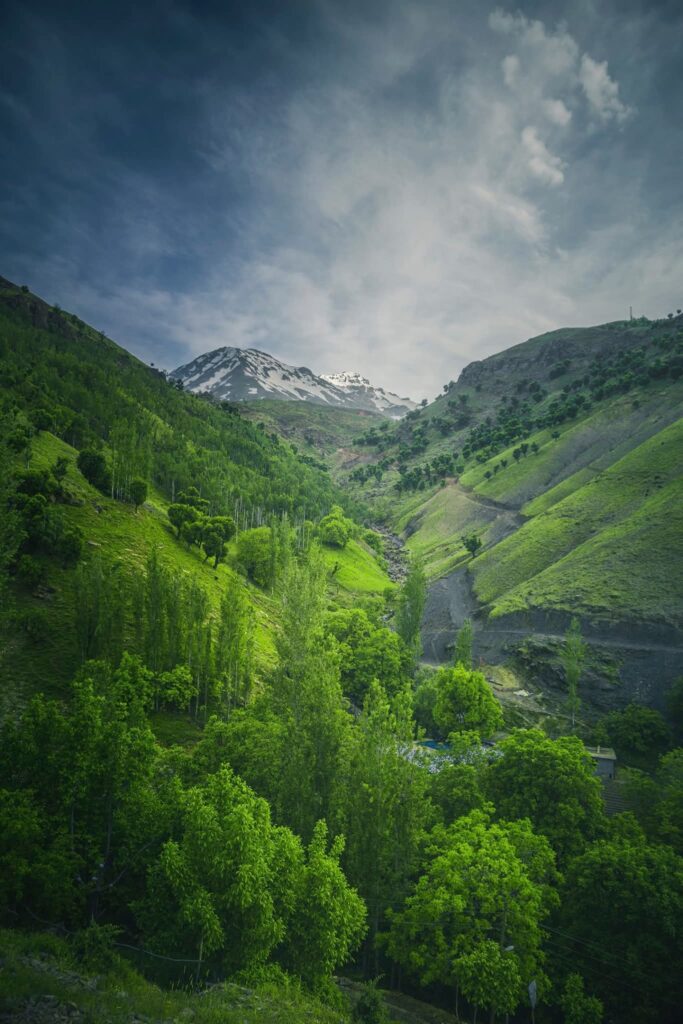
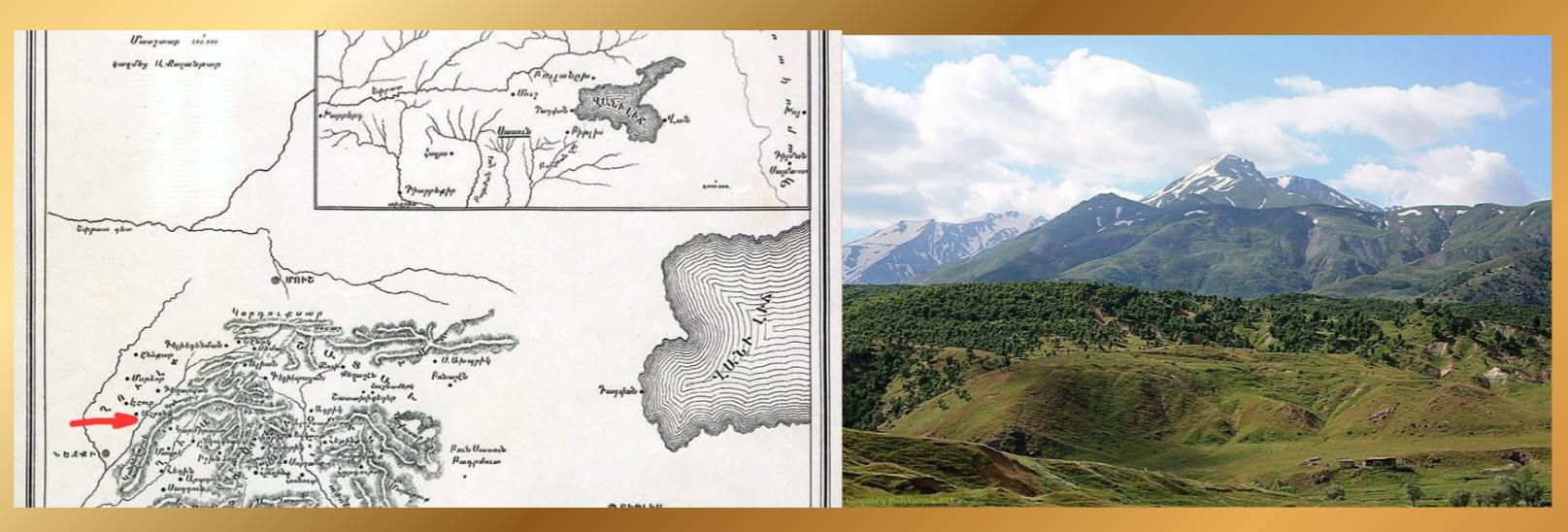
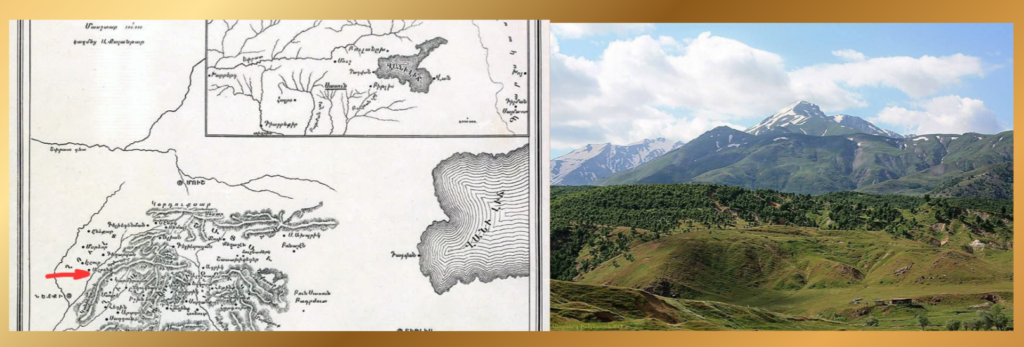
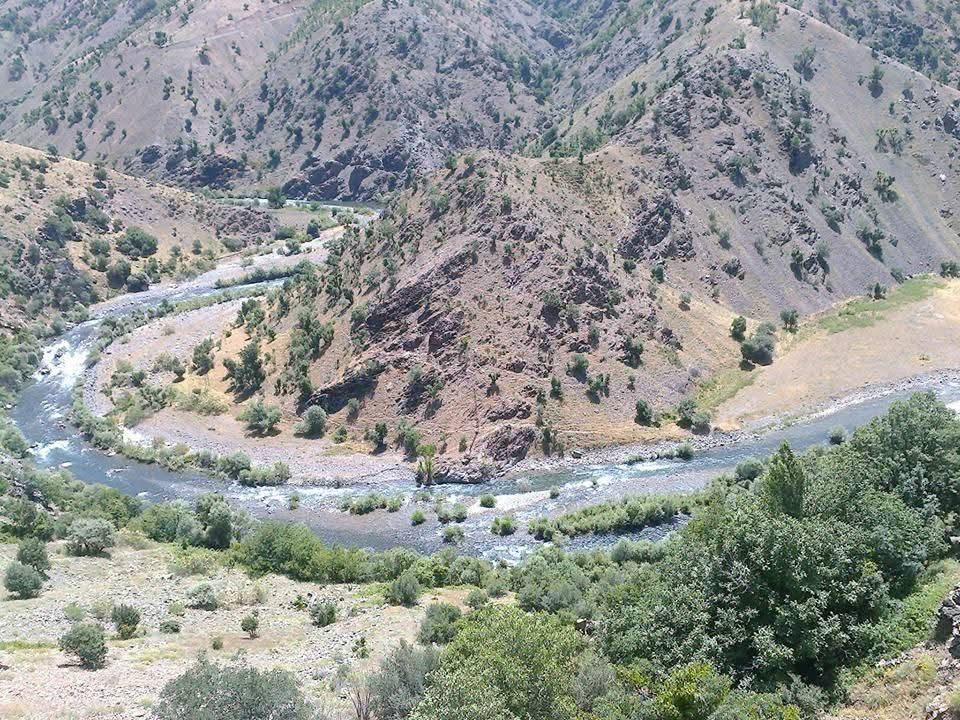
«Our village was called Aharonk, or Ahronk. The Kurds called it Hnze, whose older name was Handze. (…) Aharonk was an important village — lying to the south-west of Mount Handok, on the western border of Talvorik, at the foot of Mount Spitak Khazak, on the left side of a branch of the Tigris (which comes from the Darkosh and Handok mountains), three kilometres from the river, up toward the mountain. «The village formed one general network of vineyards, gardens, fruit trees, and with its springs, little waterfalls and countless brooks it had a paradisal look. Behind the village rose the mountain — about 1000 metres higher than the village, and it was called Sarbanak. Above it came Spitak Khazak, the high plateau of Hasamtin Druk Saruk, and that vast expanse of 15-20 kilometres is the mountain lands of the village — covered with oak forests, with wide expanses of meadows and with streams, which came down on the right and left sides of the village to join the Tigris. (…)
«In both the river and the mountain parts of the village there were countless game animals. Countless was the partridgewith its kinds, there were wild ducks. Herds of wild goats would come near the village, at a distance of two kilometres. Of wild beasts there were plenty of bears, wolves and fox, and in the river otters, naturally — also plenty of fish. There were all kinds of domestic animals, but the most plentiful of all was the goat».
(K. Sasuni, «Our Family (Memories from the days of childhood and youth: our house)». This writing, 52 pages, handed down to us — by his son and translator Babgen Sasuni, was composed in Beirut, 1942-1943. The author specifies: «Written for my children (…) who were deprived of a grandfather and a grandmother and of the memory of their ancestors»,- wrote Anahit Ter Minassian.
Excerpts taken from the review written by Levon Nairtsi of the book «The Mystery of the Mountains» — below.
«His heroes seem to be giants, each one, who «usually walk with iron steps, steady, slow and uniform, a bronze statue». («Arko-Moso»).
He has a veneration for that outwardly rough and uncouth, but inwardly so humanly feeling, noble and upright mountaineer, who is bold and brave, as only a mountaineer can be, and valiant and hard-working, like every Armenian villager.
«A people bent over the plough, but sometimes seizing Tur-Getzak, full of wounds, but valiant, flayed, but proud, nameless, but wise and self-sacrificing».
We know well,- every Armenian knows, with what fear and trembling he does his ploughing and sowing. How many – how many times he must call «Lord God», until he brings the fruit of his sweat home…
How many terrors Nature holds in store — to make the righteous labour of his sweat go to waste upon his head! One must know that people deeply, one must love them — to be able to write such lines.
«Have you seen the millet threshing floors and that heart-breaking labour the mountain villager performs when carrying the threshing floor home, his eye always fixed on the clouds of the sky? Have you measured that desperate heartache the villager feels when the threshing floor remains under the rain?» («The Immortal»).
Vigen Glak – Sasuni is a writer of village life. His village is our so beloved, simple and unadorned village, with its stacks of dung-cakes, with its earth-dug huts lost under the snows, with its tondrtun «mysterious like a place of prayer», where the smoke of the tonir «inherited from seven generations» rises every dawn in billows toward the sky like a prayer; where «the black pillars and beams have bound an ebony arch upon the jet-black walls».
Rightly has Sasuni observed – our tondrtun is a «pagan mehean», and our grandmothers — each a high priestess keeping unextinguished the fire and the smoke of the Armenian hearth… (Let them remain alive»).
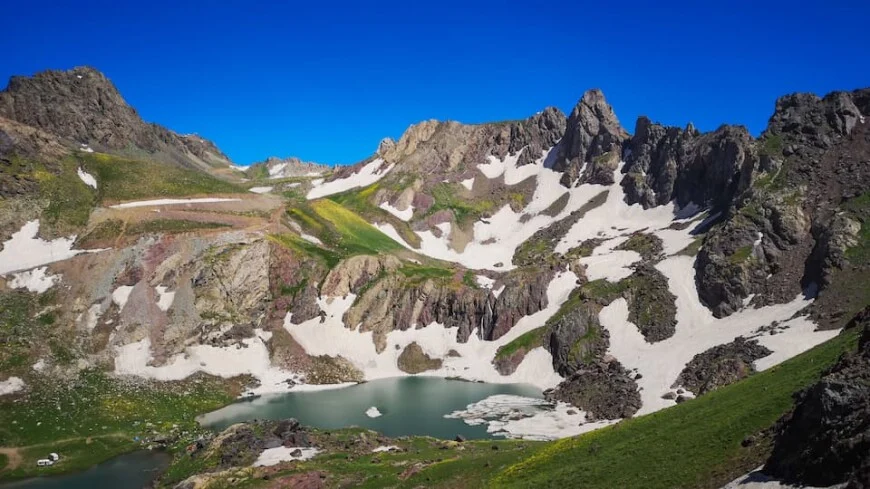
Winter in the village…
Who does not know the winter of our mountains? Who does not know how our mountain village falls asleep in winter like a bear, «withdraws into its shell like a tortoise» and only waits for some «event», «to burst out once a year from its unmoving and silent life»?
Among those extraordinary «events» is, of course, Barekendan too — with its dances, joys and feasts on the roofs of the village.
Vigen Glak knows, when needed, how to portray that village to us with a few words, with a few juicy strokes of a master’s brush:
«Here is a vague swaying in the mist, and the top of the poplar rises above the expanse; then out of the unknown our house rises up, and all at once the village with its vineyards and fields, its hills and gorges spreads out before me».
A very beautiful, living and moving picture is the village morning, when the village, like that sleeping city of fairy tales, as if by the power of some magic wand, awakens from its deep sleep,- all at once, suddenly, «with an explosion», as Sasuni says:
«The rooster, the church clapper and the sexton would break the silence.
The sun from the top of the mountain , like an all-covering torrent, would flood the village and the gardens. The bride and the cow, the hen and the kid, the ploughman and the ox would mingle with one another.
The lowing of the herd, the braying of the donkey, the quarrel of women, the cursing of the reaper»…
And all this mixed with the «good morning», «God have mercy on your parents» of the old women and old men. («The Hunter»).
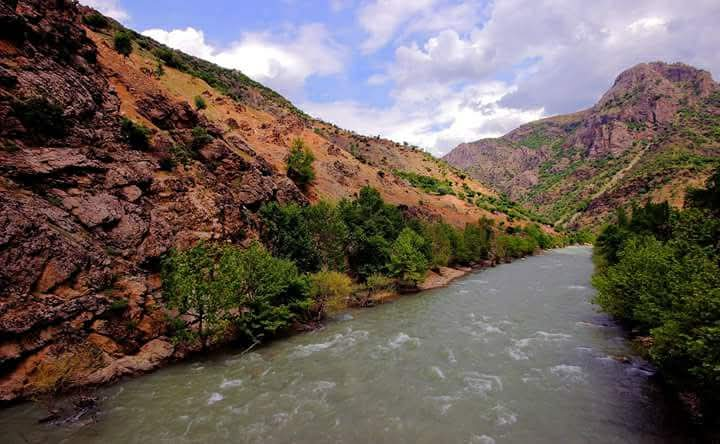
Vigen Glak is a lover of the nature of his homeland.
He is the singer of the mountains, and it is no accident, of course, that this first collection of his stories bears the title «The Mystery of the Mountains».
Generally sparing in descriptions — he gains poetic momentum and ardour when he must describe the native mountain and gorge, the sunrise and the storm. He is not verbose in his descriptions: «A piece of cloud spread its wing over the summit of Darkosh, gradually expanded and hung down toward the abysses»…
Only a few words, and a whole scene unfolds before our eyes, but those few words that he gives as description,- he gives condensed, precise and vivid.
Beautiful is the scene of the storm («Leylan»), when the caravan — lost in the inaccessible heights of Darkosh, wages a struggle of life and death against the elements of nature.
Beautiful, above all, is the description of the Tigris, which is worth reading in somewhat long quotations — to form an idea of K. Sasuni’s poetic momentum…
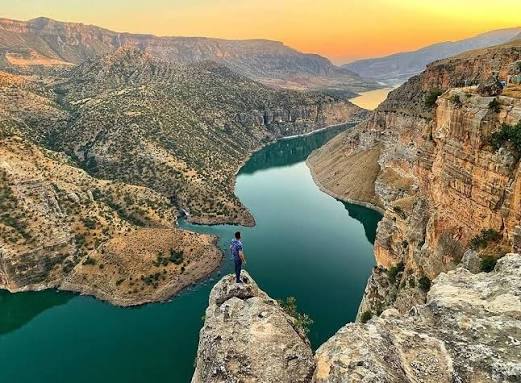
«For thousands – thousands of centuries the merciless struggle of nature had passed, whirling, down through these chasms.
The Tigris had driven like a spear into the flanks of the haughty mountains, had split their massive breast with immeasurable abysses. And the monolithic mountain — divided into two pieces — its summits stood face to face over the pit, bowing proud and contemptuous glances toward the dragon, which for centuries remained coiled at their pedestals.
Meanwhile, down from the summits, through the middle of the valley, the bowels of the mountain had spilled out, the rocks had split and toppled. Huge stones had been beaten and rounded by the waves; like a sawn tree — the flanks of the mountain had been opened layer by layer, to record the history of this endless battle of myriad centuries»…
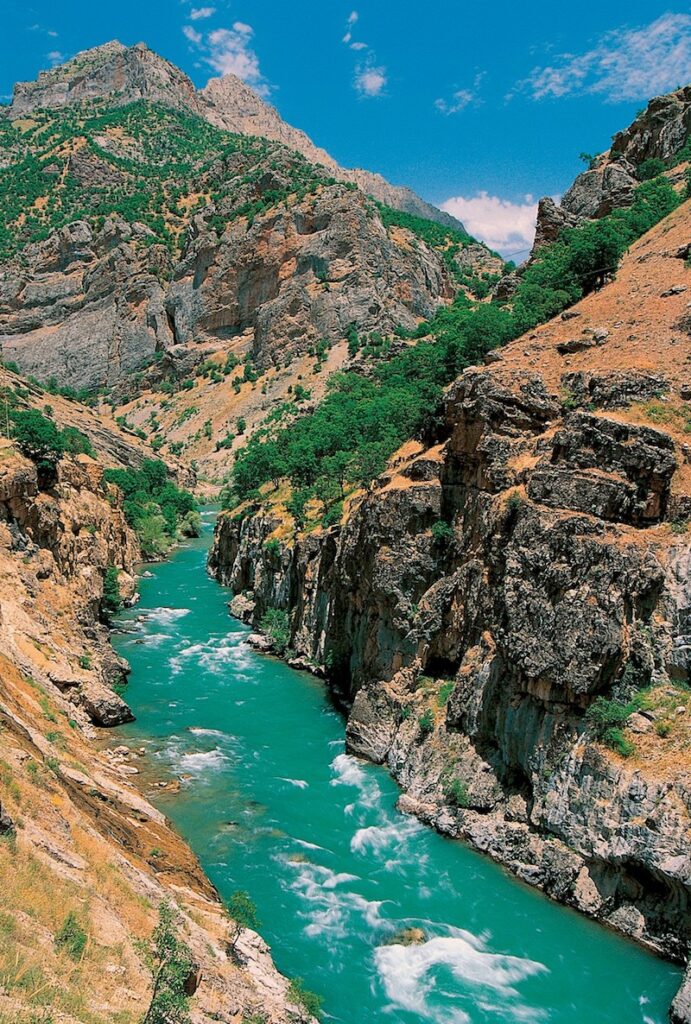
And a little further down: «And the mountain — rumbling from the depths of its womb, here – and there would clench its stone fists on the throat of the Tigris — tight enough to strangle.
The river would hiss like a dragon, its breath would stop, its mouth would foam, its body would writhe, it would desperately bite at the rocks and, at last, freed from that stone fist, it would howl in terror, without looking back it would rush toward the south, and the waves at full gallop would leap upon one another’s shoulders — like the frenzied running of hunted deer». («Leylan»).
…«But what occupies K. Sasuni is not these external descriptions. What interests him, the main thing, the essential, is the inner world of man, the hidden folds of the human soul.
Let us take, for example, just one of his stories – «The Immortal». Here the village with its simple and unadorned appearance is only a background. The essential is human relationships – complex, tangled, full of passions and contradictions. People are rough toward one another, merciless, stone-hearted. Here the agha is a «tyrant», the tax collector «merciless», the priest and the church warden are busy oppressing the people.
And it is understandable, of course, why a simple shepherd like Jaje, born and raised far from people, on the mountain, from the very first day of entering his village found himself in a deep labyrinth of contradictions — in a world of «lies, injustice and falsehood», where the lamb-eating wolves were far more numerous than there – on the summit of his Spitak Khazak.
He — that deep, sensitive soul, conscious of his inner worth and inclined to philosophize, «that tongueless man, who kept the fire of innate thought and judgment banked in the thousand – thousand folds of his soul until the end»,- naturally could not, would not reconcile himself with his surroundings…
And he rebelled against the village and the evil village customs. Being truthful to the point of rudeness, he became the merciless scourge of human shortcomings.
The villagers were afraid of him, «in the village Jaje and hail became synonyms». And despite all this, they had respect for him and «of a straightforward, unbending man flaring up for justice they would say «he is a piece of Jaje»».
Jaje from early childhood, still there — on the mountains, had heard from his father and mother that God is the creator of earth and heaven, that God is merciful, just, the protector of the weak.
He knew from the priest’s explanations that «God created man in his own image», which means that «God created man exactly like his own character, like his own face, in his own mould»…
And Jaje becomes pensive, withdrawn, ever more inclined to philosophize.
He «gradually withdrew from people and the more contemptible he found them, the sharper his relations with God became.
In his inner world stormy disputes took place and his mind was inclined to strike at, to grind down the fundamental cause. And thus he stood face – to face with the Creator»…
And one day — in the presence of the whole village, enraged, he hurls into the priest’s face:
«Priest, so then you, the church warden Shamas, the sexton Yegho, the thief Kiko have the character and the face of God? I yours too, and your God’s too…
So, God has teeth like your teeth? Come on, go, go, carry the image of God on your backs and devour the village.».
The rupture — between him and God becomes inevitable. Jaje becomes godless, he «no longer took communion, did not enter the church»…
And so until his death. He knows that whether he wants it or not — it is all the same — he will die, he feels it, yet he cannot reconcile himself with that thought.
If man is the creation of God, according to His image, then why is there death?
God is immortal, man — why mortal?
The feeling of death, which leads many – many to resignation, on the contrary leads Jaje to rebellion. He does not want to yield without a struggle and at the moment of dying, taking the «khanjal» in his hand, he cries:
«I will not give my soul to the angel Gabriel… If they come near — I will strike… I want to go to Spitak Khazak again»…