










«FROM THE MEMORIES OF MY LIFE» (H. ACHARYAN)
Part C

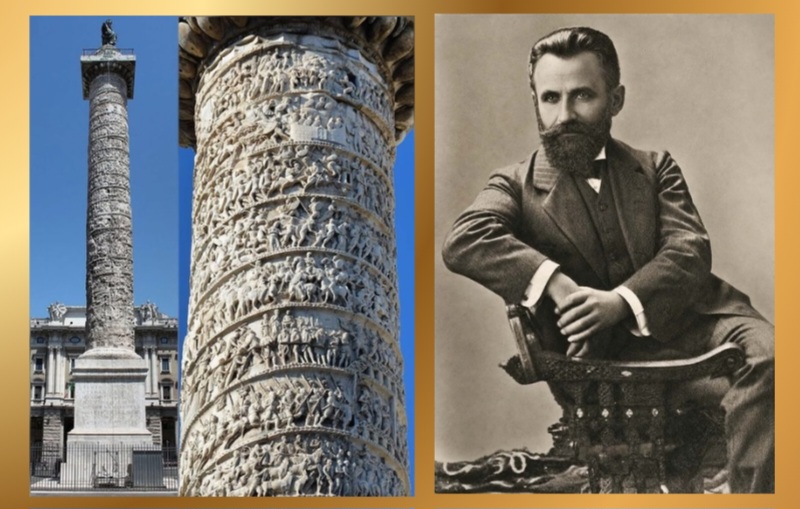
Though with extremely scant material means — yet with a firm spirit and steadfastness, with inexhaustible creative energy, Hrachya Acharyan was a scholar. After receiving his primary education in his birthplace — Constantinople, he reached Paris — following at the university the courses of comparative grammar, Zend, Arabic, Sanskrit, Pahlavi, and cuneiform.
In a period cruel for the Armenian nation — in those nightmarish years of the Hamidian massacres, H. Acharyan deepened his knowledge day by day. In 1898 — having completed the courses of the Sorbonne, he leaves Paris for Germany — to attend the lectures of Hübschmann in Strasbourg.
Returning to the homeland — he devotedly enriches his extensive works of Armenian studies — in Shushi, in Tabriz, in Karin — at the Sanasaryan school, in Nor-Nakhijevan, in Yerevan, alongside his pedagogical activity.

Again some small fragments from H. Acharyan’s book «From the memories of my life» — below.
FINAL EXAMINATIONS
In the month of June of the year 1893 our final examinations began.
It was the day of victory of our struggle: they exempted us from the examination in the sciences, against which we had struggled. Unfortunately two of those who had struggled had left — without enjoying the laurels of their struggle. There remained I and the pitiful Barnabas. To justify my last adjective, let me tell the following.
— Barnabas asked me: «How do you distinguish the words «or» and «zor»»:
I answered — «Or is nominative, zor — accusative»: «How do you understand that one is nominative and the other — accusative»:

The examinations took place in the Caucasian manner; that is — a list of questions had been drawn up, and we drew lots.
The examinations were open to the public, and anyone could be present and ask the pupils any question he wished.
I will not describe all my examinations one by one, but a few important ones.
First — the Armenian language (Grabar).
Present, besides Karagash and Mostichyan, were a group of outside guests, of whom I remember Father Gabriel Menevishyan, a member of the Vienna congregation, who was sitting right beside Karagash, and Misak Kochunyan (Kasim), who was known as the translator of the «Narek».
When I presented myself, they proposed that I draw a lot, but I refused — saying:
— Ask whatever you wish, I am ready to answer.
Everyone was pleased at this boldness of mine. Menevishyan took the floor and said:
— What opinion have you about Khorenatsi?
At that time the question of Khorenatsi’s date was sharply posed. The Vienna congregation was generally hostile to Khorenatsi, considering him a deceitful historian. So too, as we know, judged Karagash. To defend Khorenatsi was considered conservatism.
I took a middle position, and said that, although our teacher Karagash is entirely opposed to the traditional history, yet to reject everything at once and to subject Khorenatsi to cavilling — is premature.
— What is he saying,- asked Karagash, whose ears had become rather hard of hearing from old age.
Menevishyan, laughing, informed Karagash in a loud voice:
— Your pupil is speaking against you.
— Let him speak, let him speak,- said Karagash,- Vardan is a good boy.
Kochunyan, who was sitting beside me, took the floor. He took out of his pocket a small-format «Narek» and, opening a page, proposed that I read and translate it. Seeing that the book was the Narek, I refused to read it, saying:
— Our teacher Karagash Efendi has forbidden us to read non-Golden-Age books; if he permits — I shall read it.
— What is he saying,- asked Karagash again.
Menevishyan again reported what I had said and said that I would await his order.
Karagash gave permission.
I began to read the Narek with a pure pronunciation and a sensitive intonation, and when I was about to translate, Kochunyan took the Narek from my hand — saying:
— To read with such beautiful pronunciation is enough to show that you have understood well; there is no need to translate.
Thus ended my Armenian examination; perhaps Kochunyan too had difficulty understanding the Narek and wanted to come out of it with honour.

THE LAZ LANGUAGE
Below our seaside house in Sariyer there was a large hall (in Turkish — khovush), where a group of Laz fishermen lived. They caught the fish called tuna (palamut ), cut it up in thick pieces and salted it in small barrels. This was one of the export goods of Constantinople.
The Laz are a Caucasian people, closely related to the Georgians. They have a separate language — Laz. When the Russians took Batumi, the whole Laz people emigrated to Turkey. A part had also come to Constantinople.
When I compiled the dictionary of roots, I decided to put beside each root its original form, if there is one. Thus, beside the word «patker» — Persian pejker, beside the word «episkopos» — Greek episcopos and so forth. But many words remained without comparison. Since the Laz are a Caucasian people, I thought that they might have some words corresponding to Armenian.
But the Laz are an indecent people; it was not possible to establish closeness with them. I found an old Laz, named Mehmed. Emigrated from Batumi — he sat on the seashore selling fruit. I went to him and, greeting him, began to converse (in the Turkish language). Grapes were set out before him. I asked what they call this in Laz. He answered — «ghurjeni». I immediately thought that this is our word «hagharj» (of course such an etymology is not acceptable, but I was not yet versed in the laws. Such comparisons some make even to this day, and N. Marr always made them): Near the grapes there was an unripe cluster; I asked what you call this.
— Zhuri.
About this word there was no longer any doubt that it is our word «zhur».
— What do you do with that zhur?
— We squeeze it and pour it over the dolma.
— What do you call that juice?
— Katsákhuri.
I had asked three words, all three turned out to be Armenian. I resolved to learn Laz, so as to collect the remaining words too.
I took the Handy Dictionary and every evening went to him, took a chair from the coffee house, ordered a coffee for each of us and, asking words for a few hours, recorded them in my notebook.
After the dictionary, my appetite was whetted and I decided to learn the grammar too.
How difficult it was to study grammar with an illiterate man.
I give one example – I ask how they say «to die». I knew that illiterate people have no notion of the word, one must speak in a whole sentence. He in turn asked: «Who died?». So as to have mentioned someone, I said:
— «Ali died»:
— «What are you saying, I saw Ali yesterday; when did he die?»:
— «I said something false»:
— «What need is there to speak falsely, speaking falsely is a bad thing»:
That is how it went the whole time…
…The grammar was harder than the dictionary; how to ask about cases from a man who does not know cases?
Continually, day after day, I learned by heart the words I had written down: …
…One evening I told the Laz that tomorrow I would speak Laz with him. Indeed — I learned the grammatical rules too and the next day began to speak with my teacher in short sentences. The man was astonished and said:
«Now you know Laz better than I do»:
To make the book more complete I took down a few songs, as well as — a face-to-face conversation. One evening the Laz turned to me and said: «The Turkish police are pursuing you; what business does he have, sitting every evening and conversing with a Laz? Is he perhaps instilling revolutionary ideas? Look, he said, – when the Laz make friends with someone, they remain friends for ever. Do not come to me any more, flee, if you can, they are pursuing you»:
I went away and never saw my Laz teacher again.

The example of Laz shows well how great a role chance plays in our life. If the Laz had not lived below our house, whence would I have formed an idea of the Laz language? And if Mehmed agha had not sold grapes but sold apples, whence would I have known the words «ghurjeni, zhuri and katsákhuri», which served as the stimulus to learn that language? Do you think that I found many other words resembling Armenian? Never at all, those first three words amazingly turned out to be the first and the last. Of the hundreds of words I asked — I barely found 10 words, the most beautiful of which is — omisura = msur.

Let us continue the game of chance.
When in the year 1894 I went to Karin, we took the pupils of the Sanasaryan school for the summer to the place called Artadzor, where for a whole month we spent the nights under tents. There too the watchman was a Laz and, delighted at my «Laz scholarship», he became good friends with me.

On beautiful nights, under the light of the moon, he taught me a few Laz songs, which I also included in my collection.
When I went to Paris, I presented all the material to my teacher Meillet.
The Laz language had no literature; nor had it been studied, so Meillet examined my work with pleasure and, as a notable scientific novelty, presented it to the Linguistic Society of Paris.
I too had the honour of being elected a member of the same Society and my book was published in its entirety in the Society’s collection, giving me too, as a reward, 50 copies of the same book (offprints).