

«FROM THE MEMORIES OF MY LIFE» (H. ACHARYAN)
Part A

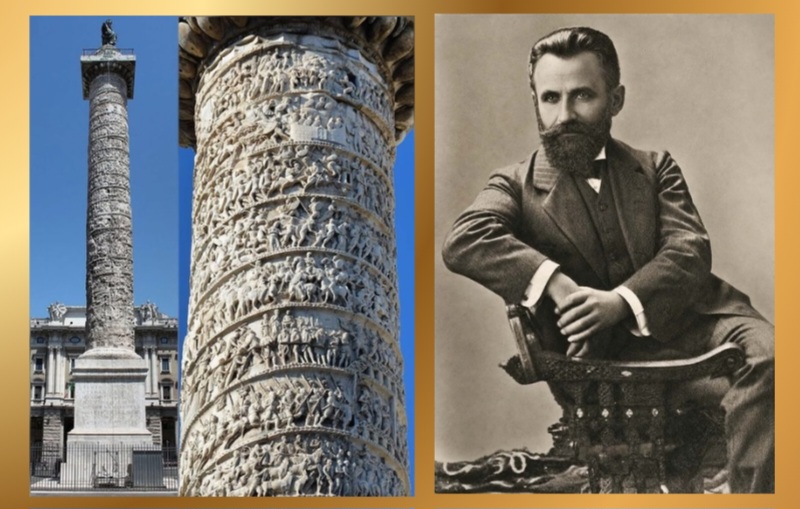
With his scholarly activity of nearly half a century, the Armenian linguist, academician of the Academy of Sciences of Armenia Hrachya Acharyan excavated the treasury of the Armenian language and left to the generations the fruits of his prolific work in Grabar, linguistics, comparative grammar, dialectology, etymology and other fields.
Born in 1876 in the Samatia quarter of Constantinople, in a craftsman’s family, H. Acharyan received his primary education in his birthplace — at the Kedronakan school. In 1895 the paths of higher education brought him to France — to the Sorbonne University of Paris, from where he returned to the homeland — to continue his fruitful scholarly and pedagogical activity in various cities…
In the memoirs he left at the sunset of his life, the distinguished Armenologist gives valuable information about numerous Armenian and foreign intellectuals and public figures.
«As a head and as a heart — I foretold a great future for that called pupil of the Kedronakan… he has everything to advance, to grow great… for he is a poet too. And contrary to the saying — instead of the word it is the writing that will fly and come to us». (Yeghia Temirchipashyan — about H. Acharyan)
Some passages from H. Acharyan’s book «From the memories of my life» — below…

MY COURSE OF STUDY
Many times I have thought about what was the reason that I entered this profession. That is the same as if we asked why some choose this and some that profession. Is the inclination innate, or does it arise from various conditions?
I think that conditions have a very great influence, as will appear from the following lines.
My mother was entirely illiterate. So too was my elder sister, who until her death did not recognize even the letter A. My father was semi-literate, but very hard-working and eager to learn. Two small anecdotes will show the degree of his literacy.
One day, coming to the school, my father asks the trustees: «How is my son doing in his studies?». They answer: «Your son is very studious». My father says: «A pity, instead of being studious, if he were working — it would be better».
Another time I bring home the school marks I had received. With us at that time the pupil’s mark was written in words and not in figures. On my sheet, against the subjects, were put several «excellent», «best» and one «good». My father — reading that sheet, remarked to me: «Why do you have only one «good», the others are «best»»:
I was afraid of exactly the opposite, because «good» was lower than «best», while he, it was astonishing, thought the opposite.
I said: «Father, «best» is higher than «good»»:
–«Whom are you trying to fool, «lavaguyn» — that is, merely having the colour, guyn, of lav, good».
I explained at length, but he was not convinced and only outside, asking in the coffee house, did he learn with astonishment that «best» is higher than «good»»:

«… My mother had had a cousin, the son of her paternal uncle, who was a priest and for that time was considered a learned man. He had died, and one of his books had fallen to my mother as an inheritance. It was a small-format «History of the Armenians», printed in Venice. I do not remember the author’s name and the year of printing, but I remember the outward appearance of the book well.
My father — loving the History of the Armenians exceedingly, continually made me read it not only during rest, but also during work.
In his shop, which at one time was in our garden, or when he worked sitting at the table in the room, I too, sitting opposite him, read that book. When the book ended, he made me read it again. And so on and on.
So that I can say that I read that book several dozen times. At the end of the book was placed the list of the names of all the patriarchs and kings of the Armenians — from Hayk to Levon VI. I had read it so much that to this day I know that whole list by heart and can repeat it like a machine.
Thus was born in me an inextinguishable love for the history of the Armenians, which later passed to general history.
I had read the history of every nation that I had been able to obtain. Every book in whose heading «History» was written always had an attractive charm for me, and I read it with great love — even if it were «History of birds».

My father had bought for me the French dictionary of Larousse .
In the second part of that book, as is known, we find a large list of names; there are marked the names, dates and lives of the kings of various countries, in the alphabetical order of the dictionary. I, a pitiful naive child, turning all those names into a regular list by countries and by chronology — had compiled a work. And for me the greatest pleasure was to read, for example — the chronological series of the kings of France; and so — of other countries. As if those countries did not have their own history book or manual.
Thus, then, in my childhood, having as my guide that little volume of the History of the Armenians, I had created in myself a love for Armenian and general history. It was that love which turned from history towards the languages of nations; in other words — from history I passed to linguistics.
For language too I had no guide. At the end of our street there was a Greek grocer; I asked him to give me the Greek alphabet; I learned all the letters and at that young age of mine read Greek freely.
A few streets away there was a Jewish pedlar, from whom we sometimes made purchases. The pedlar was a venerable and kind old man with a white beard. Spectacles on his eyes, head bent over the books, and according to their custom — always rocking, he read. I asked him too to give me the Hebrew alphabet, with their names and values. He wrote the 22 letters on a sheet, and I, learning quickly, read Hebrew too.
In our school as a foreign language, besides Turkish, we learned French. But there were schools where instead of French they taught English. Such was the school of the Nor quarter of Samatia, where our neighbour’s son — Yervand — was a pupil. On Sundays he came to our house and, sitting on the threshold of the door, studied English with me»…
«I had not yet passed on to German and other languages. I learned Grabar very well and wondered, as I still wonder to this day, why others have so much difficulty learning Grabar»…
To be continued…

In the photo — the parents of Hrachya Acharyan