«ARMENIAN PERSONAL NAMES», (Part C)
H. ACHARYAN

The continuation of H. Acharyan’s article «Armenian personal names» — below (the beginning in the previous two publications)…
- ARABIC NAMES
Above we showed that personal names in general have a religious character and, accordingly, being taken from nations of the same religion — they spread together with their religion:
Bearing in mind this universal phenomenon, strange, certainly, is the circumstance that the Armenians, even in the most brilliant years of Christianity, accepted the personal names of nations religiously hostile to them, such as the Arabs and the Turks: I do not know how this phenomenon should be explained: Certainly the Mohammedans did not compel us to accept their names by force: Probably this too is the result of the natural influence of the dominant element, an influence which in every form and every circumstance does its work, and draws to itself, unites to itself the small, conquered nations:
Arabic names known in our ancient history are Ablkharip, Abusahl, Hamam, Mleh and so on: Some were also used in Armenian translation, such as Chnchghuk, which is the translation of the Arabic synonym Hamam: - LATIN NAMES
In the days of the Rubenids, with the growth of relations, the use of Latin names also increased, such as — Anton, Levon, Zapel, Alis, Hetum, Ogostinos and so on: With the fall of the Rubenid state the Latin names were wiped out and today barely a few of them are alive: - ARMENIAN RELIGIOUS NAMES
After the spread of Christianity, at the time of the flood of Hebrew and Greek names, a new idea arose among the Armenians, that is — to translate the foreign Christian names: Against the Greek name Anastas they set Harutiwn, against Apostol — Arakel, against Teodoros — Astuatsatur, against Stavri — Khachik, against the Hebrew Set — Mkhitar and so on: This phenomenon, certainly, was the work of the Hellenist fathers and an undertaking of national zeal among the Armenians: They did not pay attention to the circumstance whether the original form of these translated names was really in use among the Armenians or not: For example — Anastas, Teodoros and so on have been names known to the Armenians, but Apostol, Stavri and so on have not been in use among us: Parallel with the translation there entered also new names formed by analogy, all of them expressions of Christian life, words close and comprehensible to the mind and heart of the Armenian people, whereby the dictionary of our personal names was doubly enlarged: Such are — Hambardzum, Zatik, Galust, Margar, Tiratur, Khachatur, Kristostur, Khacheres, Tseron, Karapet, Mkrtich, Avetis, Avag, Makruhi, Srbuhi, Tiruhi and so on, and so on, which, from that day until now, are more or less in use among us:
From the point of view of the history of our intellectual development it would be very interesting to determine when the time of the origin of these names is:

11. ARMENIAN POPULAR NAMES
Besides the Armenian religious names there are numerous other names, which, although they are names formed in Armenian, do not revolve around Christian beliefs, but by their meaning represent more real life and very often represent lovely secular poetic images: For example — Tukhtsam – black-haired, Shaghoski – who scatters gold, Vardit’er – rose petal, Heriknaz – enough of how much you coquet: Among the names of this series are — Zanazan, Varderes, Loysparon, Norarev, Vardympu, Andzrevard, Norvard, Nortikin, Vardmanuk, Knarik and so on:
These are the native, genuine, self-made names of the Armenian common people, of the villager, which shine with exceptional brilliance within the circle of the religious names cherished by the ecclesiastical class and of the foreign names loved by the noble class:
12. SELJUK-TATAR NAMES
Almost contemporary with the Armenian popular names are those numerous personal names which the Armenian people borrowed from the Tatar, Seljuk and New Persian Mohammedan nations: The Armenian people in general knew those languages very well, whereby it very easily penetrated the inner meaning of the personal names and, charmed by the beautiful images seen in them — took and adopted them: For example — Aslan-lion, Jivanshir-young lion, Bahalu – precious, Bayrak-banner, Dulbahar-spring rose, Guldasta-bunch of roses, Gulmelik-queen of roses, Gulnigar-rose-painted, Hakhbanda-servant of God, Hakhnazar-God-seeing, Etar – it is enough, Tamam – perfect, Tangrighuli-servant of God, Turfanta – early first-fruit, Khutlu-melik (Tatar) happy or blessed king:
13. EUROPEAN NAMES
These are borrowings of an entirely new time, which were taken from French, Italian and English; they were in use exclusively among the Western Armenians, especially among the Catholic Armenians, such as — Zhozef or Juzepo (Hovsep), Jiwan (Hovhannes Italian Giovanni), Valandin, Alberd, Eduard, Viktoria, Ozhen, Verzhin, Atolf, Rotolf and so on, and so on:
Of these the Italian forms have already disappeared among the Western Armenians, while the others are not much used now, except the female names, which have become dearer than the male ones because a rich store of female personal names is lacking among the Western Armenians: Recently European names have also entered the Caucasus, such as — Emma, Eleonora (shortened — Nora), Juleta, Ofelia, Valendina, Eduard, even — Napoleon, Hamled, Henri and so on:

14. RUSSIAN NAMES
Recently purely Russian names have begun to multiply in the Russian-Armenian world (the Caucasus and especially Russia): Some of the Russian Armenians seek and find a corresponding Russian name in place of their old name and use it in this form generally; thus — Nikoghos becomes Nikola, Gevorg — Georgi or Egor, Hovhannes — Ivan, Grigor — Grigoriy and so on:
This work has gone so far that even entirely non-corresponding names are very often officially yoked together, it is enough that a similar-sounding letter or sound be found in the two words:
Thus — Mkrtich becomes Nikit, Harutiwn — Artem or Artom, Sahak — Sava, Martiros — Martin, Vagharshak — Volodia, Arshak — Arkadi and so on, which have no connection whatsoever with each other: In this «art» the Armenians of Nor-Nakhijevan are especially notable:
Particularly esteemed and usual are the endearing names, such as — Misha (Mikayel), Sasha (Agheksandr), Masha (Mariam), Todia (Teodoros), Liza (Eghisabet), Kolia (Nikoghayos), Katia (Katarine) and so on:
New Russian names are — Vlatimir, Olga, Olia, Olinka, Dusia, Dunia, Marusia and so on:
15. ARMENIAN NATIONAL NAMES
Under this name I classify those Armenian personal names which began to be used among us after the awakening of Armenian national self-consciousness, that is in the last 80 years: This national self-consciousness, which, rejecting the purely religious and foreign names, brought out from the pages of history the almost forgotten Armenian historical names and put them into general use, was not satisfied with these alone and began to create proper names, all of them in the purely Armenian language and within the circle of Armenian national ideas.
Here is a small list of such new names — Hayastan, Araksi, Masis, Ararat, Armenuhi, Haykuhi, Azat, Siranoysh, Varsanoysh, Hranoysh, Hrazdan, Hrayy, Hrachuhi, Berkruhi, Vshtik, Martik (not shortened from the word Martiros, but the Armenian martik — «fighter»), Haykazn, Haykaram, Aghavni, Artsvik, Yasmik, Knarik, Arpenik, Azniv, Sirakan, Lusik, Lusntag, Geghuhi, Azatuhi, Paylak and so on:

Names also depend on place and circumstance: All the sections of the Armenian people, both in Armenia and in the colonies, have not always been subject to a single domination and, consequently, were not subjected to one influence: Pahlavi names could have been spread in the eastern parts of Armenia, while Greek names — in the more western parts, and Syriac names in the southern parts: The local difference is more definite at present: The Armenians of the Caucasus use Russian names, none of which has entered Western Armenia and the colonies:
The Armenians of Hungary, Poland and Romania naturally have Hungarian, Polish and Romanian names, which have not at all entered among us:
Circumstances too have a great influence on the spread of names:
The upper class, as a lover of novelty and brilliance, usually soon forgets the old and the native, loves foreign names more and is their first borrower, whereas the common people is more faithful to what it has: Pahlavi names first entered the noble class; kings, princes and nakharars loved to be called by the names of the Arshakuni and Sasanian royal houses: Syriac, Hebrew and Greek names entered first the religious class and through it spread among the people:
That is why, when someone takes a religious vocation, his secular name (especially if it is pagan) is removed and in its place is put a religious name, which is Greek, Hebrew or Syriac:
Thus — when Trdat left the royal throne and became a hermit, he was called Hovhannes:
When the sparapet Hetum of the Rubenids left the sword and entered a monastery, he was called Anton: This custom continues until now:
The Armenian national names were invented mainly in Constantinople and little by little spread towards the East:
When I was born (Constantinople, 1876) I was, I think, the second to receive the name Hracheay; whereas now the name Hracheay has become usual: If we go to a remote village, the usual names we hear will be the Hebrew, Greek and Turkish names, while the genuinely Armenian, Pahlavi, European, Russian and Armenian national names — hardly ever:
Whereas in Constantinople, Yerevan and other educated centres (Tiflis, Smyrna), the former have already become disused, and rather these latter exist:

In the previous article I spoke about the origin of names:
The summary of what I said is this.
The name is the means by which a member of society (the individual) is distinguished from the remaining members: Every name is a word that has its definite meaning:
Names are often borrowed from nation to nation and become general:
The Armenians, though they have their native own names, but these are very few:
The names we use are for the most part foreign — Pahlavi, Persian, Greek, Hebrew, Turkish and in various European languages, among which we also place the Russian names:
Now I speak about surnames…
To be continued…

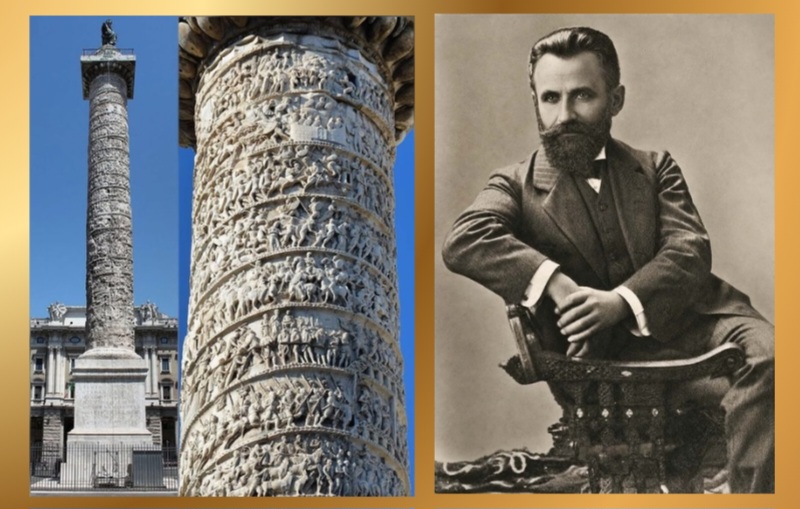
Portrait of H. Acharyan (by Martiros Saryan)