














«KHOJA CAPITAL»
(PART A)

ARMENIAN CLERICAL DIPLOMACY
«What has guided me, what has urged me, what has imperatively driven me forward has been the Armenian people…
Being a child of the people, nourished and grown up amid its sufferings, its boundless pains, at every step of my activity, every hour, every minute, I listened to its voice — the voice of that great and ill-fated mother, I turned to its noble heart and received inspiration from there»,- Leo wrote in 1907 («Vtak», Tiflis, 1907, No. 11, p. 163):
Leo presents the history and culture of the most ancient period of the Armenians — dwelling on the influence of the political situation of the time; he compares, draws parallels, notes the interactions, the commonalities and the particularities.
He reassesses the events of the past — convinced that every people itself forges its own history — in spite of external circumstances and the coercion of the foreigner…
In his study «Khoja Capital» Leo examines the situation of Armenia, located by its geographical position between two rival powers, in the 3-4th centuries and later.
A few lines from the said work — below…

«Parthian Iran was very close to Armenia — bound by ties of kinship, thanks to the political organization that it had given to the Armenians. That organization was a kingdom — in Parthian form»…
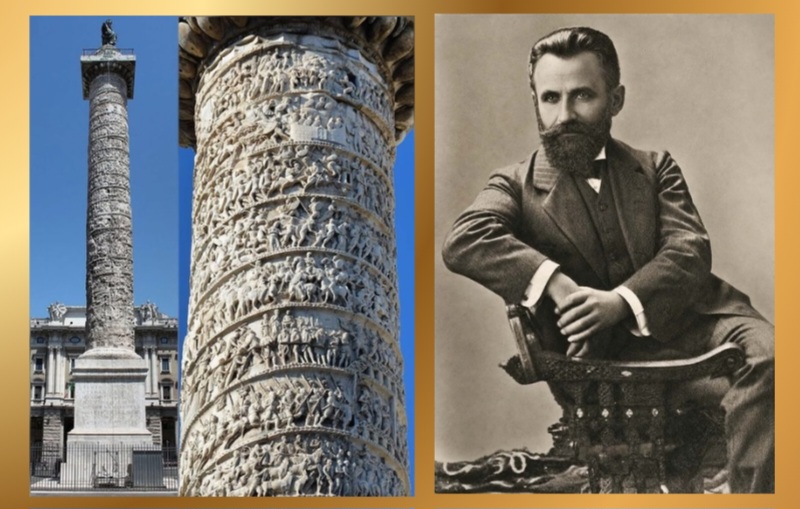
«…Now let us see the other side – Rome. This is already a phenomenon entirely alien to the East; it was born and grew up in Europe, it is endowed with a high culture, it has brought its military organization and the craft of conducting campaigns to perfection from the standpoint of the time, it lives by wars, it conquers and grows rich by plundering worlds, by reducing millions of people to slavery and making them serve it.
Among us to this day Roman imperialism has been understood merely from the standpoint of the ambition of conquest. The long-lasting occupations by the armies of Rome, whose centre of gravity was formed by the middle course of the Araks or the Ararat country, were described as: they came, they occupied, they settled, then they went away again, came again, and so on.
As if the legions of Rome were making military excursions, or were already so hungry for laurels that they undertook such distant and difficult campaigns, and if today near the village of Garni the wonderful fragments of Roman ruins have remained, this only means that the temple built with all the sanctities of Roman art and the large station spread around it had a single aim — to enjoy the cold water of the spring gushing abundantly two steps away.

No, such was not the age-old reality.
Roman imperialism gave birth to the capitalism of Rome, so that it might become its servant and, going from world to – world — conquer profits for it.
The bankers, contractors and suppliers of Rome – these were the ones who set the Roman legions marching.
Foreign provinces were needed — to colonize them, to exploit them. And behind the army whole armies of capitalist leeches moved towards the foreign countries, which had all kinds of undertakings – the collection of taxes, the trade in captives, the exploitation of the local land wealth and of industrial enterprises, etc., etc., and all this was to be patronized and protected by the Roman troops that had occupied the countries.
How numerous were these packs of profiteers following the military campaigns – can be inferred from the circumstance that when Mithridates of Pontus, the implacable enemy of Rome, issued an order to destroy the Romans living in Asia Minor, 80.000 Italians were slaughtered in the various communities of that country. Thereafter this «Roman slaughter» became a kind of custom in the province of Asia; tribes came down from the mountains of the Caucasus and staged partial massacres in this or that city.
These bloodsheds are proof of the degree to which the hatred of the local population towards the newcomer exploiters was furious and, on the other hand, of how much those exploiters needed the vigilant and energetic protection of the legions, which also became the object of the principal concerns of the Roman government that was in the hands of capital.

From this side the admonitions are instructive and interesting that Cicero, the ideologist of the capitalist strata, gave to the general Pompey, who conquered Armenia again, when the latter, put forward by the capitalist class, was going to replace Lucullus, who belonged to the aristocratic class and who, despite his brilliant victories, had been removed from office by his own soldiers — thanks to the propaganda that the capitalist agents who had come from Rome had spread in the army.
Cicero, reminding Pompey how great an importance the province of Asia has with its natural riches, developed agriculture, extensive pastures and an industry useful for export, drew his attention to the insecurity that reigned there and brought about the situation that people out of fear abandon their houses and fields, and thus the state treasury is harmed or, more precisely, the contractors who are agents of the treasury and who heap up great fortunes for themselves in tax-farming, whom the renowned orator of Rome called «honourable and respected», and found that first and foremost these must enjoy the solicitous attention of the commander-in-chief, since they «have taken their financial operations and capitals to that country, and their interests, in and of themselves, are worthy of your attention; indeed, if we have rightly always seen in the royal revenues the arteries of our state, just as rightly have we called the class that manages those revenues the guarantee of the existence of the other classes. But, besides that, the members of the other classes too, enterprising and active men, partly themselves engage in financial transactions in Asia, and therefore, as absentees, have the right to receive your support, and partly have placed great capitals in that province:

Thus humanity itself demands of you that you save so many of our fellow citizens from misfortune, but above all this, your prudence must tell you that the ruin of so many citizens cannot pass without a trace for the life of our state too. Of course, it may be objected that after losing them we can recover our revenues by the road of victories, but first there is little benefit in this, because the former companies, being ruined, will not be in a position to take up their contract, and other companies will not come near out of fear; then too we must remember well what this very Asia and that Mithridates himself taught us at the beginning of the Asian war, a lesson that cost us exceedingly dear.
When at that time numerous citizens lost great capitals in Asia, payments in Rome stopped and all the rates fell.
It cannot be otherwise; it is impossible that in a state many citizens lose their fortune without dragging into that ruin masses of other persons too.
Protect, then, our state from that danger and believe, if not me, at least your own eyes: the rates of Rome, the financial operations of Rome which are carried out here, in the Forum, are in close and organic connection with the financial transactions carried out in Asia; the ruin of the latter cannot fail to drag the former too into the same abyss»:

That is what it meant to be a Roman province.
The conquest was not military, but pre-eminently economic, and the Roman soldier was the guardian of Roman capitals. Thus the exploited colony was bound by hundreds of vital threads to the centre of the state, and the commander of the world-wide Roman state was the stock exchange of Rome, its Forum:
Armenia bordered on the province of Asia and was no less important than it, not only from the strategic, but in particular also from the economic standpoint. Being the advanced guard of Roman imperialism in the East, which ensured the possibility of domination over the Euphrates-Tigris valley as far as the Persian Gulf, it at the same time had within itself such sources of its own, local wealth as could not fail to attract the Roman capitals following hard on the heels of the Roman soldier.
The Roman military occupation did not take in the whole of Armenia, but a part of it, and if that part was Ararat and not some other province, this too was for the very same reason that this same province, and no other, had become the centre of the Armenian state, and that because of its economic importance of the first rank:

It was here that the Roman military occupation settled, and so firmly that the difficult construction of the small but costly temple of Garni was considered a necessity. And together with the military occupation, the capitalist occupation of Rome also settled firmly in the Ararat country, at whose disposal came the varied crops of the land renowned for its fertility.
If in the province of Asia among the principal economic supports of Rome were the large carpet-weaving workshops and the craft of gold-woven brocades, Armenia too was famous for its carpets, while for gold-thread brocade weaving the city of Dvin was renowned in the Arab period, whose fabrics throughout the East bore the name «Armenian goods», (Note. The highly developed industry of woollen and silk fabrics of Dvin is described with admiration by the Arab geographer Al-Istakhri (X century): See my «History of the Armenians», volume two, book A. manuscript), a renown that, of course, could not be created at once, but was the result of centuries of technological development.
We have no need here to detail what other valuables for export the Roman capital settled in the Ararat country could exploit – it is enough to recall one – the cochineal red.

Thus, we have before us an exceedingly great vital phenomenon – European capital among the Armenian people, in its country. This capital knew not only how to fleece and carry away, but also how to organize an economic environment — corresponding to the demands of its exploitation and profit-making.
This meant the introduction of Roman orders into Armenia, which, before getting to know the Romans, was under the strong influence of the economic orders of Iran.
Along with the sharp rivalry of political influences there also goes the rivalry of economic influences.
The prevailing one is, of course, the European method, as the higher and stronger. But it also had its weak side, and that was that, being bound up with Roman capital, it was also bound to the extent of the Roman military occupation, unable to step onto such lands where there was no Roman soldier.
This meant that over the whole territory of Armenia only the Ararat country was becoming the arena of the new economic phenomenon, and hence a kind of exception — in the all-pervading Armenian reality»…
To be continued…