















«WHY NAGORNO-KARABAKH (ARTSAKH), ACCORDING TO INTERNATIONAL
LAW, DOES NOT BELONG TO THE REPUBLIC OF AZERBAIJAN»
IN VOLUME 3 (SEPTEMBER-DECEMBER) OF THE YEAR 2023 OF THE FOUR-MONTHLY JOURNAL «HERALD OF SOCIAL SCIENCES» OF THE NATIONAL ACADEMY OF SCIENCES OF THE REPUBLIC OF ARMENIA was published the article of Doctor of Philosophical, Sciences Alexander Manasyan —
«WHY NAGORNO-KARABAKH (ARTSAKH), ACCORDING TO INTERNATIONAL LAW, DOES NOT BELONG TO THE REPUBLIC OF AZERBAIJAN», from which we quote small fragments.
«Introduction
The Karabakh problem in the trap of false stereotypes
In political circles the opinion is widely spread that Nagorno-Karabakh (NK) by international law belongs
to Azerbaijan:
Without turning to the foundations of the problem, it is by this supposedly self-evident idea that the OSCE was guided in the negotiations on Artsakh conducted under its auspices for about thirty years — seeking such a solution of the problem that the territorial integrity of Azerbaijan would not be violated, and that somehow the right of the people of Artsakh to self-determination within its borders would be ensured:
In the course of the negotiations the OSCE, contrary to the letter and spirit of the UN Charter and of the Helsinki Final Act, regarded the territorial integrity of states as paramount:
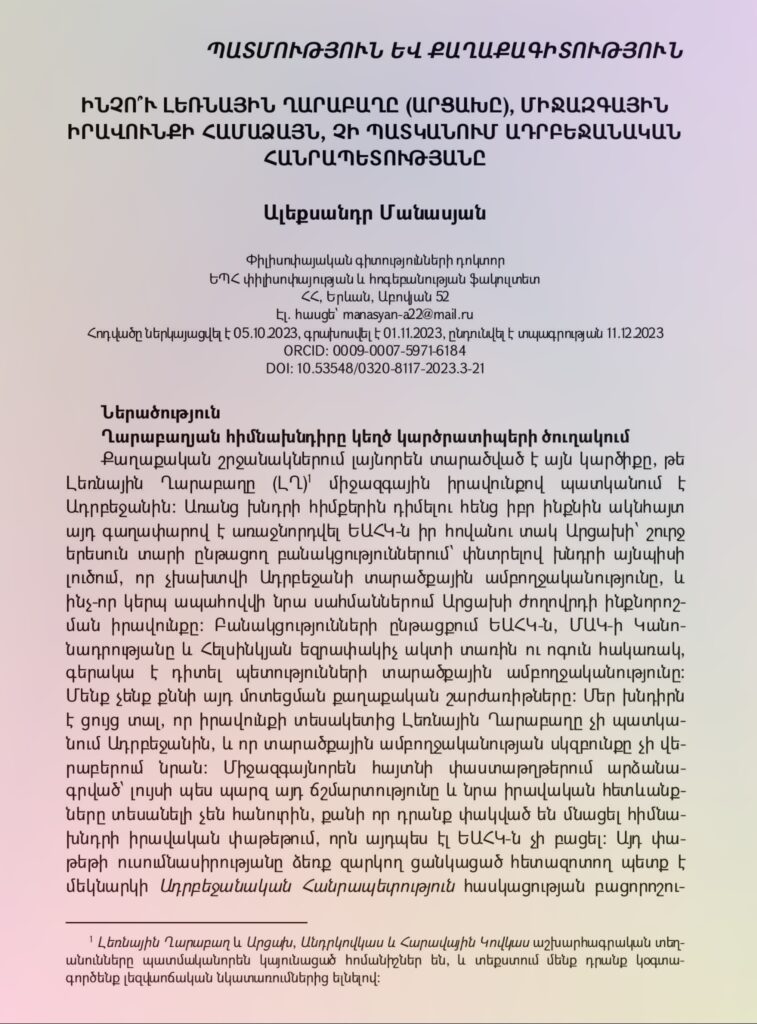
We will not examine the political motives of that approach:
Our task is to show that from the point of view of law Nagorno-Karabakh does not belong to Azerbaijan, and that the principle of territorial integrity does not concern it:
That truth, clear as light, recorded in internationally known documents, and its legal consequences are not visible to all, since they have remained closed in the legal package of the problem, which the OSCE never opened:
Any researcher who undertakes the study of that package must start from the clarification of the concept of Republic of Azerbaijan, since under that «hat» there are three different Azerbaijans, and often it is not clear in the name of which one Baku is speaking»…
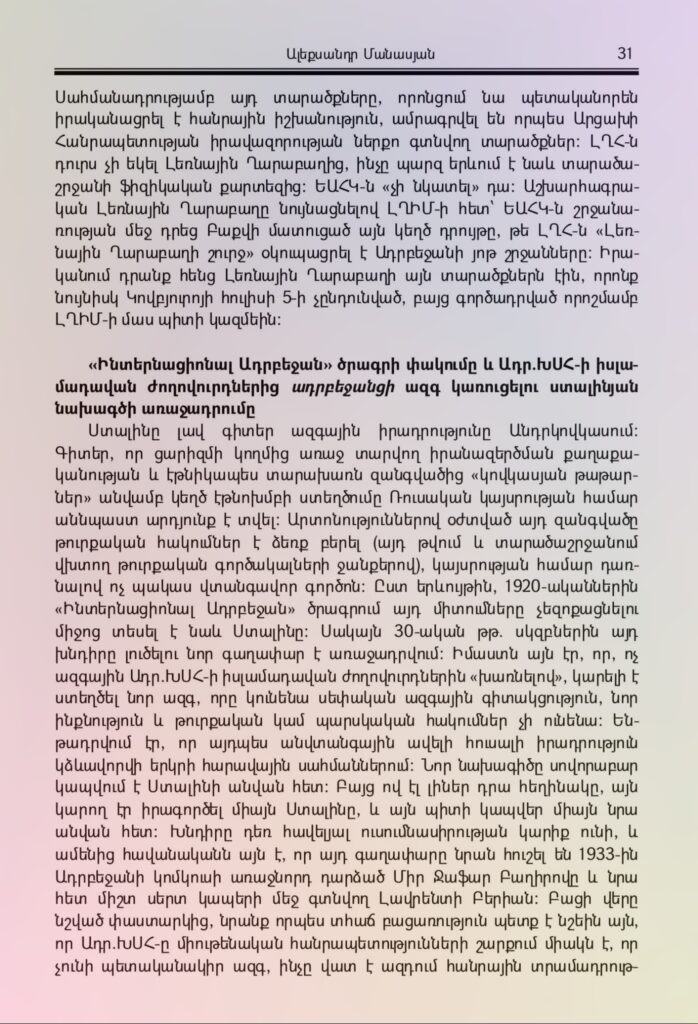
«Conclusions
There is no legal basis whatsoever to assert that Nagorno-Karabakh (Artsakh) in the 20th century was/is part of any of the three states called «Azerbaijani» in Transcaucasia:
The ADR founded by the Turks, having received a refusal of membership in the League of Nations, left history without established or recognized borders — without Artsakh:
Artsakh was also not the sovereign territory of the Az.SSR founded by the 11th Red Army of Soviet Russia, since —
1. the Az.SSR was not a sovereign state,
2. Artsakh found itself within its borders by the not adopted, but executed «decision» of July 5, 1921 of the Caucasian Bureau of the Communist Party of Soviet Russia, when it had already been proclaimed part of Soviet Armenia,
3. Baku acknowledged that the Az.SSR was an illegal formation by the constitutional act of 1991 on the independence of the Az.R, from which also follows the illegality of the Kavburo «decision» to bring Artsakh into the borders of that unlawful formation:
From the point of view of international law Artsakh also does not belong to the present-day Republic of Azerbaijan, which appeared in 1991 in the course of the dissolution of the USSR, which restored the ADR founded by the Turks, which existed in 1918-1920, to which Artsakh did not belong:
On December 10, 1991, by referendum, Artsakh gained independence in territories not belonging to the present-day Az.R:
In 1991 Europe ignored this and, disregarding international law, decided to recognize the ADR together with Artsakh, when it was known that in the XX century not a single «state» that appeared under the name «Azerbaijan», including the Az.R, had come onto the scene by an act of self-determination (by a referendum on independence)»:
«Summary
In the 20th century in Transcaucasia three illegal formations under the name «Azerbaijan» laying claim to Artsakh/Nagorno-Karabakh (NK) appeared:
The first was the Azerbaijan Democratic Republic founded by the Turks (1918-1920), which the League of Nations in 1920 did not recognize as a state, and which left history without de facto established or recognized borders, without Artsakh:
In the same 1918-1920 Artsakh was a de facto independent formation and had legitimate authorities in the person of the Congress of Plenipotentiary Representatives of Nagorno-Karabakh (NK CPR) and of the People’s Government:
On April 28, 1920 the NK CPR declared Nagorno-Karabakh an inalienable part of the Republic of Armenia (RA):
The second illegal formation under the name «Azerbaijan» — the Azerbaijan Soviet Socialist Republic (Az.SSR) was founded by the XI Red Army of Soviet Russia on April 28, 1920 — as a non-national, international republic of a new type having no titular nation:
Within the borders of the latter NK, already proclaimed part of Soviet Armenia, was brought in by the not adopted, but executed decision of the Caucasian Bureau (Kavburo) of the Communist (Bolshevik) Party of Russia:
To give the annexation a legal appearance, a part of NK alienated from Soviet Armenia had within the borders of that non-national republic the status of an autonomous oblast, and after the formation of the USSR — like all autonomies, also of a subject of the national-state system of the USSR:
During the USSR Artsakh periodically demanded by mass petitions to correct the injustice committed against it in 1921: In 1988 this took on the character of a nationwide movement:
The third illegal formation under the name «Azerbaijan» — the Republic of Azerbaijan came onto the scene in the course of the dissolution of the USSR:
By the constitutional act on State independence of October 18, 1991 Baku characterized the sovietization of Azerbaijan as its occupation by Soviet Russia:
On December 10, 1991 the referendum on the independence of the Republic of Artsakh took place in those territories not belonging to the present-day Az.R where Baku had not managed to complete the ethnic cleansing:
Europe «did not notice» the NK Republic, which had proclaimed independence in a manner irreproachable from the point of view of international law:
In December 1991, when the process of the dissolution of the USSR had approached its final line, the European Community decided to recognize the Republic of Azerbaijan with unknown status and borders, where until then there had been no act of self-determination and no referendum on independence:
In the thirty years of negotiations on the settlement of the Az.R – NKR conflict under its auspices, contrary to irrefutable legal facts, Europe «did not see» that the NK Republic had been established in territories not belonging to the Az.R., in its structures, and giving the genocidal Azerbaijan a passport for admission to the UN:
As a result of the aggression unleashed against the Republic of Artsakh in 2020-2023, Artsakh today is a territory occupied by the Az.R»: