Year: 2025

  • «AND THE SUN RISES WITH THE MAJESTY OF A HIGH PRIEST»…

    «AND THE SUN RISES WITH THE MAJESTY OF A HIGH PRIEST»…

    «AND THE SUN RISES
    WITH THE MAJESTY OF A HIGH PRIEST»…

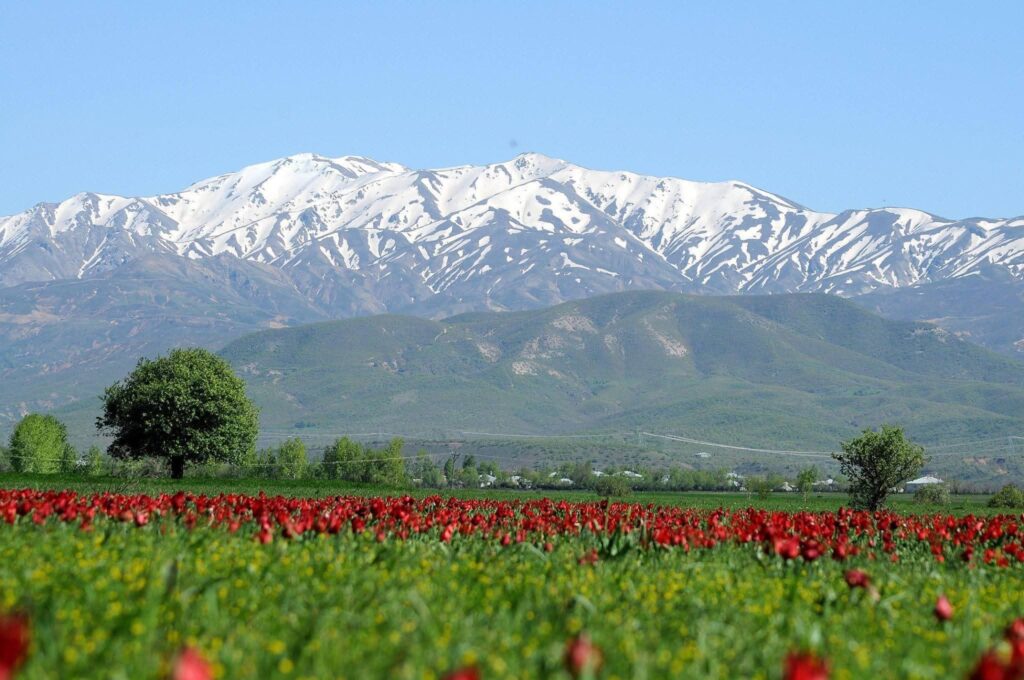
    Hayk — with its provinces usually separated from one another by natural boundaries — by mountains and river basins, the entire Armenian Highland with its geographical position and its historical course have conditioned the character of the Armenian nation. The culture of the Armenians, shaped by the national worldview, has often been influenced by political events, by customs imported from abroad…
    «The spiritual life of the Armenian people has undergone great ruptures and has been subjected to such unexpected turns that at times it was simply interrupted — entirely losing its connection with what came before.
    Alarming political upheavals so shattered the chain of historical succession that at times the next generation fell into such ignorance and such a helpless state with regard to the not-distant past as we — today. The fragmented condition of the country and the frequent interruptions of the normal course of life hindered the elaboration and preservation of unified traditions.

    As soon as the political storms calmed down, the acute periods of misfortune were left behind, and life entered its usual course, interest in the past awakened, the study of the monuments saved from the alarming times began — with the aim of understanding the connection with ancient times, of linking the present with the past in some way». (Nikoghayos Adonts).
    At the end of the 19th century and the beginning of the 20th century, the heroes fighting weapon in hand in the liberation struggles waged by the Armenians were also encouraged by our intellectuals, pen in hand.
    «The poet’s dreams and longings collided with leaden reality, were steeped in the sea of blood of the Armenian massacres, shattered or took on the crimson of blood. He tried «to weave a future, to create a world», whereas he could not present the painful truth, for prison and exile were ready. And often the poet turned to myth, to vision, to ballad, to fairy tale, to allegory and to dream, and with the boundless possibilities and genre particularities they offered he was able to create images of epic and popular heroes, as well as to glorify the eternal values of the survival of the Homeland.
    At times, too, the spirits of freedom and the valiant men of pagan-chivalrous times were invoked — to inspire the heroes of the new times, to lead them to struggle and to build the desired world.
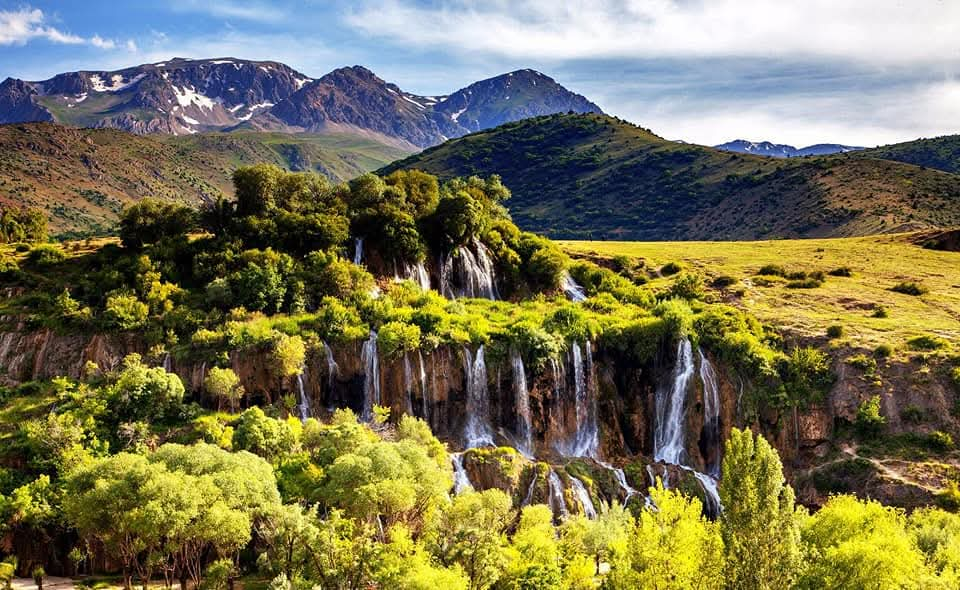

    We read one of Isahakyan’s notes from the spring of 1896:
    «O ancient world, mysterious world, dark and bright world, wonderful and marvellous world… «people» of the deep and inscrutable world. You were not weak, cowardly, lustful, tender like us, you were brave, strong, terrible, giants, the earth trembled under your feet, and the sky shone above your heads like a crown…
    Awake from your graves, let your strength spread over us, let your mysteriousness and your aspirations, your fire and your flame possess us, warm us…
    O ancient world, lavish, gigantic, tremendous world»…(Av. Isahakyan, Memorial Book, Yerevan, 1977, p. 231).
    These pagan outbursts, the glorifications and invocations of manly strength and power, of free life and delight, were the daring ventures of the innovative poet, whose powerful echoes were heard later in Western Armenian poetry and became a dominant art — the «Pagan current».
    Moreover, Isahakyan was one of those exceptional ones who invoked the Strength, the Might, the Valour, the Fire and the Flame of the mighty spirits of primeval times — in order to criticize the philistine, feeble and cowardly milieu of his days, to arm and to encourage the heroes of the new day.
    He did not idealize the Ancient gods (the Dits, K.A.) and did not make them literary heroes, as other poets did.
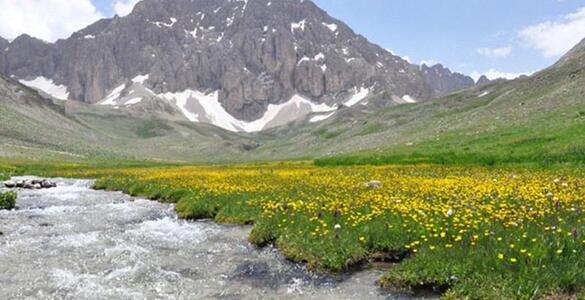
    He discovered the genealogical miracle of divine and mythical epic heroes in Azatn Massis — in the inner eruption of his Homeland, in the unprecedented exploits of the popular heroes of those days and in the immortal creation of our great epic» (quoted from A. Kh. Khachatryan’s article «Avetik Isahakyan’s epic poem «Massa Manuk»»).
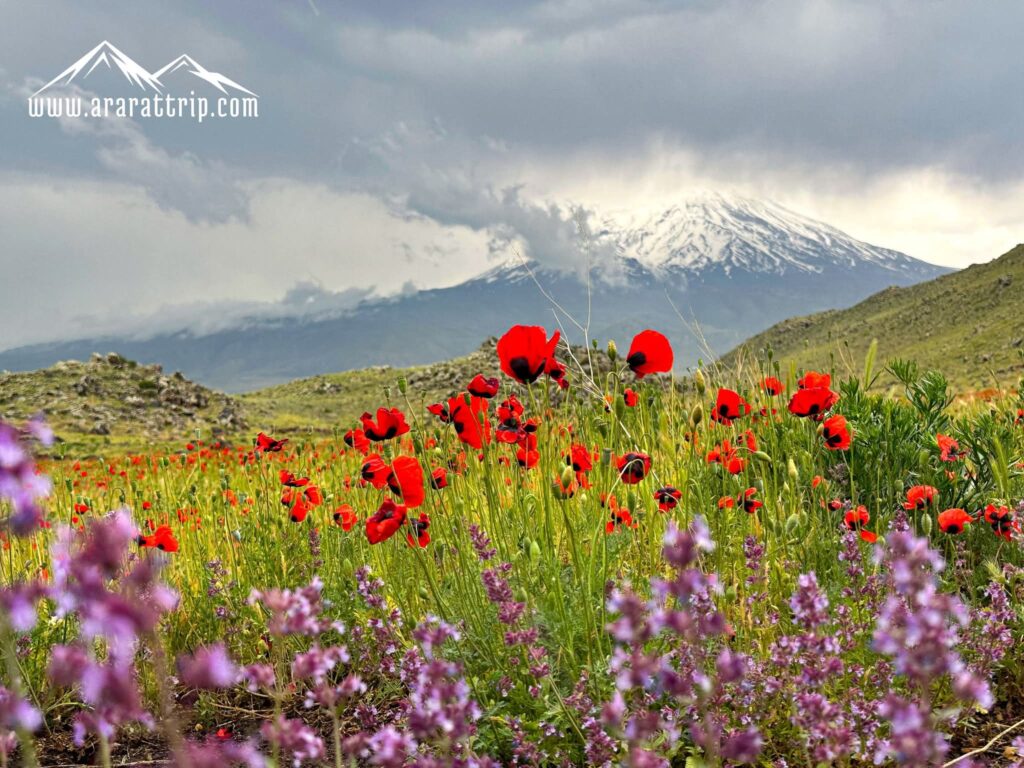
    To the armed Armenian braves fighting against violence — to the heroes «turned into holy lions» he wishes «Sun» — health and a bright life — in the spirit of the Haykazunis, who for millennia have glorified the Sun and the Light:

    «Let us wish the Sun to the great braves –
    To Andranik and to Vardan,
    To Serob, that limpid spring …
    To those thousand – thousand valiant lads,
    Who have no number and no count,
    those who, like the stars,
    Glitter and have no name,
    To the brave and fearless lads,
    To those braves, the eye of the night,
    Who know the language of the road.
    To all, all the fedayis,
    Who give light and have no count,
    May they live long, a green sun,
    May they remain bright» …

    Like the Armenian Ancestors — «the Light glorified with the birth of the Dits» — the Sun, the light of day — the Eye of the «Unapproachable light» with its radiant beams, with the brilliance spread at dawn by its shining rays, continues to be praised to this day…

    Light, joyful light…
    And not the light of evening,
    At the setting of the sun,
    But the joyful light of righteous being —
    Of the dew-footed morning…

    …Kneeling Nature rises to its feet.
    The night office is ending.
    And the Dawn approaches slowly,
    Like a watchful Sacristan —
    Extinguishing and putting out
    Every kind of lantern and lamp.
    And the sun rises
    With the majesty of a high priest.

    And the lazily sprawled, fleshy shadows
    Begin, as it were, to digest themselves —

    They lose flesh, grow thin,

    Gradually becoming taut

    And slender —

    Like a dark-skinned dancer.

    The Dawn goes on blowing its crimson horn,
    From all of whose narrow holes widely sprays
    The Righteous Sun itself,
    And there sounds that melody, simple and complex,
    Which sounded with the birth of the gods:

    «Light, joyful light»…

    Light, joyful light,
    Joyful and surpassing light,
    Singing and playing light.
    You daily apostle,

    Who bring only faith,

    But frustrate and drive away

    Even veiled-disguised hopes.

    You messenger, but also a pander,

    You — a scout, but also an informer,

    But above all — always love

    And after all — always love…

    Light, joyful light,

    Like the rain

    Pour down so,

    That in the world

    Only one-single shadow may remain,

    And that only in the sky —

    Only the curved shadow of the rain —

    The rainbow…

    Light, joyful light,
    Act so,
    That with your painter’s fingers
    Even the hawks, colour-adorned,
    May become, as it were, roosters
    And sing again with a peculiar cock-a-doodle-doo
    That melody, simple and complex,
    Which sounded with the birth of the gods
    «Light, joyful light»…

    Light, joyful light,
    Spray,
    Sift down,
    Bury yourself so and so deep,
    That we may not live — like the fish
    In its ever-dark, windowless state,
    That under your skilful, all-penetrating rays
    Even secretive water may become sincere-clear,
    And from your noiseless strokes and your warmth
    Every unbaked dream may crack at once,
    And may be sung again even with that very crack
    That melody, simple and complex,
    Which sounded with the birth of the gods:
    «Light, joyful light»…

    PARUYR SEVAK, 1967
  • «AND WHO HAS WOVEN THIS SUBLIME TALE»…

    «AND WHO HAS WOVEN THIS SUBLIME TALE»…

    «AND WHO HAS WOVEN THIS SUBLIME TALE»…

    With a gaze turned toward cosmic boundlessness — Man has always dreamed of uncovering the inaccessible secrets of the infinite realms, the mysteries of Nature operating by harmonious laws.

    «… Listening to the talk of the breeze — Abu Mahari spoke without a sound:
    -The world too seems to be a tale — without beginning, without end, an enchanting miracle.

    And who has woven this sublime tale, woven it with stars, with myriad miracles,
    And who tells it in myriad-myriad forms — unceasing and untiring — with such enchantment?

    Nations have come, nations have gone, and they have not grasped its meaning;
    The poets have understood a mere trifle and they stammer its immortal sounds.

    No one has heard its beginning, and no one will hear its end,
    Every sound lives for centuries, every sound has no end, no beginning.

    But for every newborn this splendid tale is told anew,
    It begins anew and ends — together with the life of every man»…

    The reflections of one of the heroes created by Avetik Isahakyan sum up the questions that have interested the sages of the world for millennia.

    In recent times, continuing the inquiries begun as early as antiquity, scientists study the «accessible part» of the boundless expanses and, widening the limits of what is accessible to man’s limited mind, they «excavate» some answers…

    From the stars born of nebulae to the elementary particles of matter — the same regularities operate.


    Life was born, developed and has been preserved in this environment regulated by wise interrelations.

    And everything testifies that the structure of the Universe is not only aesthetic, but also ordered with mathematical precision.

    The study of the Universe shows that it is not only a gigantic material and energetic system, but also — a highly ordered and harmonious whole, where the regularities at work are bound together by a universal unity.

    Science — observing the physical laws that lie at the foundation of the Universe, confirms that harmony and balance are not random phenomena, but are the irrevocable foundations of Creation or of nature.


    By the disposition of the Creative force, thanks to harmonious interaction, a single whole operating by ordered regularities has been formed on earth and in the entire Universe. It changes constantly, yet in this whole boundless system everything operates by the laws of balance, by the same inviolable principles.

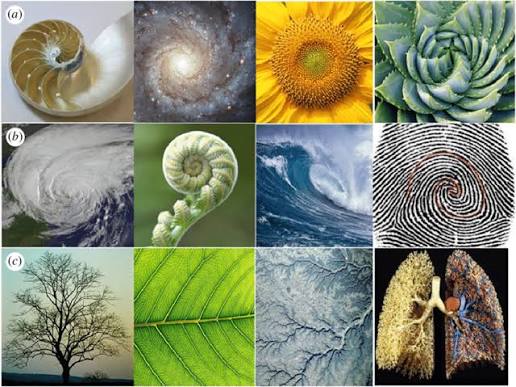
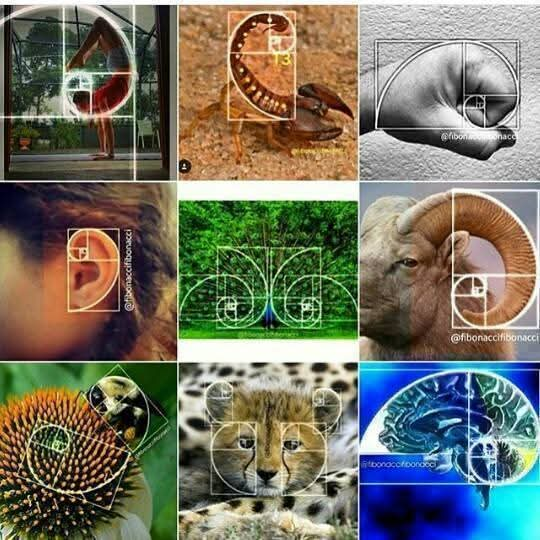
    The phenomena of general self-regulation are present in every particle of the Universe – in the enormous stars, in the tiniest cells of nature, from the seeds of plants, the arrangement of petals or the structure of the beehive to the constellations rushing through cosmic boundlessness…

    The laws of gravity, of the conservation of vital force (energy), the structures built on precise geometric proportions — the traces of «sacred geometry» are everywhere.

    The Haykazun Arevordis glorify the Creative force — the wise order established by the Architect of the Universe, praising Life, the Cosmic breath that ensures its continuance, and they sing odes to the Glorious Areg-Mihr, who bestows well-being and abundance upon mankind, who spreads light and justice…

  • «AS MUCH AS I CAN, THAT I DO»…

    «AS MUCH AS I CAN, THAT I DO»…

    «AS MUCH AS I CAN, THAT I DO»…

    Since the most ancient times the Haykazuns, with their wise thought, their reflective word and counsel, have guided the generations, have given lessons of life experience to inexperienced youths and young people — often using profound fables and allegorical stories.
    Folk fables have been told from age to age.
    «To represent the truth in images» — to reflect reality artistically through profound stories — in the language of fables — through fable-telling. The fabulists — like the sages of the ancient world, continued «the Words of wisdom» — with their brief but edifying speech they educated the small and the great, exhorted them to be circumspect, to face trials by their own labour, relying on their own strength, by personal efforts, without expecting outside help.


    In the 11th century Grigor Magistros, in the stories he recorded, presents fables told orally — «transmitted by mouth», sometimes indicating as their source — «we found it transmitted», «it is told» or — «they say among the common folk» — meaning the vernacular, the popular, the gusan tradition. In the same way — «they say among the common folk», he presented the lines of the famous Navasardian praise:
    «O who would give me the smoke of the chimney and the morning of Navasard,
    The running of the stags and the bounding of the deer:
    We blew the horn and beat the drum,
    As is the custom of kings»…

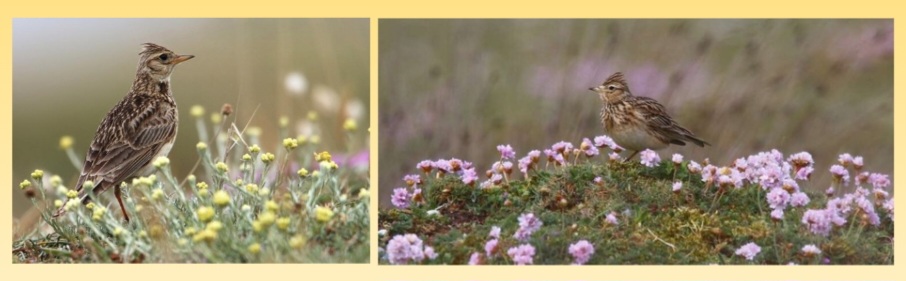
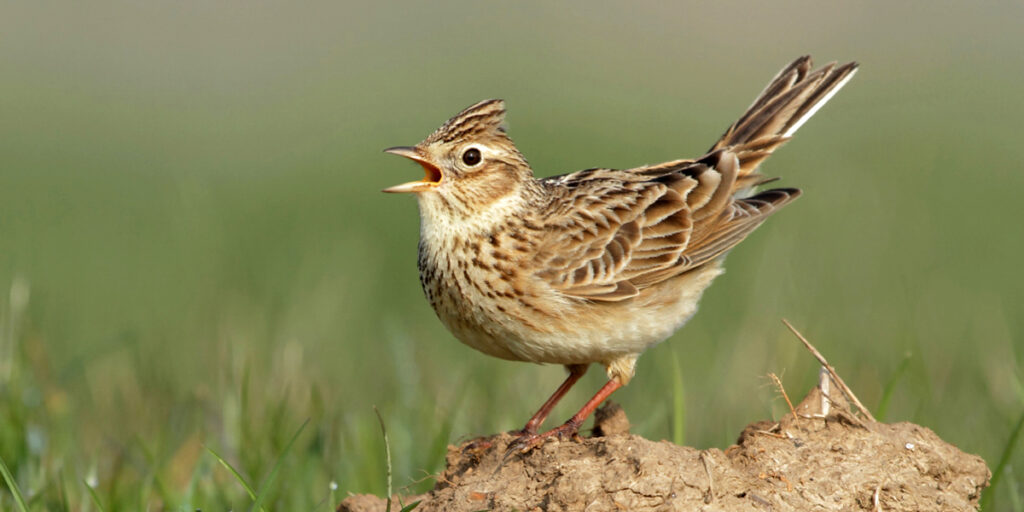
    Among such fables coming from antiquity is the story he mentions about «the lark that holds up the falling sky with the strength of its legs stretched upward».

    Hearing the news of the collapse of the sky, the lark lies on its back, sticks its legs up and strives to hold up the sky. Those who see it laugh at it and say:
    -Hey, sparrow, how can you hold up the sky with your straw knees (with your thin little legs) (in Grabar — «With what straw knees will you rise up, little bird, with your sea of wits?»).
    -I am holding up my own share of the sky — as far as I am able (in Grabar — «As much as I can, that I do»),- answers the lark.

    The fable shows — that if each one «holds up his own share of the sky», it will not collapse and destroy everyone (the effort each one contributes to the common cause according to his ability brings a useful result).

    The Armenian Ancestors also often recalled another story with the allegory of the lark.
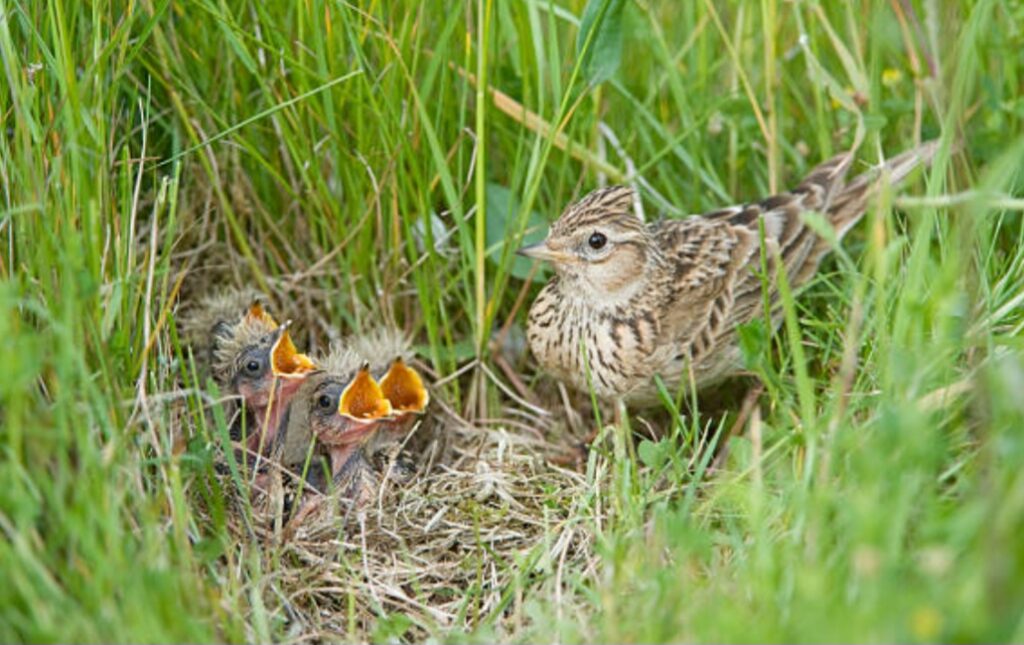
    From Aesop to La Fontaine, Khachatur Abovyan and Khrimyan Hayrik — there has resounded the fable of the lark that foresees the coming of the owner of the field in order to move its chicks out of the field of ripe ears at the right time — stressing the idea of relying on one’s own strength.

    «The lark bird, which has perhaps taken this fitting name from eating the field, having placed its nest in a field of ripe ears, hatched chicks. The far-sighted mother always instructed her chicks to listen to the owner of the field — to what he says, when he comes with his son to see whether the time to reap the field has come. The first time the chicks listen and tell their mother that the father says to his son: «My son, the field is close to ripening, go, speak, let our neighbours come to help us, let us reap the field together».

    The lark answers: «Stay carefree for now, since the owner of the field is waiting for the help of the neighbours, this field will not be reaped». Hearing the second time, the chicks tell her this — that the villager was saying to his son: «The neighbours did not come, at least invite the relatives».

    The clever lark again repeats the same: «Be calm, my chicks, if the work is left to the relatives, the field will never be reaped».

    The third time the chicks tell that the owner of the field, crying alas-alas, was saying to his son: «My son, you and I will take our sickles, and we ourselves will reap our field: it is useless any longer to wait for the neighbours, the relatives».
    The attentive chicks, when they tell this last word to their mother, she answers: «Now I truly believe that the field will be reaped, I must move you» (Khrimyan Hayrik).

    The said fable — by the pen and with the counsel of Khachatur Abovyan:
    «Trust your friend’s word,
    Yet stand firm in your own affair»…

    THE LARK WITH ITS CHICKS AND THE FARMER

    There is a saying of old.— Your friend’s word
    Trust, yet stand firm in your own affair.
    A very true word it is― blessed be the mouth
    That said it: so let us hear the fable.
    When spring opened, the days grew sweet,
    Mountain and gorge blossomed, fields and plots
    Put on their adornments, dressed themselves up.
    Flower, scent and breeze took every place.
    All joyfully called voice to voice,
    The bear in its den, the fish beneath the sea,
    The birds in the meadows, on the mountain tops
    Rejoiced in their sun.
    I know not — was it willingly, or just by force:
    A lark bird, minding its pleasure,
    Was flying, going, roaming prettily,
    No longer thinking that spring had come.
    A little more remained, it had to pass.
    At last its nature drew it too,
    Its heart wished to become a mother of children,
    To have chicks behind it and roam about.
    What need has a bird of great preparations,
    It wants neither a house nor great pomp.
    It made a nest in the wheat, laid eggs, sat.
    After a few days it hatched chicks.
    The wheat ripened, the time of reaping came,
    But the chicks’ day had not yet come
    To fly, to go, to find food,
    They looked to their mother to bring grain for them to eat.
    One day, as the mother went away from the nest,
    She gave them counsel, and so flew off.
    «Stay well — she said — my dear children,
    Stay you here, perhaps people
    Will come to reap the wheat,
    Find out — what they speak, what they say.
    And tell me, so I may find another place,
    Now I am going to bring provisions».
    As soon as she went out, the owner of the wheat came,
    Looked at the wheat and said to his son:
    «The wheat has ripened, you too can see.
    The ears hang heavy in our wheat.
    Lose no more time, tomorrow you will go,
    You will let our relatives know,
    That they come to our field to help us».-
    As soon as the poor chicks heard this voice,
    They quivered and twittered in fear.
    Ah — where are you, our mother, in what place — they said:
    Come, hasten, ah — to our cry for help».-
    «What has happened», the mother asked.
    «What should there be, the owner of the field said,
    His son should go to call the relatives,
    So that tomorrow the wheat be reaped, finished».-
    «Did he say nothing else?», the mother asked.-
    For this you need not grieve at all.
    Let the day dawn, then you will know.
    Here is your food, eat, be filled,
    Children, and lie down. You have not eaten bread».-
    As best they could, they pecked,
    Head pressed to head — under their mother’s wing
    They huddled and quickly shut their eyes.
    The day dawned, no relative came,
    The bird again flew off to bring provisions.
    And the poor farmer too came to his field.
    He shook his head, and said to his son:
    «The distant friend, the near kinsman
    How can they be one — beloved son.
    Give the name of God, go tomorrow,
    Tell your father’s brother and our in-laws».-
    A clamour fell among our chicks:
    Again they called their mother — that right
    At that hour she should come back, find them a remedy.
    «Ah — our dear mother — come, ah — come.
    The son went to bring the kinsmen».
    «Do not make a sound», the mother answered.
    «And do not be afraid at all, not at all.
    Remember God and stay here;
    Let the day dawn, then you shall see,
    The kinsman too will have his own trouble.
    The cowardly man has many pretexts.
    The third time the owner came to his field.
    «Oh, what tricks they play on us», he said.
    Very well — let this be a lesson to us,
    That we no longer put hope in another’s word.
    And let us imprint it well in our heart.
    That a man’s brother, his friend, is himself,
    Go, dear one — tell your mother and your sister,
    To take the sickle, to come to the field tomorrow,
    «Woe to those — who live on the hope of others».-
    When the lark heard, it called its chicks.
    «Now the time has come for us to go», it said.
    The chicks too at once gathered by her head,
    For the first time they spread their wings
    And behind their mother, as best they could,
    Came out of the field, rose little by little
    And fluttering, and chirping
    And twittering, and chattering
    Cheeping, cooing
    Went over the field, passed on,
    Reached beneath the cloud, vanished from sight.

  • «THIS FABLE SHOWS THAT»…

    «THIS FABLE SHOWS THAT»…

    «THIS FABLE SHOWS THAT»…

    Among the most ancient means of teaching and upbringing are precepts and fables. Through exhortation and fable-telling — with examples of brief stories presented allegorically, they admonished and educated children as well as adults.
    The educational role of the fable has been valued in all ages, in many countries, and various versions of many fables have «travelled», reaching distant places. Fables with similar content are found in the folklore of many peoples.

    As early as the end of the 19th century Nikolai Marr carried out a meticulous, comprehensive study of the collections of Armenian fables, of individual tales, of the original texts, and proved that many fables were translated from Armenian manuscripts and adopted by other peoples, gaining international recognition.

    «N. Marr proves in a strictly scientific way that the Arabic «Book of the Fox» is translated from the Armenian collection of the same name and brings many facts confirming this conclusion. He notes that in the Armenian «Book of the Fox», alongside classical Grabar, there are passages written in the vernacular, which, compared with the uniformity of the Arabic, present a very motley language and cannot be the result of a translation. Besides this, over many pages and with rich linguistic examples he points out the traces of Armenian words in the Arabic translation. Thus, for example, the translator, sometimes not understanding an Armenian word correctly, replaces that word with an entirely different word.»,- writes A. Dolukhanyan («Armenian medieval fables in the research of N. Marr»).

    «Assimilating and developing the fundamental tenets of his renowned teacher, academician Hovsep Orbeli expressed himself more definitely:
    «Many of those fables,- he wrote,- entered Georgia in translation, merging with Georgian folklore. Many others entered the Arab milieu in Arabic translation — thereby paving the way toward the distant West» (quoted from the article «The Theory of Fables in Medieval Armenia» by Doctor of Philological Sciences P. H. Hakobyan).

    «Yes, wise people found that device solely in fables.
    What was to be made known and warned of by fables — from the king down to the lowest commoner, it was impossible to make known and to admonish otherwise»,- we read in the preface of «The Select Fables of Mkhitar Gosh, Olympianos and Aesop», published in 1878.
    The abstruse, hidden meaning of fables captivates everyone to this day.
    «This fable shows that»…
    Fables are accompanied by a clearly formulated moral.
    Here is a fable by Aesop.

    THE FROG — A DOCTOR

    «He who is unlearned cannot be a teacher and counsellor for others.

    The frog, dweller of the swamp, came out onto dry land and announced in the hearing of all the animals: «I am a doctor and I know all the remedies better than even Paeon, the physician of the gods».
    But the fox objected: «Now how are you going to cure others, when you yourself are yellowed and earth-coloured like a sick man, and unable to cure yourself»…

    «The undertakings of ignorant and conceited persons incapable of seeing their own shortcomings must end in failure and ridicule, should such persons become counsellors to those more experienced and wiser than themselves» (quoted from the cited article of P. Hakobyan)…

  • «A PEOPLE WITHOUT CULTURE IS NOTHING»… (Avetis Aharonyan)

    «A PEOPLE WITHOUT CULTURE IS NOTHING»… (Avetis Aharonyan)

    «A PEOPLE WITHOUT CULTURE IS NOTHING»… (Avetis Aharonyan)

    «Aharonian gave his whole life to the nation and the homeland to which he belonged, for half a century he sang the suffering of the Armenian people, he suffered and was tormented together with his people, he sacrificed his pen and his mind to the cause of its liberation, and he received this last heavy blow on the road of duty, for the love of Armenian culture.
    Aharonian, after Raffi, is the greatest Armenian writer who has known how to deserve the worship of generations and to sow the spark of patriotism in their souls in an undying way. Under his pen of genius the Masises and Aragats, which have become an object of worship for all Armenians, are so marvellously depicted». (Aspet Manjikian)

    Below we present some excerpts from the last speech of Avetis Aharonyan, delivered in Marseille in February 1934 — taken from the journal «Varag» published in Boston (1965, April, Special issue 49).

    «This last speech, which he delivered with self-forgetful rapture from the stage in Marseille, about the suffering and the hopes of the Armenians, is the «swan song» of Avetis Aharonian.
    A crowd of thousands of exiled Armenians was listening to him spellbound, when suddenly the strings of his heart broke and he fell senseless, as if thunderstruck…
    «People of Armenia, dear compatriots…
    You have moved me deeply. I thank you for all the expressions of your respect»…
    «…We are living through days, unprecedented days, evil-tormented and uncertain, when every Armenian individual has stored up hatred and passion in the depth of his soul. To speak to all of you there is one subject, and that is Armenian culture, about which I decided to speak to you.
    That subject is common to all – it admits no dispute, no passion, no strain.
    It is a beauty from of old, remaining from the centuries, a racial beauty and a racial truth. In its name, like all the other nations, we too must feel ourselves united, must face all kinds of events, because our people without culture is nothing and is condemned to death.
    Armenian culture, endowed with racial beauty and with a distinctive stamp, which we must perpetuate.
    Do you observe the world, the nations — new-born or old, all have pressed close to one another, each one is setting its house and place in order, is seeking support.
    You, Armenian people, instead of thinking of your hearth, of your roof, are seeking passion, are sowing hatred.
    The Armenian people has a proverb – «God saw the mountain — and laid the snow on it».
    That proverb is true for the whole world — except for us. It is not for us.


    The snow on our mountains was heavier than the capacity of our mountains. The snow of our country was too heavy, the pain of our people was heavy, it broke our back and we fell from country – to country. It is time we reflect, understand one another.
    Against all this seek peace, people of Armenia, inner peace: you need it as much as your land and your water.

    After this little preface I shall pass on to my main subject.
    What is culture for the diaspora and what is culture for the homeland?
    Culture is something boundless — bound to the sun, the soil, the water, the race of a country and to mankind.
    Without soil there is no culture.

    Colonial culture is the tail-water of an irrigation channel. Whoever is a villager like me knows well what tail-water is. The villager, after watering his field, cuts off the water, so that another’s field may be watered too. Is it not done by turns? The cut-off water, however, still flows toward the field, and one who sees it may think the water has not yet been cut off. But in reality the remaining water — that tail-water, has no force, has no current behind it.
    And so is culture for the Armenian colonies: it is tail-water.
    Culture is born from the soil, it is the soil that gives it form, nature and stamp.
    Culture gives a people language, beauty, truth. In the course of centuries our people bore and brought into the world inaccessible beauties, sacred and titanic values. With its songs of joy and sorrow it brought our culture out of terrifying and unspeakable storms and carried it all the way here. But we, scattered and dispersed, in which country shall we deposit that treasure — Armenian culture? In the Balkans, or in Syria or America?
    No, only and only in the homeland .


    Our national culture is deeply bound up with the Sun, which with its rays has entered the depth of our people’s soul. The Sun is infused into our soul and into our language.
    One of the young poets of Armenia, in a sudden flash, said a marvellous thing: «I love the sun-flavoured word of my sweet Armenia»…

    The wisdom, the depth and the capacity of the centuries are enclosed in that word.
    Sun-flavoured…
    Tell me please, is there in the languages of other nations a word that is the exact translation of that word?
    No. The word «arevaham» has no meaning in another language, but in Armenian it does.

    In our culture the Sun is different.
    Our words are sun-flavoured in the mouth of our people, the Sun even has a smell. When the Armenian housewife spreads out clothes to dry, she says — «It smells of the Sun».

    And our nature?…
    Giant mountains, dark gorges, incomparable plains, limpid and clear waters.
    From the spirits of our mountains hope, beauty, terror and amazement pour into the souls of men. The mountain ranges of the Armenian world are in themselves the cradle of poetry.
    And our plains?…
    Ah, Ararat Plain, blessing-bearing and fruitful, on whose boundless expanse earth and horizon become one. A hundred kilometres long and sixty kilometres wide, on which you cannot find even a piece of stone.
    Our people say: «Put an egg at one end of the Ararat Plain, and you will see it from the other end».
    The rivers of our world, like lions with bristling manes, are fury, are struggle and the spirit of our culture.
    And our night… what roaring, what writhing of waves and what a storm…
    Our culture is also the measure of our will and impetus, of our strength and effort.
    That is how the character of our race was formed.
    This is our culture… This is how the spirit, the nature of our race was formed»…

  • «ON QUESTIONS AND SOLUTIONS»  (ANANIA SHIRAKATSI)

    «ON QUESTIONS AND SOLUTIONS» (ANANIA SHIRAKATSI)

    «ON QUESTIONS AND SOLUTIONS» (ANANIA SHIRAKATSI)

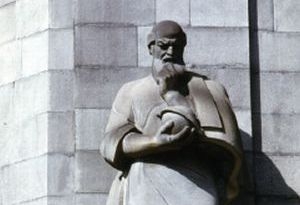
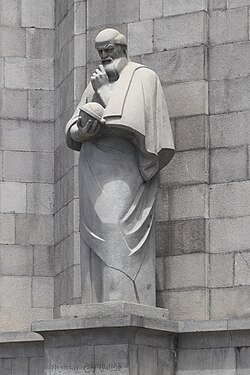
    For millennia the Armenian Ancestors used skilful means to educate studious, sound-minded and «wisdom-loving» — philosophical generations.
    They valued virtuous, just and healthy conduct, urged their children to strengthen their body and to enlighten their mind by persistent work, by special training. Like the writing «On Virtues and Vices», known in the Ancient world, (which is attributed to Aristotle), numerous philosophical works also attest that they offered praise to the beautiful, to nobility, to prudence and to courage, and censured the ugly — the abominable, the vicious…

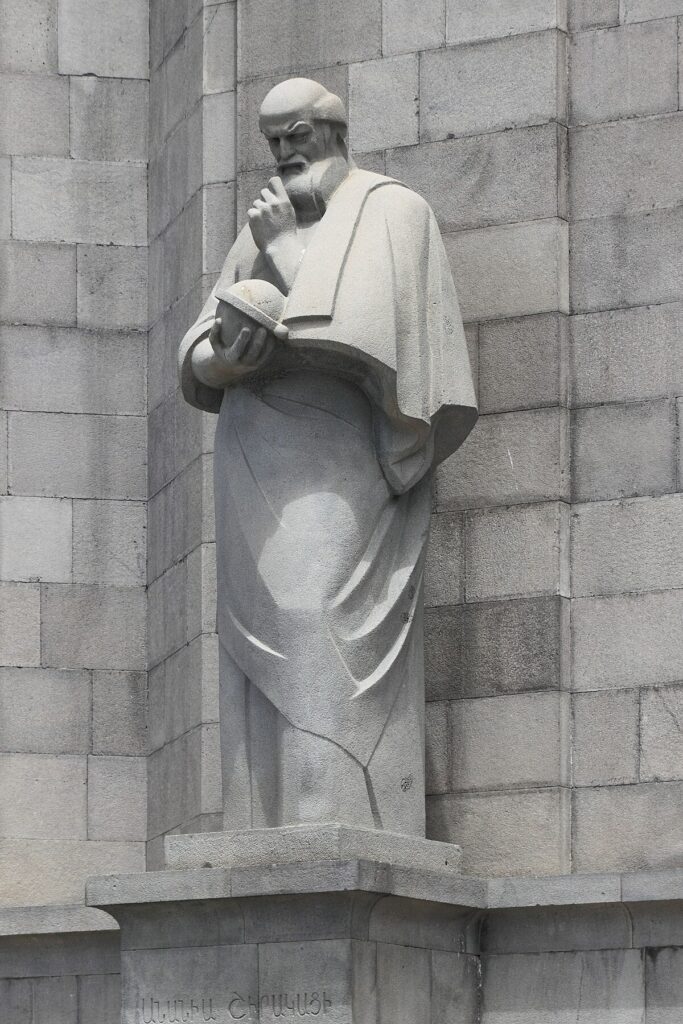
    Continuing the traditions coming from of old — the renowned 7th-century computist («mathematician») Anania Shirakatsi also encouraged his pupils not to fear difficulties, to progress diligently and with unbreakable will.
    As a figure devoted to the homeland and a skilful educator, he encouraged adolescents and young people to overcome every difficulty and obstacle for the sake of knowledge.

    Using recreational problems with amusing content and various «questions» — he guided his pupils through the world of knowledge by excellent means — teaching from the simple to the complex.
    In the small instructive arithmetical manual «On Questions and Solutions» Shirakatsi has left important information about historical episodes of his time — choosing as the material of his problems, for example, the rebellion of Zorak, of which he tells — as «heard from his father».
    «Thus I heard from my father, that during the war waged by the Armenians against the Persians Zorak Kamsarakan performed great feats of valour — attacking the Persian troops three times in the course of one month:
    The first time he slaughtered half of the army.
    Pursuing — with the second attack he slaughtered a fourth part, and at the third — an eleventh.
    The rest — 280 in number, fled to Nakhichevan.
    Now — by the count of those remaining we must find out how large the Persian army was before the slaughter.


    (In Grabar – Problem I .
    Thus I heard from my father, that in the time of the wars of the Armenians with the Persians, great valour was shown by Zorak Kamsarakan; for within the days of a month he attacked the troops of the Persians thrice — and in the first he struck half of the army; and following after he struck in the second the fourth part of the army; and in the third the eleventh. And those remaining fled to Nakhchavan, in number CCLXXX.
    Now we too must find out from those remaining, how many they were before the slaughter).

    The questions also contain information about the life, the comings and goings of the medieval city, as, for example, when it is required to calculate the amount of the duties (toll) levied on a merchant passing through different cities. Thus, from problem XI (the 11th) we learn that after the payment of various «tolls» in three cities, of the initial 2376 dahekans the merchant had, 11 dahekans remain.
    (In Grabar – Problem XI.
    A merchant passed through three cities, and they levied toll in the first and took half and a third of his goods. And in the second city they counted whatever he had and took half and a third; and in the third city again they counted and took half and a third. And when he came home, there remained XI dahekans.
    Now know, how many dahekans he had in all.

    Solution of problem XI.
    The merchant had MMCCCLXXVI dahekans).

    In one of the problems one has to find how many cows, oxen, sheep and goats can be bought for the price of one noble steed (according to the solution of the problem the price of the horse was 616 dahekans).
    (In Grabar – Problem XV.
    I had a noble horse, I sold it and with the IV part of its price I bought cows, and with the VII part goats, and with the X part oxen, and for CCCXVIII dahekans I took sheep.
    Now know, how many dahekans it comes to in all.

    Solution of problem XV.
    The price of the horse had been six hundred and ten and six dahekans).

    The ninth problem –
    During a hunt of the Kamsarakans at Gen they had caught many game animals and brought me a boar as my share of the game. Since it was enormous in appearance, I weighed it and it turned out that its entrails are a fourth part of its whole weight, the head — a tenth part, the legs — a twentieth, the tusks — a ninetieth, and the body — 212 litres.
    Now — find out how many litres the whole boar was.

    (In Grabar — Problem IX.
    There was a hunt of the Kamsarakans at Gen and they had caught much game; and they had a boar brought to me as my share of the game. And because it was huge in appearance, I weighed it and the entrails were found to be the IV part of the whole weight; and the head the X part, the legs — XX, the tusks — XC, the body — CC and XII litres.
    Now know, how many litres in all the boar was).

    Let us wish «skill in the sciences and in craft» — to the present and future quick-witted, clear-minded sons of Armenia…

  • «FESTIVE PROBLEMS» (ANANIA SHIRAKATSI)

    «FESTIVE PROBLEMS» (ANANIA SHIRAKATSI)

    «FESTIVE PROBLEMS» (ANANIA SHIRAKATSI)

    The fragments of the history and culture of the past reach us, in their overwhelming majority, in a damaged form — in pieces, often with writings difficult to read…
    By the deciphering of these barely discernible relics some episodes are restored — thanks to the painstaking work of specialists, and from the slumber of centuries the faded witnesses of times gone by arise. In them ancient Armenian resounds, they tell of the way of life of people, of the level of education, of the worldview, of the manners of the time…

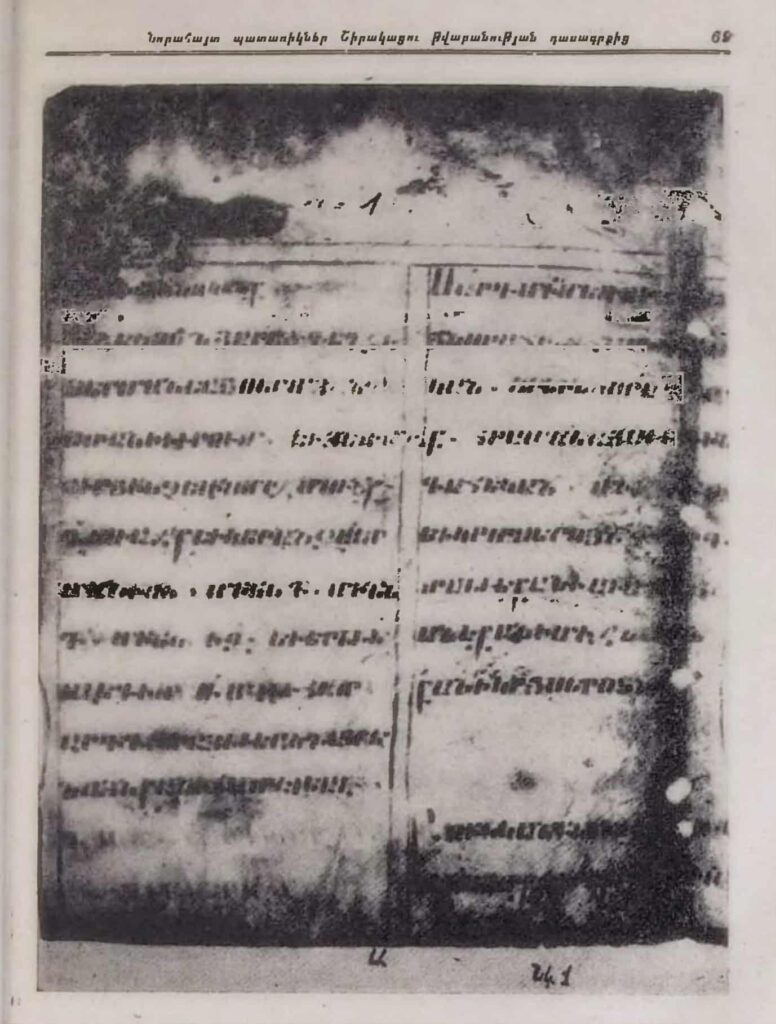
    Studying the folio numbers of three pieces of hard parchment of unequal workmanship, their script — the erkatagir letterforms of the capitals, the lines of writing, the shades of the pigment (the writing material — the ink), the distinguished historian, manuscript scholar and source scholar Artashes Matevosyan concludes that the fragments are parts of one and the same manuscript.


    «The examination shows that they were parts of one and the same manuscript. Later that manuscript was used as a flyleaf — being cut and adapted to the dimensions of the manuscript to be bound.
    For that reason the first fragment lost not only the margins, but also part of the text. Worse is the state of the second and third fragments. Of the flyleaves there remained a thin strip attached to the manuscript.
    The first fragment of the scrap was detached from the manuscript earlier, while the others — recently, from manuscript № 4954 of the Matenadaran (copied in the second half of the XIII century). Hence, the parchment manuscript of which these fragments were parts was already «aged» in that century and was used as a flyleaf.
    Now let us examine the fragments of the scrap one by one, after which it will become possible to make palaeographic, textological and philological
    observations»…
    «…What problems are these, who is their author?
    Anyone familiar with the «Questions», or problems, of Anania Shirakatsi will notice the identity of those and of these problems»…

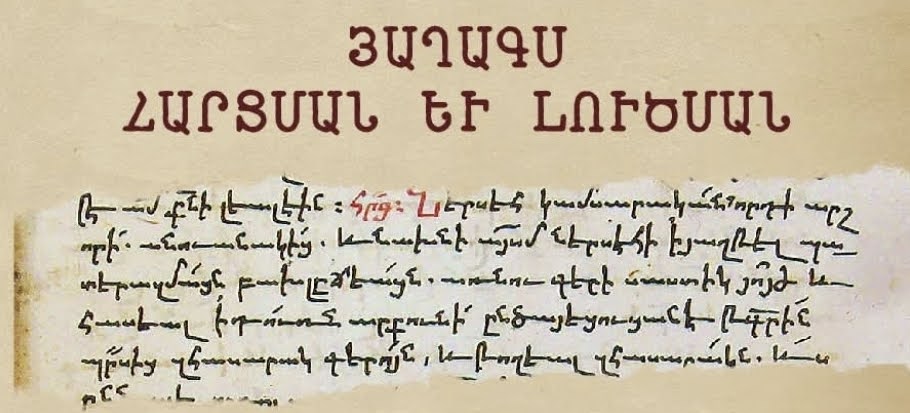
    The two-column text in erkatagir and in scribal hand, of 14 lines — with six holes made for sewing, is from the «Festive Problems», the author concludes (A. S. Matevosyan,
    «Newly found fragments from the arithmetic textbook of Anania Shirakatsi»).

    For the purpose of teaching logic — the development of reasoning, numerical calculation, computation, since the most ancient times the sages of the Ancient world, as well as the Armenian Kurms, elaborated and applied various means of education.

    Thanks to medieval manuscript books some versions have been preserved of short problems intended for testing the knowledge of table-companions and for amusement during feasts and merry gatherings, which are known under the name «Festive Problems».

    «I write for you also festive problems, for when you make merry over food and drink and wish to speak amusing and laughable words» (Anania Shirakatsi, Writings, p. 233, quoted from the above-mentioned study).

    In the part of Shirakatsi’s arithmetic called «On Questions and Solutions» are the 24 arithmetical problems with examples taken from the events and the everyday conditions of the time — with their answers.

    A. G. Abrahamyan in his article «Anania Shirakatsi, an Armenian scholar of the seventh century» writes:
    «For us, as a specialist in the ancient period of the history of the Armenian people, it is pleasant to speak about Armenian authors in general, but among them there is one, one closer to us, whom we love to the point of worship – that is the eminent scholar of the seventh century, the renowned son of Shirak, Anania Shirakatsi. In the course of more than twenty years of study of Shirakatsi’s writings, the more closely we have become acquainted with Shirakatsi’s scientific heritage, the deeper we have gone into the depth of the questions he raised, the more his charm has grown and deepened in our eyes»…

    … «We must also say that in the dark medieval reality, some thoughts and views of our enlightened author did not find wide acceptance in conservative circles, and for that reason Shirakatsi’s writings were not copied and were left without attention.
    As early as the 11th century the famous scholar Grigor Magistros, in his letter to Catholicos Petros Getadardz, complains that the works of Anania Shirakatsi, which the author had collected with great toil, with wanderings and roaming, from diverse books rich in content, have been left without attention and are hidden «under the bushel»».

    «… The «Six-thousander» had long been known in Armenian studies, but remained undeciphered.
    Various legends had been created around the «Six-thousander»: it was considered an astrological book and some mysterious magical meanings were attributed to it. In old times even the opinion had currency that this text, in general, cannot be deciphered: whoever tries to decipher it may go mad.
    For quite a long time we were occupied with the deciphering of that text. We persistently continued our researches on the «Six-thousander», until we finally deciphered it.

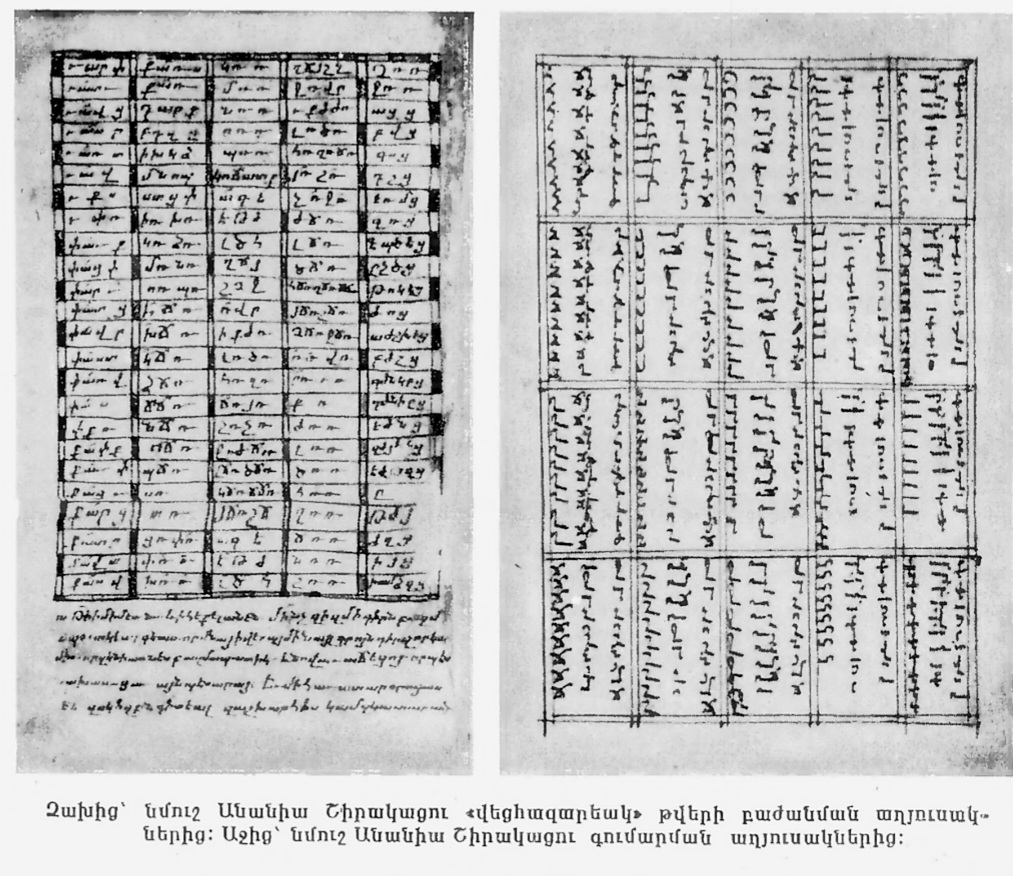
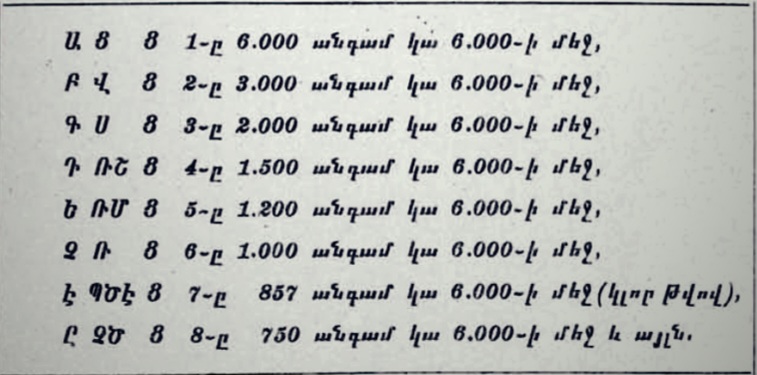
    From the deciphering it became clear that Shirakatsi’s «Six-thousander» is a mathematical text, his arithmetical operation of division.
    It was called «Six-thousander» because it is the number six thousand (6.000) that is divided by all the letter-numbers of the Armenian alphabet — by the old Babylonian sexagesimal system. Let us give a little table:

    The difficulty of the deciphering had arisen from the fact that in the Middle Ages our copyist scribes — not understanding the meaning of that work, had mercilessly distorted it, but now it was not difficult to restore, once the meaning of the text became clear.
    Shirakatsi’s «Six-thousander» was followed by his 24 arithmetical problems, which, as we said, were known in Armenian studies before us and had been published.

    After these arithmetical problems Shirakatsi set out his nine joyful problems, or, as he himself named them — the «Festive Problems».
    We consider it necessary to give here in translation one of those problems of his, so that you may imagine their character:
    «Tell your companion that a Hun (the name of one of the ancient peoples) was my poultry-keeper for 100 years and ate 100 eggs a day.
    Find out how many eggs he ate in all.
    If your companion knows reckoning well, he will at once say — «He ate 365 byur (3.650.000) eggs», and if he is ignorant — then his torment over the numbers will give you joy»…

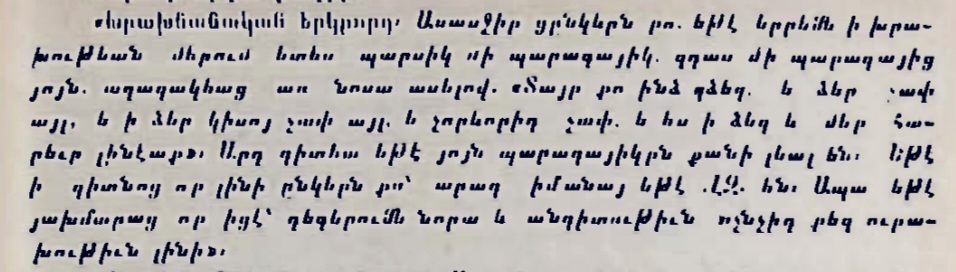
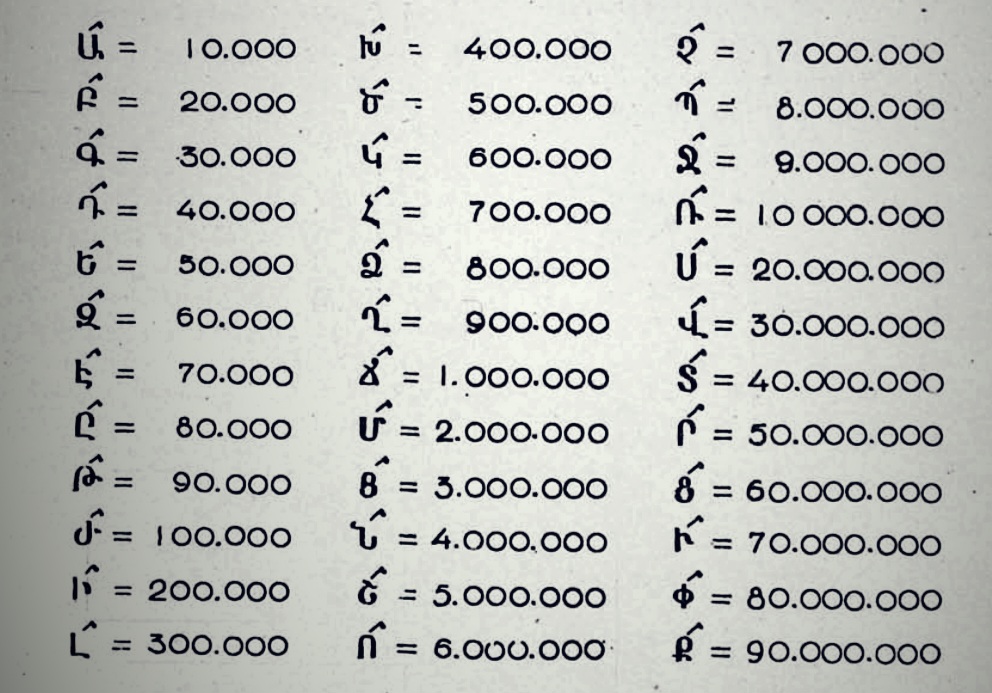
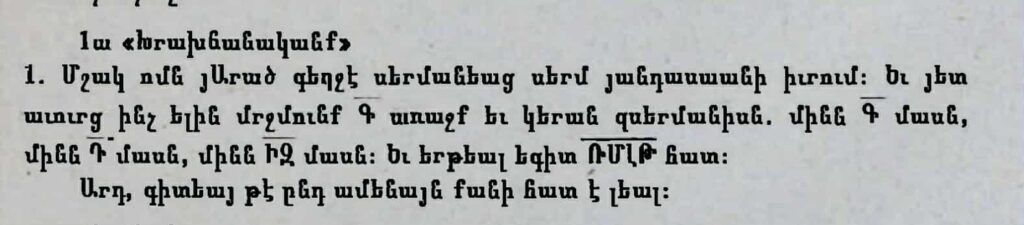
    As a reminder let us add that «byur» is the special word used for ten thousand (10.000), as the «myriad» is among the Greeks, and in the «alphabetical» system of numeration, where instead of numbers the letters of the alphabet were used, large numbers were marked with a special sign placed with the letter, as, for example — ա՛ = 10.000 (one byur), ժ՛ = 100.000 (ten byur)…

    Our grandfathers too had the custom of using such amusing problems to test the abilities of young people.

    It is also interesting to know that the tables for teaching the art of computation — addition, subtraction, multiplication, have an address «from the living voice of the good teacher» to pupils «loving wisdom, longing for knowledge» — «a command to the pupils», introductions, titles, for example, «Preliminary exercise. First chapter of computation, which is called reception», «Advanced exercise. Second chapter of computation, which is called explanation», «although briefly I have arranged a few out of many»…

  • «THE RIGHTEOUS SUN AND THE SKY — LIKE A CHEST»… (PART B)

    «THE RIGHTEOUS SUN AND THE SKY — LIKE A CHEST»… (PART B)

    «THE RIGHTEOUS SUN AND THE SKY — LIKE A CHEST»… (PART B)

    With a glorification resounding from the depths of millennia the Armenian still greets the Sunrise:
    «Morning of light,
    Righteous Sun»…
    And he praises the Light of the Life-giving, all-luminous Sun, which «with its rays illuminates the whole universe»…
    «The Eye of the Sun», «The Fountain of perceptible light», which sends its light to the earth, radiant and beautiful, and with its lightning-ablaze rays «raises up the seeds, the plants, renews life»…

    Meanwhile in the 6th century Cosmas Indicopleustes, in his book «Christian Topography», depicted «the earth constructed with extraordinary particularities» — «enclosed in a chest, surrounded by waters», «the closed cosmic system» — taking as a basis the descriptions of the Old Testament, and mockingly refuted «the pagan conception of the sphericity of the earth» («Book IV. Recapitulation — with biblical illustrations of the Universe and with the refutation of the pagan conception — the notion of a spherical universe»).

    Continuing the previous publication — let us again quote from the article «The natural-philosophical views of Anania Shirakatsi» by Sen Arevshatyan, academician of the NAS RA, Doctor of Philosophical Sciences, professor:

    …«For medieval cosmology the question had become a stumbling block: on what does the Earth rest, how does it hold up its weight? The most widespread view was the one defended by Cosmas Indicopleustes — that the earth, as a quadrangular plane, rests on the waters.
    Shirakatsi comes out against that view. He writes:
    «I do not understand, if the Earth rests on the waters, then how is the immeasurable weight of the Earth held upon such a quantity of watery nature without sinking, and (the water), splitting apart, does not spread out on all sides of the earth, and it does not sink into the waters».

    Shirakatsi calls «frenzied» those «pagan philosophers» (whereas in reality — this is the view of Cosmas Indicopleustes and of the church), who say that «The Sea surrounds the Earth, and the Earth is on the sea like an island, and the water is on the air and is surrounded on (all) sides». This contradicts the principle of weight characteristic of the elements.
    The seas are on the earth, and «outside the Earth there is no other sea».

    Shirakatsi tries to explain by rational causes the state of the Earth located at the centre of the universe — rejecting its placement on the waters. He asserts that the Earth maintains such a position thanks to the rapid rotation of the celestial zones and to two opposing forces — the weight of the Earth and the forces of the winds, which balance each other. The weight of the Earth pulls it downward, and the force of the winds — upward, and thus balanced it maintains its stable position at the centre of the universe.

    Of great interest was Shirakatsi’s explanation of the causes of the eclipses of the Sun and of the Moon. Their eclipses, according to Shirakatsi, occur at the time when, and for the reason that, the Moon, the Sun and the Earth find themselves on one line.
    During a solar eclipse the Moon passes between the Earth and the Sun, and the Moon temporarily covers the disc of the Sun, while the Earth finds itself between the Sun and the Moon, we see the shadow of the Earth on the Moon. By this we are once more convinced that the Earth is spherical, since we see that its shadow is round»…

    …«In contrast to the dominant church doctrine, Shirakatsi holds that the Moon has no light of its own, that it receives its light from the Sun. The Moon is like a mirror placed opposite the Sun and reflects its light»…

    …«In the 7th century, under the conditions of the dominance of the ecclesiastical-theological worldview, Anania Shirakatsi came forward with ideas progressive for his time, established strong ties with the representatives of the natural-scientific thought of the ancient world and laid the foundations of natural-philosophical thought with his works devoted to the fields of cosmology, astronomy and mathematics»…

    The same author — referring to David the Invincible, born in the 70s of the 5th century in the village of Nerdin in the province of Taron, who, thanks to the influence of the traditions of the ancient Armenian perception of the world, developed with his views and his wise thought the secular direction in philosophy, writes: (quoted from the article «David the Invincible and the philosophical thought of Ancient Armenia»).

    «In the development of Armenian philosophical science David the Invincible, that greatest philosopher of the V—VI centuries, played an extremely important and, we can say without reservation, decisive role. He was a bold reformer of science, who with his works opened a broad road for the secular direction of Armenian scientific thought.
    Under the conditions of the dominance of Christian ideology he came forward as the true founder of epistemology, logic, ethics, aesthetics and other philosophical sciences and left a deep mark on the development of the scientific thought of the following centuries.

    The philosophical heritage of David the Invincible, which by its ideological sources is connected with the philosophical schools of the ancient world, is of great interest for the history of world science»…
    … «However, decisive significance for the rise of philosophical thought belonged to the literary-scientific activity of the so-called Hellenizing school, which laid the foundations of the secular direction in ancient Armenian science and literature.
    The intense translating activity of the Armenian Hellenophiles, who had received their education in the greatest scientific centres of the time — Alexandria, Athens and Constantinople, was of essential significance for the future of Armenian philosophical thought.
    As a result of their activity Christian apologetics was pushed back from the front line of ideological life.


    The translations of the works of Aristotle, Plato, Philo of Alexandria, Porphyry and the Anonymous commentator, made by the Hellenizing school during the V—VI centuries, gave the ancient Armenian intellectuals new ideas and theories, which corresponded to the needs of the development of the secular culture of Armenia.
    And it is by no means accidental that the most eminent representative of Armenian philosophical thought, David the Invincible, was born precisely from that milieu, from the ranks of the Armenian Neoplatonic Hellenophiles, who played a great role in the history of the spiritual culture of their native people».

    «The circumstance must be particularly emphasized that thanks to David the Invincible that variety of Neoplatonism spread in Armenia which
    it is customary to call «the Alexandrian direction of Neoplatonism» — as distinct from the Athenian and Syrian schools. That direction preserved and transmitted to the following generations, especially to the philosophers of the early Middle Ages, the progressive scientific tendencies of the ancient world.

    It is true that for the Alexandrian school, as for the other currents of Neoplatonism
    as well, a syncretic combination of the teachings of Plato, Aristotle, Pythagoras and Stoicism — on an idealist basis — is characteristic. However, unlike the Athenian and Syrian schools, the Alexandrian Neoplatonists devoted great attention to natural science and. mathematics, and in the multicoloured bouquet of Neoplatonism they emphasized, more than the other Neo-platonists, Aristotle’s logical teaching and his epistemology, in which the materialist, scientific tendencies were expressed most clearly»…

  • «THE RIGHTEOUS SUN AND THE SKY — LIKE A CHEST»… (PART A)

    «THE RIGHTEOUS SUN AND THE SKY — LIKE A CHEST»… (PART A)

    «THE RIGHTEOUS SUN AND THE SKY — LIKE A CHEST»… (PART A)

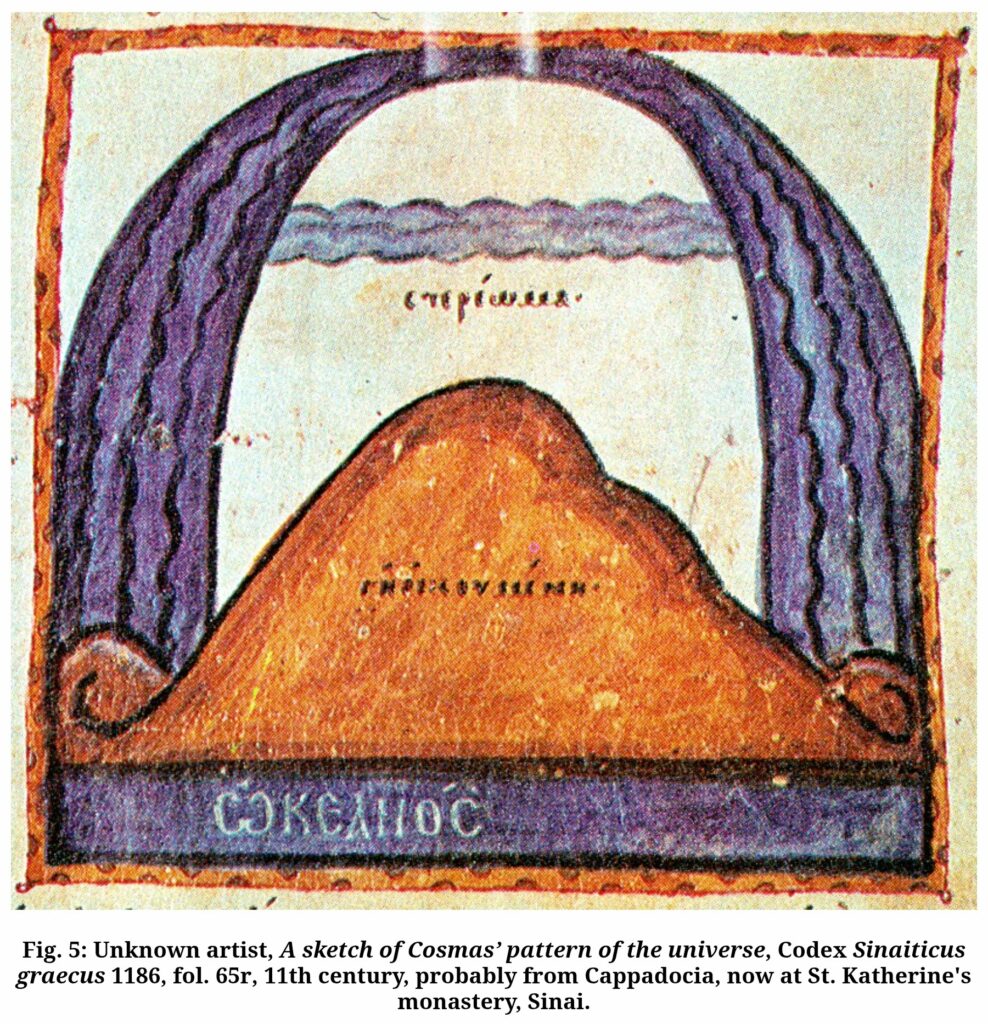
    While the Armenian Ancestors studied the world surrounding them and gazed intently at the everlasting «dance» of the celestial luminaries and constellations — glorifying the Light-giving, Warmth-giving and Life-bestowing Sun as «the Eye of the Universe» and «the Fountain of Wisdom», and at sunrise greeted the Righteous Sun — in honour of the Light and Knowledge it bestows, some apologists of Christianity imposed their primitive and erroneous views — convinced that «The Sky is like a chest — with a vaulted lid, at the bottom of which is the Earth. It is flat, quadrangular and rests on the waters»…

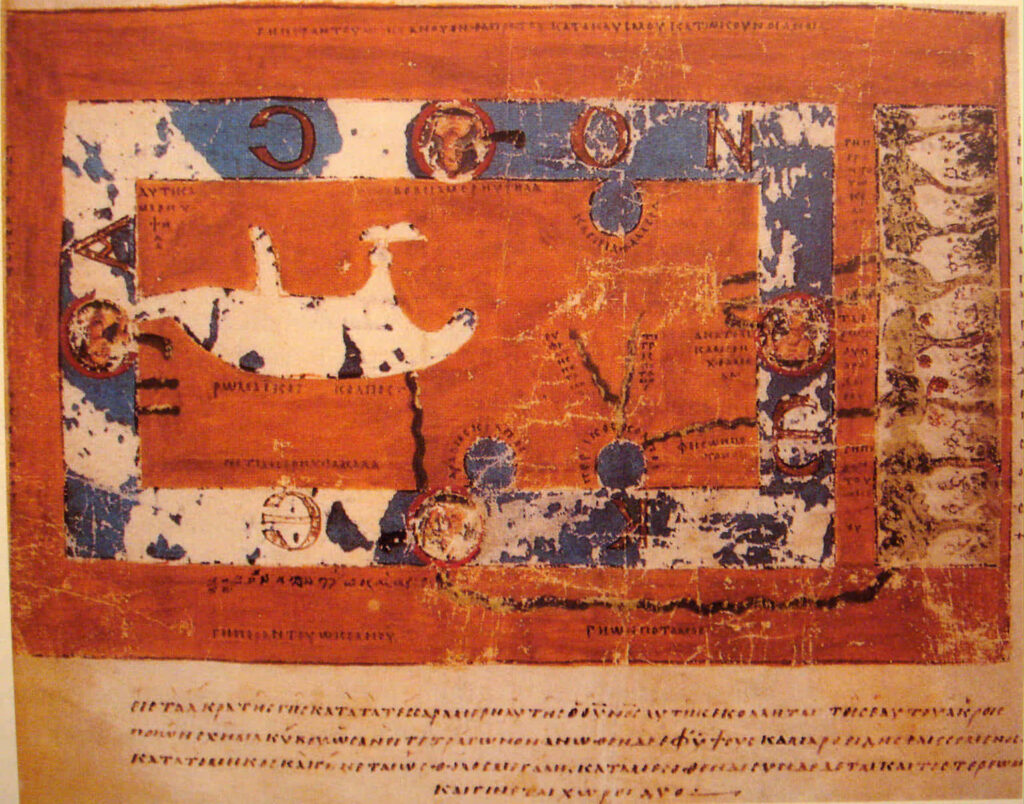
    «Against false Christians, who, like the pagans, declare that the sky is spherical»,- in the 6th century Cosmas Indicopleustes («the traveller to India») presents his long and «convincing» anti-scientific explanation in his book «Christian Topography», (Book I).

    «It should be noted that his (Cosmas Indicopleustes’, K. A.) teaching was accepted by the church with love. To come out against it meant to criticize the dogmas of theology, which in the conditions of the early Middle Ages was a bold step»,- writes E. L. Danielyan (quoted from the article on the question of the cosmological views of the author of the «Ashkharhatsuyts»»).

    Map of the Earth according to Cosmas Indicopleustes

    In issue No. 5 of 1974 of the journal «Lraber of Social Sciences», which represents the social sciences and Armenian studies of the NAS RA, the article «The reflection of some geographical ideas of antiquity in the works of medieval authors» is summed up thus:

    «In the early Middle Ages (V-XI cc.) science in Europe was in decline.
    The reason for this was Christian ideology. A product of the decline of science and of Christian ideology was the work «Christian Topography» of Cosmas Indicopleustes (VI c.), in which the author set out his notions of the Earth and of the universe.
    However, in the early Middle Ages the biblical geographical notions of Cosmas Indicopleustes were not dominant.
    The analysis of the works of some scholars of the same period, as well as of the 7th-century «Ashkharhatsuyts» and of Anania Shirakatsi’s «Cosmology», allows us to suppose that at that time, despite the persecutions of the church, the ancient ideas about the sphericity of the earth, the thermal zones and the antipodes had become widespread». (A. B. Ditmar, O.D. Shabrova, Yaroslavl).

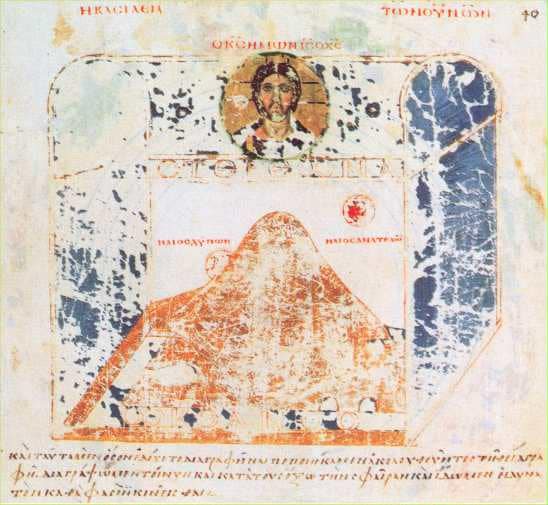
    Miniature from the book «Christian Topography» (9th century), where the flat Earth is depicted — enclosed in a chest

    Below are some excerpts from the article «The natural-philosophical views of Anania Shirakatsi» by Sen Arevshatyan, academician of the NAS RA, Doctor of Philosophical Sciences, professor — to show the legacy of pre-Christian science within Christianity.

    …«For his time Shirakatsi became the only author who turned to the rich heritage of antiquity and was able, under the conditions of the dominance of the religious-theological worldview, to appreciate the achievements of Hellenic science and to introduce them into Armenian science — in the period of its formation. However, as a child of his time, Shirakatsi was unable to renounce completely the views of the church.
    He strove to combine the ecclesiastical with «pagan» science, and moreover — within that «pagan» science he makes a division between «good» and «evil» scholars, between acceptable «good» scientists and «evil» thinkers to be rejected — thereby creating a convenient path for enriching the newly created Christian science with the achievements of the science of the ancient world.
    Shirakatsi defends the ancient Greek theory of the origin of the world from four elements»…
    …«In the question of explaining the structure of the world Shirakatsi follows the views of the ancient cosmologists — assigning a decisive role to the weights of the elements»…

    «…In his cosmological system Shirakatsi follows the traditional Geocentric theory, widely spread in the ancient world and in Christian cosmology, and the related notions of the finiteness of the material world».
    «The Geocentric theory — having at its basis the idea of the existence of god — of the «prime mover», had been adopted from ancient Greek philosophy by the fathers of the Christian church; more precisely — it had been taken over from the Aristotelian-Ptolemaic system by early-medieval religious philosophy.
    Its most valuable tenet was that the earth is spherical.
    Eratosthenes, who adopted that Aristotelian idea, measured the diameter of the earth.
    Accepting the Geocentric system of Aristotle and Ptolemy — most of the fathers of the church threw out of it the idea of the sphericity of the earth.


    Only some more enlightened representatives of Christianity, such as, for example — Basil of Caesarea, John Philoponus and other doctors of the church, defended the theory of the sphericity of the earth. A considerable part of the orthodox clergy clung to the cosmological theory that derives from the ideas of the Bible.

    It was elaborated by the 6th-century Alexandrian doctor Cosmas Indicopleustes (Indikopleustes), who in his work «Christian Topography» developed the idea that the Sky is like a chest — with a vaulted lid, at the bottom of which is the Earth.
    It is flat, quadrangular and rests on the waters. The Earth is surrounded by the ocean, beyond which is an uninhabited, desert territory. That territory is surrounded on four sides by a high rampart, on which rest the sky, the Sun and the Moon, which move not around the Earth, but around a towering conical mountain peak.
    Compared with the achievements of the science of the Hellenistic period, the «Christian Topography» of Cosmas Indicopleustes was a great retreat.
    Anania Shirakatsi refutes the main tenets of the «Christian Topography» and defends the positions of Hellenistic science.
    «If anyone wishes,- writes Shirakatsi,- to receive from the outer philosophers a convincing example of the position of the earth, then the example of the egg seems suitable to me.
    Just as in the middle (of the egg) is the spherical yolk, and around it is the white, and the shell encloses everything, so too the earth is in the middle, the air surrounds it, and the sky encloses all of this within itself».

    Shirakatsi’s notions of the sphericity of the earth and of the structure of the universe are very clear and definite.
    «Now, that upper sky,- he says,- which the Greeks call «ether», and the Chaldeans — «dense fire», … like a vaulted ceiling, smooth, with a round, exact embrace, spreads around the spherical earth with its unceasing and unstoppable rapid rotation, of an invisible substance, which is subject only to rational cognition».

    Closely connected with the disputes of the ancient cosmologists about the shape of the earth was also the question of the antipodeans (antipodes), that is — are there people on the opposite side of the earth, does life exist on the lower part of the earth, or is it desolate and uninhabited.
    According to Christian cosmology, that question was connected either with accepting the sphericity of the Earth, or with denying the tenet of the Bible that the Earth is established upon the waters.
    Shirakatsi — in order not to betray his scientific convictions, finds that at one time he «accepted the existence of the antipodeans» and thought «that this corresponds to the divine word».
    But straightaway he tells his dream, in which to his question — «Do other living beings exist on the lower part of the earth, or not», the Sun, appearing in the form of a young fair-haired man, answers — «They do not exist. But (there) I illuminate the mountains, the gorges and the desolate caves».
    Shirakatsi thus accepts that on the lower part of the Earth there are «mountains, gorges and desolate caves» and rejects the existence of the antipodeans, only because it does not correspond to «the divine word»…

    To be continued…

  • «THE PEOPLE MUST FIGHT FOR ITS LAW AS FOR ITS WALL»…

    «THE PEOPLE MUST FIGHT FOR ITS LAW AS FOR ITS WALL»…

    «THE PEOPLE MUST FIGHT FOR ITS LAW AS FOR ITS WALL»…

    «The people must fight for its law as for its wall».
    «To me one man is equal to ten thousand, if he is the best». (Heraclitus)

    About 2500 years ago, from a noble and influential family living in Ephesus, descended the Greek philosopher Heraclitus, whose profound saying — «Everything is transient» is known to many.
    «A man’s character forges his destiny»,- he asserted, and he also reminded of «those who sleep while awake».

    Heraclitus was convinced that power must belong to «the best few and not to the worst majority or to the ignorant multitude, which does not tolerate the wise and the strong».

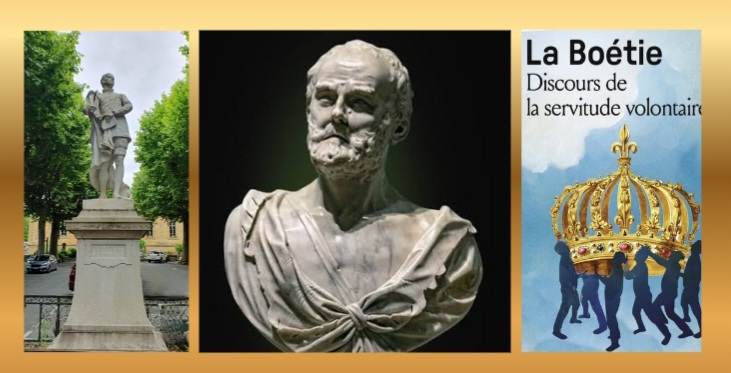
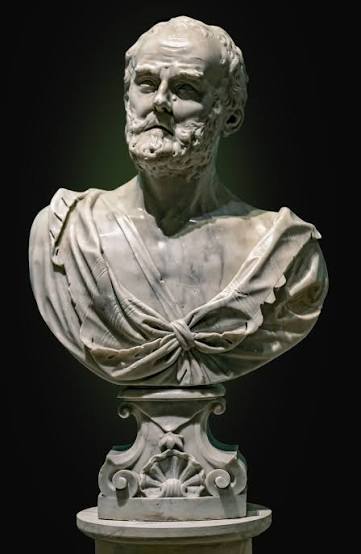
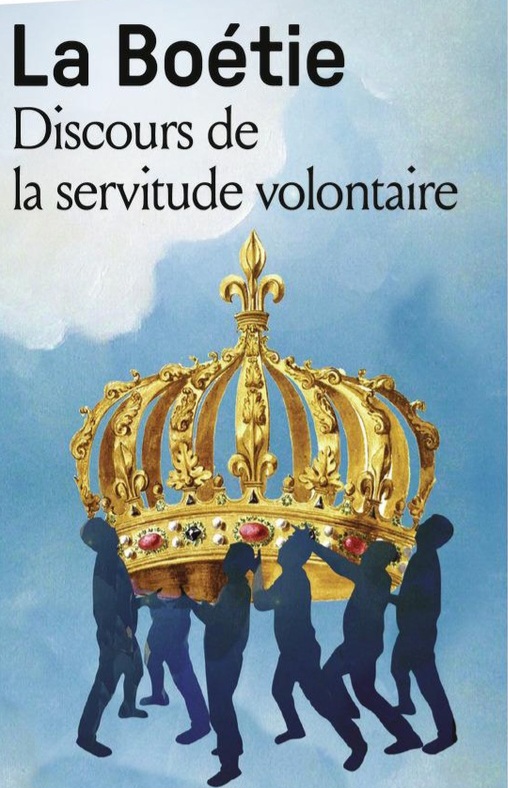
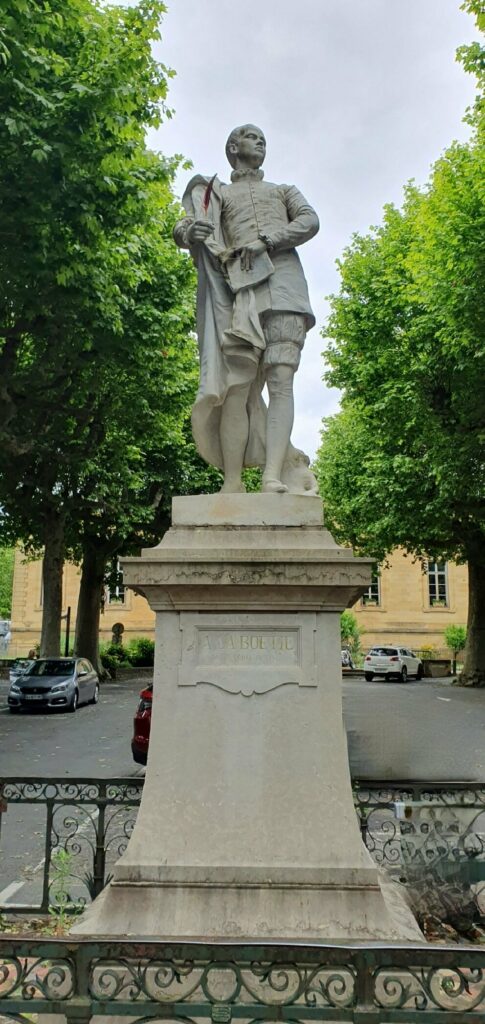
    The 16th-century French writer-humanist and jurist Étienne de La Boétie (1530-1563), when only 19 years old, in 1549, set down the «Discourse on Voluntary Servitude», in which he examines the reprehensible phenomenon of peoples who, as a result of their tolerance and credulity, submissively support tyrants abusing power.
    Here, then, is an excerpt from that discourse in my translation:

    «… For the present I would only like to understand how it happens that so many men, so many provinces, cities, so many nations sometimes endure a single tyrant, whose only strength is the power that they themselves give him, and who can harm them only as much as they are willing to endure, and who could do them no harm whatsoever, if they did not willingly prefer suffering to opposing him. Truly, it is a strange thing – and yet so widespread a phenomenon that one must rather sigh (lament) than be astonished, seeing how millions of men are wretchedly enslaved, their heads placed under the yoke, not because they are compelled by brute force, but because they are charmed, one may say — bewitched, solely by a mere name, which they ought not to fear, since he is alone – nor love, since he is inhuman and cruel toward all.
    Such, however, is the weakness of men: forcibly enduring the obedience imposed upon them, they cannot always be stronger»…
    Nevertheless, he clearly points out the way out.
    «Resolve firmly — to serve no more – and you will be free.
    I do not ask you to push him or to shake him, only support him no more, and you will see how — like a great colossus whose base has been broken, he will collapse under his own weight and shatter»…