Year: 2025

  • «SELF-DECEPTION» (RAFFI)
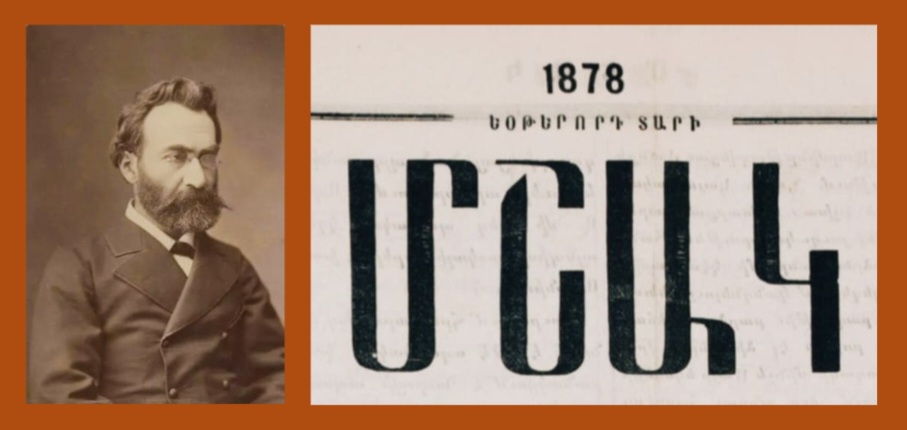
    «SELF-DECEPTION» (RAFFI)

    «SELF-DECEPTION» (RAFFI)

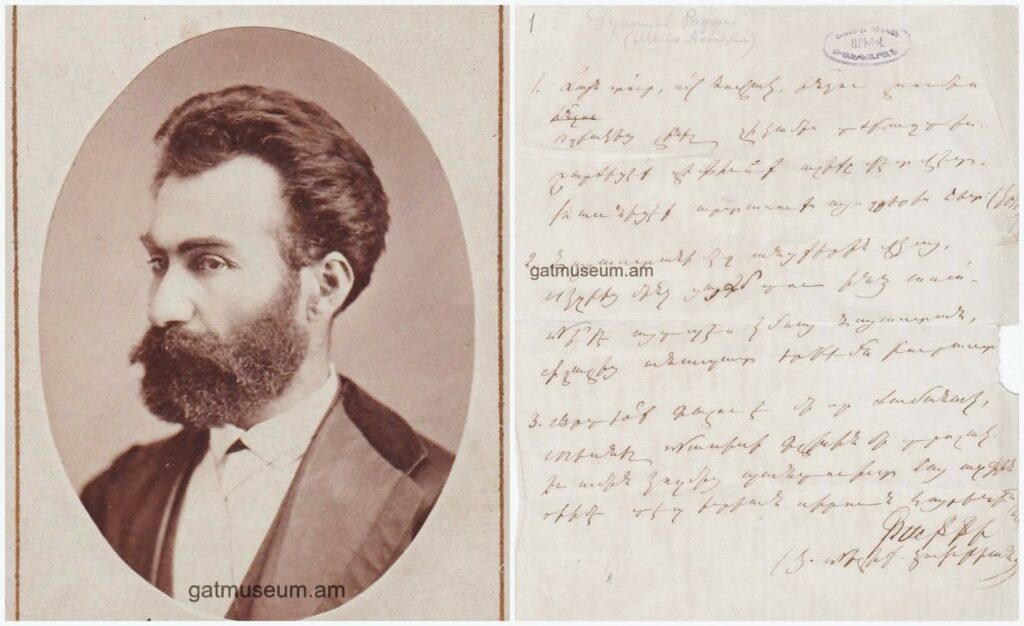
    An article written with a sober, clear-headed and critical gaze, which sounds extremely topical in our times, though it was written in the year 1878 — by Raffi’s pen…

    SELF-DECEPTION

    «Know thyself!»

    Self-deception!… it is a very simple word, but in it are hidden all the miseries of man: You see that one is a fool, but he thinks he has brains: Another is timid, he thinks he has the heart of a lion: A third has learned nothing, but imagines himself a genius: A fourth is an evildoer, but considers himself a model of virtue: — All this comes from self-deception:

    Self-deception has only one eye and it sees everything from the good side; its other eye is blind to seeing ugliness, deformities and vices: And for this reason the wretch who finds himself in such a pitiful condition is always content with his state, because he sees no shortcomings in himself: And therefore he always remains motionless; he has no striving towards progress and no demand from life; — he considers himself filled with everything:

    Self-deception is moral suicide; it is a deadness in which all human passions are at rest…

    The opposite of self-deception is self-knowledge; its father is envy, and its mother — discontent: It is satisfied with nothing: It has much, but always thinks it has little: It always looks upward, strives to rise: It has grasped the general human perfections, it is acquainted with high and sublime ideas, and comparing itself with the perfected whole, finds itself very small and small…: That is why it is always discontented: It repeats with Socrates: «I know only one thing, that is, that I know nothing»: In that saying lies all the sublimity of self-knowledge:

    Blessed is the man who feels thus: From here comes persevering labour, it is this that inspires man towards incessant progress, it is this that gives birth to geniuses, to craft, to science and to the welfare of the world:

    Discontent with one’s condition — is a noble stimulus that leads towards its improvement:

    Such characters as appear in individuals, the same appear also in whole peoples and nations: Because the whole is made up of parts; whatever the parts are, that the whole is too:

    There are nations that are very content with their state, think they have everything and do not see their shortcomings: There are also nations which, the further they go, the more they produce, the more they perfect themselves, — the more discontented they are:

    Let us speak about ourselves:
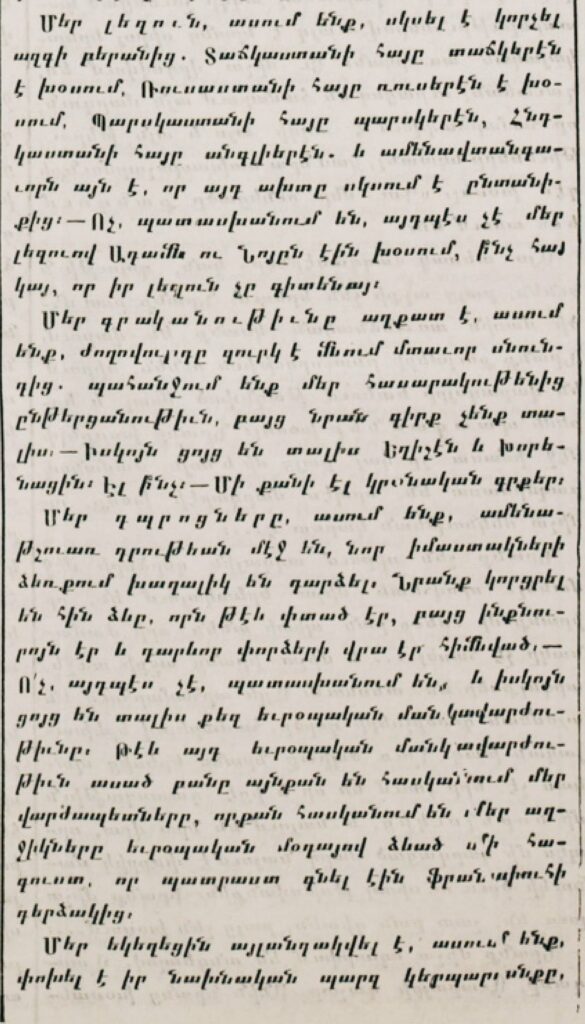
    We are in a state of complete self-deception:

    The family, the foundation of nationhood, has begun among us to rot, to become deformed, – on the one hand extravagance, on the other immorality day by day destroy in it whatever is good, whatever is noble: It has lost its patriarchal simplicity, and from the new, so-called European education — has appropriated only the bad sides: — No, they say, it is not so; the one thing the Armenian can boast of is his family sanctity, in which thrift, the virtuous harmony of the members and so on reign:

    Our language, we say, has begun to be lost from the mouth of the nation; the Armenian of Turkey speaks Turkish, the Armenian of Russia speaks Russian, the Armenian of Persia Persian, the Armenian of India English; and the most dangerous thing is that this disease begins from the family: — No, they answer, it is not so; Adam and Noah spoke our language; what Armenian is there who does not know his own language?

    Our literature is poor, we say; the people remains deprived of intellectual nourishment; we demand reading from our society, but we do not give it books: — At once they point to Eghishe and Khorenatsi: What else? — A few religious books besides:

    Our schools, we say, are in the most wretched condition, they have become toys in the hands of new sophists: They have lost the old form, which, although rotten, was independent and based on age-old experience: — No, it is not so, they answer, and at once they show you European pedagogy: Though our schoolmasters understand that thing called European pedagogy as much as our girls understand a dress cut in the European fashion which they had bought ready-made from a French dressmaker:

    Our church has become deformed, we say, it has changed its original simple aspect, it has become a factory of ritualism, simony and unbelief: — You are irreligious, you are an unbeliever, they answer; one cannot speak against the sanctity of the church; there is no church as free as ours:

    Our ecclesiastical government, we say, has become an administration of bashi-bazouks; arbitrariness reigns over order and canons; the unworthy advance, the worthy are oppressed: — At once you receive the same foolish answer, that you are speaking against religion, and along with it they add a few curses:

    Our clergymen, we say, have become worthless labourers; their learning, their conduct do not correspond to the office they have taken upon themselves: They scandalize our people more than they give it a moral and spiritual direction: — At once they will show you Nerses the Great, Sahak Partev and Mesrop: And the present ones? — The present ones atone for their sins with the labour of the old ones…:

    Our journalism, the monthlies and the quarterly reviews, we say, instead of awakening the people from its prejudices, instead of acquainting it with new and fresh thoughts, instead of leading it towards the right path — lead it further astray, numb it further in its immobility: — This is how the people must be educated, they answer you:

    In short, everything goes well among us… You speak about economic disorder, about the irregularity of commerce, about the backwardness of agriculture, about the patriarchal state of craft, about the pitiful condition of the peasant — the labouring class, in a word, about everything that man needs,- you receive the same answer: everything is fine among us…:

    All this comes from self-deception; all this comes from that one-sided view by which we see everything from the good side:

    Self-deception has given birth among us to a kind of «patriots», to whom to this day neither our novelists, nor our theatrical stage, nor our journalism have paid attention: Their motto is contained in this principle: «Whatever is Armenian, that is good»:
    This kind of «patriots» represents a perfected type in our society, who, it seems, belong to a separate shkola (school, K. A.), whose founder is unknown:

    They do indeed love the nation, as a young man is in love with a maiden who does not know him at all, who has not heard even one word from his mouth, who has seen no favour from him, but he loves… Even the maiden’s follies are dear to him…:

    They love… they are indignant… they are inspired… and every passion stays within their heart: They find the nation within the four walls of their room; outside they have no relation with it: As our imaginary lover has his beloved within his head:

    To this kind of «patriots» «work» is unknown: But they consider they have done the nation a great good when they speak about it, and they speak always with their own kind; the stranger does not hear their voice: They do not have even that thing which is called desire; because to desire something one must demand something; but they have no demands either: They are satisfied with all that already exists, with what our forefathers left: And to do something new they are still waiting…

    Their word – is praise: To praise, to be inspired; to rejoice in perfections the nation does not have, – that is the imaginary object of their love: And they are always indignant, they consider a traitor, an apostate the man who dares to notice this or that shortcoming of the nation, or to speak against its prejudice: «You are destroying what we have», – they say:

    This kind of «patriots» exist, they are there, but they are not seen: They for the most part lead a private life: They have the character of the kurms, they love to remain hidden behind the curtain and sometimes to speak oracles: There is no meaning in their words, but at the same time they are many-meaninged, like the word of a prophet, which always needs interpretation…
    They do not like to enter into national affairs, because they always imagine that they must do some «great» thing, the time for which has not come… and they always see obstacles before their eyes: Moreover they despise the work of the present-day activists, considering it child’s play: A silent smile never leaves their face: When they hear some reasoning from an upstart, they look on him as a developed man looks on the crooked and wrong babbling of a little child: They themselves are always silent, they know much, but do not speak…

    They are always inspired by the past; Vardan, the field of Avarayr, Ani are the subject of their conversation: In Turkey and in the national constitution of C. Polis they see a great future, and they find the salvation of the Armenians in the Armenian church:

    These «patriots» are the perfected type of their kind, who are considered geniuses: They are good people, but they are dangerous: Blind love is always harmful; because it always sees the good, it does not notice the bad:

    But there is also a secondary kind, which is the false copy of the first: They are crafty people who under the patriotic mask hide self-interested aims: Such ones mix into affairs: They become — trustees of schools, treasurers of churches, guardians of rich orphans, executors of sums bequeathed for charitable purposes, incense-burners of the prelates, patrons of poor actors, permanent and hereditary schoolmasters in the same school, and sometimes editors of newspapers and journals: Among this kind of patriots are also those benefactors who have always robbed, plundered and in a thousand-and-one ways heaped up wealth by brigandage,- and in the end wish to pose as good men and cover their dirty past with a patriotic veil:

    This kind of «patriot» loves the nation in order to rob it, as the vampire sucks the blood of its victim by numbing it: He will speak to you always in the Armenian language, he will try to stay far from foreign words, and always (but only in words) will express good wishes about his «dear» and «honourable» nation: «Ah» and « oh» never leave his mouth when he hears of the misery of the nation, and many times tears appear in his eyes when he reads «The Wounds of Armenia»: There is no measure to his anger when he hears enmity and abuse about the nation, and he hates all those who are not Armenian: — All this he does, but if he knew that they would give a few kopecks for the bones of Hayk, he would at once dig them out of the grave and sell them…
    Reader, you have become sufficiently acquainted with the two types we have drawn – the rotten and the false patriots: Do you wish now that I acquaint you personally with one of them, and you may consider that you know them all, because all resemble one another with very little difference:

    He is of the last kind:

    Here we are entering his retreat; here works the nation’s eminent thinker: Facing a big writing desk, on a likewise big armchair he sits: He is a stout man, he speaks likewise in a stout voice; his cheeks are likewise stout and have a deep-red colour: It seems the patriot’s belly has always been full; he is very healthy, though the hair of his head has turned white:

    Right opposite the writing desk (before the patriot’s eyes) in a black frame, hangs a mysterious picture, which represents a maiden with dishevelled hair, who is sitting on ruins: Around her are scattered broken sceptres, dust-buried crowns, shattered banners and various weapons: And she herself — the maiden, resting her chin on her hand, her beautiful head inclined to one side, sadly looks at the ruins of Armenia… A little way from this picture, to the right and left of the patriot, two other pictures in gilded frames hang from the wall: One of them is Hayk, and the other — Vardan Mamikonyan: Below Hayk’s picture the map of ancient Armenia is nailed on the wall:

    On the writing desk many papers are laid, on which, so that the wind does not scatter them, is placed a brick-like thing; it is a lime composition decorated with mosaics, brought from the ruins of Ani:

    In one corner in a big bookcase books with gilded Venetian bindings are arranged, as if stacked for show: The room is decorated in Eastern taste; carpets are spread, a takht is placed and mutakas are seen:
    The patriot is silent; his much-troubled face shows that he is busy:

    Behold! two little children like angels ran into the room: Calling «Papasha, papasha», one of them leapt onto his father’s knees and wrapped himself around his neck: And the other child tried and tried to follow his brother, but rolled onto the floor: The father lifted him and kissed him:

    One of the children’s name is Levon, the other’s — Ruben: The father has done the nation a great service by reviving these historical names…
    — Why do they not speak Armenian,- you ask the patriot.
    — They are accustomed so with the mothers and the maids… and I have no time to occupy myself with them,- he answers.

    The children snatch from the writing desk the latest issue of «Meghu», to take it and make themselves a «whirligig»: The father calls them to bring it back, but the little rascals disappear:

    Reader, all this, I think, made a good impression on you; you saw the outward displays sufficiently attractive; now let us enter the patriot’s inside – into the heart:

    I will begin the conversation; you only listen:

    — You probably do not receive «Mshak»?- I ask.
    — Is it really worth wasting money… – he answers in a contemptuous voice: — One can only spit on this newspaper and not read it:
    — Perhaps you read it?- he asks at once.
    — Yes, and with great pleasure:
    — I did not expect that from you…
    — Why?
    — Honourable brother, what is left that it has not disgraced?- family, religion, church: It denied all the noble sides of our nation; there was no soot left that it did not smear on it: It disgraced us, disgraced us utterly…
    — Why not disgrace, when there are things to be disgraced:
    — Is that really permissible? Suppose there were shortcomings among us, is it really permissible to bring everything out into the public square?
    — Only those foolish sick people act like this, who, hiding their pains, try to pose as healthy: By covering our shortcomings what have we built until today?
    — At least we kept our honour: Foreigners did not understand our deficiencies:
    — Foreigners are not blind like us…
    He began to look for something among the papers:

    — Here, I will show you the letter of Mr. Kovyan received from St. Petersburg… what honourable reasonings, what honourable reflection… Where has it got lost… Sasha!,- he called the servant.

    — Do not trouble yourself; I have no need of the «honourable reflections» of St. Petersburg; without your reading it, I can tell what will be written in that letter:

    He turns towards me:

    — So, tell me please, must one not spit on such a newspaper, which denies our good sides, refutes and destroys everything, turns everything upside down: Whom does that please, who does not get angry?

    — That is very natural; try telling someone blind in both eyes — you are blind; he will at once get angry, though you have stated an irrefutable truth:

    He grew heated:

    — It is disgusting… one must always praise, one must encourage, one must hearten; you only make people despair… you see everything in black colour… you deny life, strength in the nation…

    — That old and rotten method of education has already shown its result: The journalism of the hos-hos of C. Polis followed that form until today; it always praised, it was always inspired, showing that they have everything, that everything is ready: But the circumstances showed what kind of people they prepared: The nothingness of the Turkish Armenians was revealed:

    The patriot’s arrow, it seems, hit a stone; he stopped and began to think:

    I continued.
    — The same was done among us too until today; «whatever is Armenian, that is good».- this was the principle of our nation-lovers: — The Armenian merchant conducts his trade by cheating: — One must praise him, that is not theft, because the doer is Armenian: The Armenian family day by day decays in moral rot: — No harm; because it is the family of our nation, one cannot speak ill of it: The Armenian clergymen have become brigands: — One must praise them, because they are our spiritual fathers, the keepers of the tradition of our religion… Why should I lengthen my speech, you praised every refuse, every filth, every corruption, and you praise it, because it is the refuse of an Armenian…
    — What harm did we do with our praises?
    — The harm that you deceived the nation and, by eulogizing its follies, its worthlessness, gave occasion for worthlessness to remain forever worthlessness: You closed the nation’s eyes so that it would not see its deformity:
    — And you, who censure, destroy, annihilate, what do you put in its place?
    — We perform the office of the gardener: The gardener, when he mercilessly cuts the dried, rotten and superfluous branches of the tree, does not think to graft a new branch in their place; because he knows that the new one will sprout by itself, if there is life in the tree, if there is strength and it has a root in the soil…

    The conversation is interrupted: The court attendant brings in a summons and has it signed:
    — For what matters are you summoned?
    — Again it is for that cursed will…

    The patriot forgot the love too, the nation too, Vardan too, Hayk too: He stood up with these words.
    — Excuse me, I must go to my lawyer:
  • «FAMOUS ARMENIAN CHAMPIONS OF THE PAST»  (N. ADONTZ)

    «FAMOUS ARMENIAN CHAMPIONS OF THE PAST» (N. ADONTZ)

    «FAMOUS ARMENIAN CHAMPIONS OF THE PAST» (N. ADONTZ)

    «Nakhamartik – vanguard-fighter, champion, general» — a brave, mighty warrior and proud defender, a valiant who rushes forward. Akhoyan — «a vanguard-fighter of the army, contending against the enemies, a resister», also — adversary…
    «Akhoyanabar — valiantly, akhoyanayardzak — one who attacks as a champion, a forefighter, brave»:
    Inspired «by a champion’s assailing flight», a few pages from the past — as set forth by N. Adontz — below…

    FAMOUS ARMENIAN CHAMPIONS OF THE PAST

    Personal bravery, physical strength, had an incomparably greater place in life in ancient times than at present. Bravery was heavenly, almost divine. Many of the great historical personalities owe at least their first successes to their arms rather than to their heads. The means and instruments of self-defence and combat were the wide-bowed or thick-drawn bow, the sling, the mace, the spear, the axe and the sword. Heavy armament, iron-clad armour, demanded such bodily strength, such a stalwart build, as the modern automatic rifle, the machine-gun and the other monstrous engines have no need of at all. The more mankind advances, the more the importance, the need of strength diminishes. The course of history can be characterized as a continuous transfer from bodily and physical might towards intellectual and spiritual strength. Arms give way to the head. Bodily bravery — the older it grows — remains the ornament of past centuries, the more man looks with longing and yearns for the old bravery. The ancients are pictured as titans, invincible giants, enormous, huge-bodied (big-bodied), great-souled, stalwart, unlike an ordinary man.

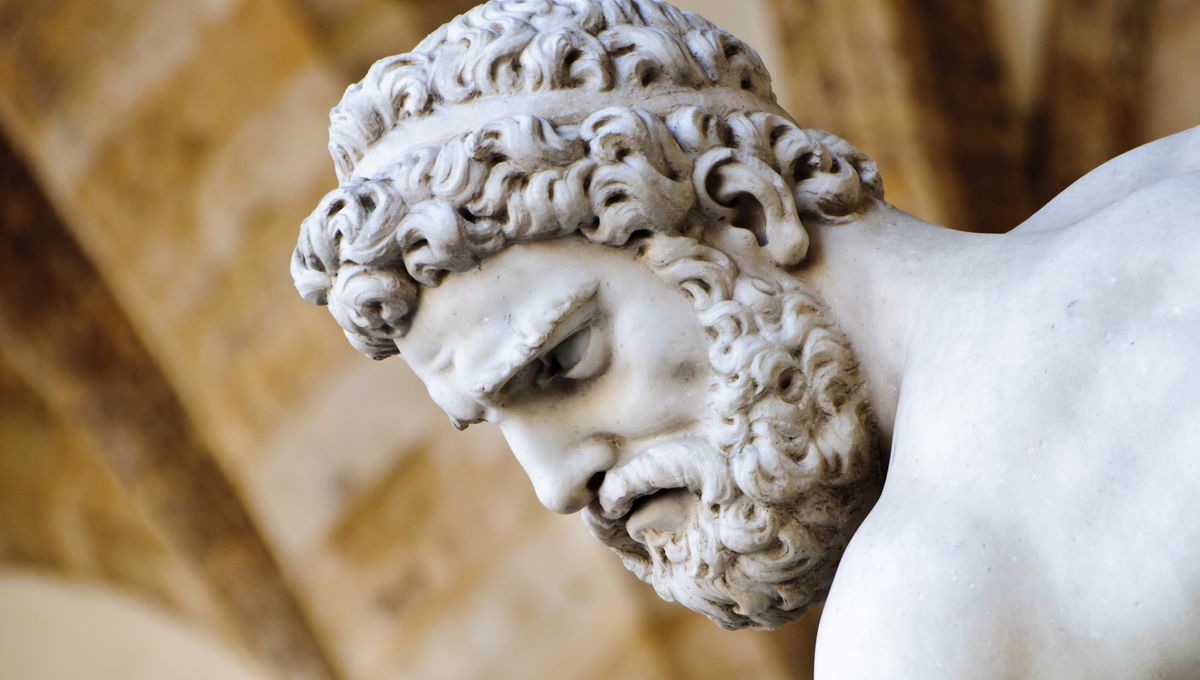
    (They) become an object of worship, are considered demigods, that is — half-gods, descended from gods (Dits, K.A.) and mortals. Heracles while still in the cradle strangled two dragons which Hera had sent to kill the newborn child. The name is connected with the root «hero», Latin — «serv», which means to keep, to watch, rend – harua–haurna-servare – giant: Our Vahagn too is a dragon-reaper.

    The ancients glorify bravery, they create types of heroes and consider bravery a divine gift. Bravery also gives immortality — heroes sometimes ascend to heaven and as gods join the company of the other gods.

    All ancient nations have a god of bravery and heroes who are types of bravery. The Greeks — Achilles, Troy — Hector, the Persians — Rostam, the Armenians — Tork (the older god of our bravery and our very forefather is Hayk).

    Our ancestors too greatly valued bravery. Hayk is the forefather of the Armenian nation, the embodiment of the Armenian nation. The comely, stalwart, brave-curled, bright-eyed and thick-armed Hayk was brave and eminent among the giants. Bel marches on Hayk with giants vying with heaven-reaching stature. Movses Khorenatsi drew this image of Hayk — basing himself on the description of the strength of the Armenian leader, of his personal bravery. The princely houses of the Mamikonyans, Bagratunis, Syunis, Amatunis and Artsrunis gave such figures as are truly heroes. I would like to present a few historical figures whose bravery was not only bodily, but linked with fearlessness and superhuman daring.
    Bodily strength without spiritual valour is a dead strength.
    It is this that moves the bodily, giving it spirit — doubles it.

    The persons to be mentioned below are not great figures of history, (they) did not leave a brilliant trace behind them. And yet — they are types of heroism, because, despising death with manly valour, going out into the arena of single combat — they crowned with glory the people that bore them and nourished them. I must pay a meagre tribute of respect to those who brought honour to the Armenians as single-combatants. In the formidable Byzantine army, among thousands, among tens of thousands, suddenly an Armenian rushes forth against the enemy — as one able to accept the single combat.
    Here they are — Artavan, Artavazd, Anzalas, Hovhannes Guzes, who are attested by foreign historians (Note.- He alludes to the famous Byzantine historian Procopius of Caesarea).

    1. Artavan Arshakuni, a general of Armenian origin in the Byzantine army, the son of Hovhannes Arshakuni: At first he fought against Byzantium; in 539 he killed the Byzantine generals Akakios and Sittas, who had marched on Western Armenia: Thereafter he served Emperor Justinian I…
    2. Artavazd (? – 542), a general of Armenian origin in the Byzantine army: He distinguished himself in the Italian campaigns waged against the Goths (541-542) and, especially, during the siege of the city of Verona: He accepted the proposal of the Gothic warrior Valaris to fight him in single combat and killed him:
    3. Anzalas (Enjugh), an Armenian warrior of the Byzantine army: In the year 553, during the battle that took place near the city of Toscana, he accepted the challenge of a brave fighter named Kokkas from the army of the Goths and killed him in single combat:
    4. Hovhannes Guzes, a general of Armenian origin in the Byzantine army, the son of Tovma, comes of Armenia: He distinguished himself in the wars waged in the year 551 for Lazica and Colchis: In single combat he killed a brave Alan of gigantic body and secured the victory of the Byzantine army:
    1. ARTAVAN (548)
    2. SMBAT BAGRATUNI, SON OF MANUEL (590)

    In 590 Emperor Maurice tried to send the Armenian nakharars to Thrace. But the nakharars of the Armenians rebelled and wished «to withdraw from the service of the king of the Greeks and to set up a king of their own».
    This was done with the following aim, «that they too might not have to die in the regions of the Thracians, but to live and die upon their own land» («History of Sebeos», edited by G. V. Abgaryan, Yerevan, 1979, p. 92).
    The emperor sent royal envoys to Armenia with an edict, but Smbat Bagratuni, son of Manuel, killed one of them. The Byzantines arrested Smbat and took him with seven (other) persons to the capital. They tried him and decided to throw him into the kyunik, that is — the circus (note — the «kyunik» was an open-air circus arena, on which chariot exercises, bullfights and other contests took place). Smbat was «a man of enormous body and handsome appearance, and of tall and broad stature, and of powerful and lean body» (Sebeos, p. 92). He had been renowned as «mighty and warlike» in many wars. (Smbat) had such strength that, passing under «densely forested cedars and mighty trees» — mounted on a stalwart mighty steed, he would raise his hands, seize a bough of the tree and, squeezing the steed’s back with his loins and legs — lift it up off the ground. Those who saw were terrified and greatly astonished.

    They stripped Smbat and left him only in his drawers, then they threw him into the kyunik, «that he might be food for the beasts» (Sebeos, p. 93). First they let loose on him the bear (this and all following emphases are the author’s – P. H.). Smbat shouted loudly and went at the bear, struck it on the forehead with his fist and it died on the spot. The second time they let loose on him a bull. Smbat seized the bull by the horns, again with his cry cast terror on the bull, tormented it — twisting its neck and breaking its horns.
    The bull, weakened, retreated and took to flight. Smbat, running after it, «seized the hoof of one of its hind legs», the bull’s hoof was torn off and remained in Smbat’s hand. The bull fled with one foot «bare». (A similar feat Khorenatsi attributes to Trdat (III the Great) — saying that a Greek wrestler in old times «tore off the hoof of an ox», while Trdat with one hand «seizing by the horns» two wild bulls, «tore them off along with a rebellious crushing») (Movses Khorenatsi, «History of the Armenians», Tiflis, 1913, p. 218).

    The third time they let loose on him a fierce lion. When they let loose the lion, Smbat deftly seized it by the ear and sat on its back.
    Then he put his hand to its windpipe and, squeezing, strangled the lion.
    The crowd, raising cries of acclaim with enthusiasm, shouted and appealed to the emperor to pardon the Armenian prince. And Smbat, tired, was resting, sitting on the lion. The empress and the emperor took pity on him, granted pardon and sent him to the baths. Here they washed Smbat, clothed him and took him to the palace. Later Smbat became the victim of slander and was exiled «to distant islands» (Sebeos, p. 93), then the emperor ordered him to be transferred from there to Africa — giving him the office of military tribune.

    1. SMBAT VRKAN KHOSROV SHNUM BAGRATUNI (607)

    The king of the Kushans in the land of the Hephthalites (Turkestan) encamped against Smbat with a great formation. The Hephthalite sent an envoy to Smbat.

    • What profit is there in entering the war thus in a confused throng and exhausting our troops? By what shall my bravery and yours be known? Come! let only you and I fight in single combat. I from here, and you — from there, come out as champion, «that today my bravery may be known to you».

    Smbat answers: «Behold, I am ready to die».
    For a long time they attacked one another and fought in sight of the two armies.
    But they could not overcome one another, because they were of giant strength (and not «sakavazavrk», as it is printed; see K. Patkanyan’s edition, p. 67) and solidly armed. At last Smbat succeeded in thrusting the spear, piercing the coat and firm (not vertevamur) and solid armour’s strength and (the king of the Kushans) knocked him to the ground:
    And the troops of the Kushans «when they saw their king — were terrified and turned and went in flight» (Sebeos, p. 103).

    1. BASIL THE MACEDONIAN (circa 820-886)
    2. ASHOT BAGRATUNI (973)

    After the death of Gagik Shahnshah of Ani his two sons — Hovhannes-Smbat and Ashot quarrelled. Ashot receives troops from Senekerim, king of the Artsrunis, and moves against his brother. At that time a Georgian prince was with King Hovhannes-Smbat as ambassador.
    He, boasting, asks that the king of the Armenians allow him to go and take Ashot alive and put an end to the bloodshed. Hovhannes-Smbat says: «Ashot is a mighty man; how do you think to bring him before me?» The Georgian answers: «I will take him alive from his horse». But King Hovhannes-Smbat warns the Georgian: «Do not despise the lion’s cub, until you see». The Georgian prince swooped like an eagle on Ashot — shouting: «Who is Ashot, let him come forward!» Ashot grew enraged like a leopard and the Georgian — while he wanted to strike with the spear, Ashot with the speed of lightning drew his steel sword and so struck the helmet that he rent the Georgian’s iron-clad body, split it in two down to the breast and «threw him to the earth together with his waist» (Matteos Urhayetsi, pp. 13-14).

    1. VASAK PAHLAVUNI, PRINCE OF BJNI (1021)

    The king of the Delums (the Daylamites – P. H.) came and devastated the province of Nig. Vasak, sparapet of the Armenians, went out against them with his son Grigor. Vasak could not wait until the troops gathered. He went ahead with five hundred men. From the army of the foreigners came out a champion — a black Abyssinian, who was called «Seven Wolves», who like «a black cloud thundering, emitting flame from his armour» — called Vasak to single combat. Vasak’s subordinates were terrified, for «such a man had not yet been born on earth». Vasak calmed them and said: «I will go out against him and give him the same gift that David gave to Goliath». The Abyssinian came at him beast-like, to take Vasak on his lance. But Vasak hastened and with his steel sword so struck the Abyssinian’s head that his helmet was split in two, and «the parts of his body fell to the ground» (Matteos Urhayetsi, pp. 13-14).

    1. HASAN AND CHNCHGHUK (1042)

    Hasan and Chnchghuk were the sons of Prince Khachik of Vasparakan.
    They had just returned from Thrace, where they had fought against the enemies of the empire. During their absence Prince Khachik and his younger son — the fifteen-year-old youth Ishkhan, had fallen victim during the attacks of the Muslim tribes of Salmast.

    To take revenge they bribe a Kurd and send him to Salmast — to spread the news that Prince Khachik’s estate is undefended, «why do you sit idle» — many flocks of sheep wander masterless. The Kurd did just so. The foreigners raided Vaspurakan with 15 thousand:
    Hasan and Chnchghuk had 5.000 soldiers.

    Like «a wounded beast» — Hasan, attacking the enemy army, calls out: «Who is, where is that man who killed my father — Khachik, let him come forward!» And behold, a black man of the foreigners came out and cried in a mighty voice.
    «It is I who killed the lion Khachik, and behold, his war-horse, his garment, his standard and his sword are in my hand». Hasan — seeing his father’s belongings, began to weep and, drawing the sword from its sheath, swooped on him like a lion and, striking, cut him in two pieces, threw him to the ground and snatched the (father’s) horse and standard.

    In like manner Chnchghuk too called out: «Who killed my young brother — Ishkhan, let him come out into the arena, that I may see him». A brave Persian came out and said: «It is I who killed your brother Ishkhan; behold! his white horse, his bright standard and his sword». Chnchghuk came at him like lightning, slew him with one blow and, taking his brother’s horse and standard — turned back.

    The Armenian troops, enthused, attacked the enemy, «put them to flight and slew of them four thousand men» (M. Urhayetsi, p. 92).

    1. THE SONS OF PRINCE HABEL OF THE FORTRESS OF ARKNI — HARPIK, DAVIT, LEVON
      AND KOSTANDIN (1052)

    Slanderous and treacherous men went (to Emperor Constantine Monomachos and accused the Armenian princes living in the province of Paghin of Fourth Armenia, that they «are disobedient to your commands and wish to rebel against you». The Byzantines devastated the entire province. They wished also to arrest the four brave and mighty sons of Prince Habel, lord of the great fortress called Arkni — Harpik, Davit, Levon and Kostandin. The eldest of the brothers — Harpik, fell victim to treachery; the others were taken captive to the capital.

    The emperor and all the Greeks were amazed — seeing their terrible appearance («the dreadful sight of their forms»), for with their stalwartness they surpassed all the Greeks («they were dreadful in appearance and with their shoulders they were taller than the whole house of the Greeks»). The emperor, having regard to their handsome, stalwart appearance, subjected them to no bodily punishment, but ordered the brave, mighty and eminent princes Davit, Levon and Kostandin to be exiled to an island: (The brothers remained in exile until the year 1056, when Empress Theodora «with great magnanimity released them to their paternal land, to the fortress of Arkni», M. Urhayetsi, p. 122).

    1. SADUN ARTSRUNI (1256)

    (Mongol) To Hulavu Khan, governor of Armenia, Georgia, Iran and the Near East on behalf of the Great Khan Mangu, comes a man «of the Mughal nation» (Mongol), very enormous, of tall stature, broad-shouldered, his neck «like a buffalo’s», his hands ungainly like a bear’s. He ate a sheep every day. He had brought a letter from Mangu Khan and a priceless kapa.
    In the letter it was said: «if there be found with my brother Hulavu Khan a bavka (wrestler) who will throw this wrestler to the ground, let the kapa be his! And if this bavka wins, let them clothe him with the kapa and send him back to me with a great embassy and with honour.

    Hulavu called all the chiefs of his troops and asked whether they knew any man, Tatar, Armenian or Georgian, who could fight in single combat with Mangu Khan’s bavka. But among the Tatars no such one was found, for «whoever saw that man — all feared his enormous stature and his sight». And the Armenian and Georgian princes said that there is only one man who can be a remedy; it is Prince Sadun of the Artsrunis, but he is not here, «but is at his home». Sadun «was of tall and comely stature, very strong from childhood» («History of the Tatars by Vardan the historian», Jerusalem, 1870, p. 47) and experienced and trained in single combats.

    The khan sent a man after him. Hearing the command, Sadun was very saddened, because he had never fought in single combat before the khan, and the opponent was enormous and strong. Sadun first went to Gag — «to the all-reaching Saint Sargis» and made a vow and a sacrifice, then set out for Hulavu. When the khan saw Sadun, his vigour and his tall stature — he rejoiced greatly. He ordered that the two wrestlers live together for nine days, that each day they eat a sheep and drink a skin of wine.

    When the appointed days had passed, (the khan) ordered all the chiefs to assemble before him and, calling the two wrestlers, ordered them to fight. The combat lasted three hours — from 3 to 6 o’clock in the daytime, and the wrestlers could not overcome one another. But Sadun with a mighty clash threw down the champion of the Great Khan Mangu and rose greatly in the eyes of Hulavu Khan. The khan wrote a yarlik («iarlakh») «and to forgive him up to nine offences» («History of the Tatars», p. 49).

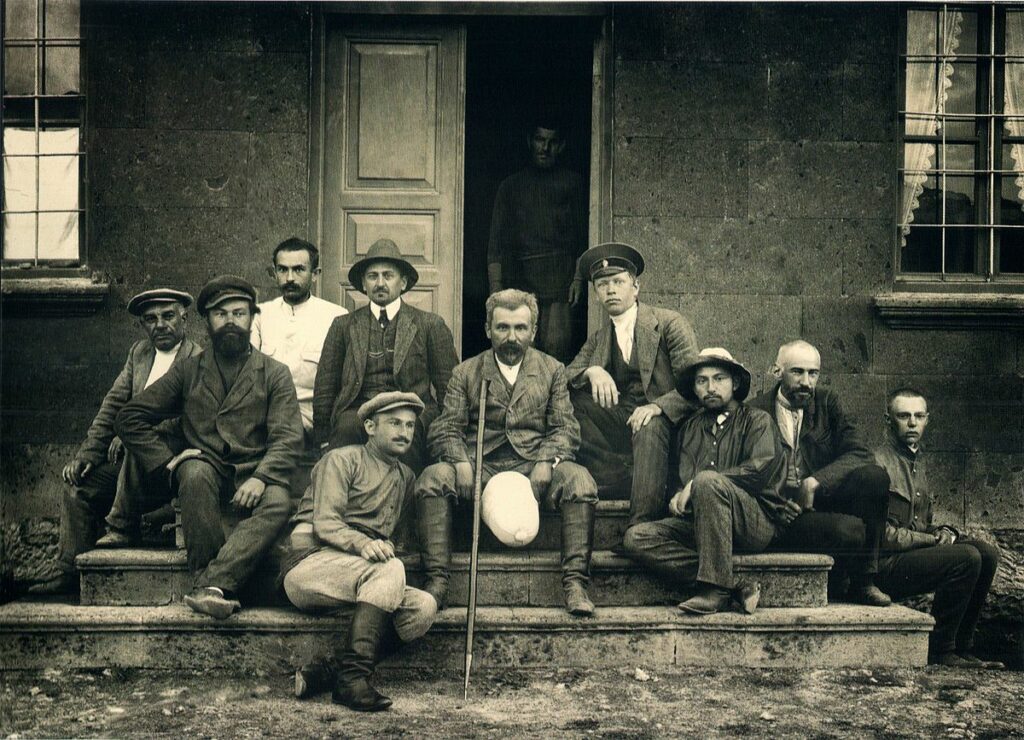
    In the photo — N. ADONTZ in the year 1912 at Ani — with N. Marr, H. Orbeli and the other members of the expedition (photo by A. Vruyr)

  • «ARMENIAN PERSONAL NAMES» (Part E)  H. ACHARYAN

    «ARMENIAN PERSONAL NAMES» (Part E) H. ACHARYAN

    «ARMENIAN PERSONAL NAMES» (Part E)
    H. ACHARYAN

    The last part of H. Acharyan’s article «Armenian personal names» — below (the beginning — in the previous four publications)…

    «Other nations know name, patronymic and surname; for example — the Chinese, whose words are very short, follow this custom; let us recall from Chinese names — Kon Fu-Tsi, Li Hung-Chang, Sun Yan-Tsen, Shi Hoang-Ti, Shun Yeu-Yue and so on: Among these the first syllable is the surname, the second — the patronymic and the third — the name:
    Among the Russians too, as is known, the surname with name and patronymic is in use; for example — Ivan Fyodorovich Paliev and so on:
    Europeans make wide use of the surname: The name among the French is so worthless a thing that by saying name they understand surname, while for the name they use «little name» (petit nom). One person can have 3–4 names, but only one surname: Thus of my classmates in Paris let me recall —
    Edouard-Marie-Antoine-Aude
    Louis-Marie-Jean-Bodin.
    Lucien-Elien-Albert-Broche
    Charles-Jean-Marie-Brou.
    Pierre-Paul-Narcisse-Fernand-Chilot
    Joseph-Jean-Baptiste-Vendryes.


    After these general notes let us particularize our discourse on the surnames of the Armenians:

    Among the ancient Armenians the common people probably used name-patronymic, while the nobles bore a surname: Surnames in the most ancient period were formed with the particle «uni», which later became «ean» (yan):
    In the 6th century the Armenians take from the Persians the plural particle «an, ean» (yan) and make surnames like theirs, even by the Persian law of the izafet; in the letter written by Catholicos Nerses, among others the following princes sign.
    Hamazasp i Gugvaramean
    Sameh y-Artavazdan
    Grigor i Hmayakan
    Sahak i Vardanan
    Datoy i Garjughean
    Zavrak i Gazavonan
    Varaz-Yohan i Yohanan
    Vardan i Mushegean
    Sahak i Hmayakean
    Ashot i Varaztirotsean
    Mushegh i Hmayekean
    Vriw y-Artashran
    Sahak i Manuelean and so on, and so on: (Book of Letters, p. 74):
    This is the period of Persian influence: In the time of the Arabs surnames disappear, inasmuch as the princely clans are wiped out: Later — in the time of the Turks, likewise there is no surname: In Turkey, in the time of my childhood, only the patronymic was used in the form of a surname; for example — at school I was registered as Hracheay Hakobean (by my father’s name) and in conversation they often said in the shortened form Hracheay Hakob: In the year 1888 the system of surnames entered the school: The board of trustees ordered all of us to go home and, asking and learning from our parents — to bring a surname: In general the pupils made their grandfather’s name their surname, others some nickname and so on:

    The history of my surname is interesting: I went home and asked what our surname is: My father proposed taking his father’s name — Harutiwn and being called Harutiwnean: I was then 12 years old, but already had some linguistic taste: To my taste a surname formed from a name was not pleasing; so I rejected Harutiwnean and wanted something else: My paternal aunt said that their clan in Rodosto was called Hyupryuk oghlu, so she proposed writing Hyupryukean: I did not then know the origin of the word Hyupryuk; I did not know that it too is a name, Hyuperik, which is very rarely used: In Yerevan a few years ago there was someone named Hyuperik: I did not like the surname Hyuperikean either and rejected it: (In Constantinople the nickname is often confused with the surname, and instead of saying surname, they say nickname, in Turkish laghab, that is — mock-name):
    I asked my father what mocking name they give you; he said: «They call me Krchin Akob»: I liked this name and took the surname «Krchinean», whose meaning was unknown:
    I presented myself to the board of trustees and said that my surname is Krchinean:
    One of the trustees said that there is no word «Krchin», it must be «Krchik», and made my surname Krchikean: For a whole year at school I bore the surname Krchikean: My comrades continually mocked me — calling me «krchik, mrchik, trchik, khrchik, brchik»: The year came to an end, I finished the elementary school and entered the secondary one: I — tired of krchik, decided to change my surname: The Grabar of the word krchik is «achar», which seemed to me very euphonious, and at the new school I made my surname — Acharean, which my father also accepted:
    42 years ago from now, at the Seminary of Etchmiadzin, when I told this incident, Manuk Abeghean said laughing: «We have not seen a Turkish Armenian who did not have a made-up surname»: True, but Abeghean’s surname too is made up: He was originally called Aghbeghean, that is — with a Turkish word — «son of the white-moustached»: Abeghean rightly found Aghbeghean unpleasant, cut it in the middle and made it Abeghean, which is the name of one of the nakharar families of the ancient Armenians:
    I told an individual incident; but it is the indicator of one of our social phenomena: The passing from patronymic to surname was one of our progressive steps:
    Today among us everywhere the surname is accepted; it is a thing recognized and established by the state, which cannot be changed at any moment one wishes with such ease:

    Our surnames are formed in 4 ways:
    The first is the surname from a name. thus — Hovhannisean, Grigorean, Karapetean, Nersisean and so on: With these can be placed surnames of the Ter or Melik form; such as — Ter-Karapetean, Ter-Grigorean, Ter-Hovhannisean, Ter-Martirosean or Melik-Abrahamean, Melik-Shahnazarean, Melik-Parsadanean and so on:
    All these were formed for the first time from the name of someone’s grandfather or of the grandfather’s father:
    They are all products of a late time; so we do not find among them Hracheaean, Artavazdean, Vramshapuhean, Meruzhanean and similar surnames, because those names are very old:
    Thus, surnames from names are formed naturally in the male line; but there are surnames too that are formed from female names: Thus, Manandean is formed from the name «Manand», which is a woman’s name; likewise — Nayunts, Shushanean:
    There are families where the woman is a more influential personality than the man; in this case they say not the son of Karapet or of Grigor, but the son of Mariam baji or of Takush khanum and so on: Thus a surname is formed from a female name:
    The second form of surnames is the surname formed from a mock-name or nickname: Someone was given a mocking name, that mocking name passed to the sons and a surname was formed: Such are for example — Erkaynean (or in Turkish — Uzunean), Karchikean, Kolotean, Shirinean (sweet), Garagashean (with black eyebrows), Gharakyozean (with black eyes), Topalean (lame), Cholakhean (with a broken arm), Terpeterean (slovenly), Khachanean, Purnazean (with a big nose), Chortanean (he was a miser who lived only on chortan), Tervishean (careless): Surnames of this kind sometimes bring the matter to tastelessness; for example — in literature a Catholic vardapet from Constantinople is known — Poynueyriean (crooked-necked), in Evdokia there was Yaghlighatmeremezean (son of the one who does not eat oily pastry):

    The people of Nor-Nakhijevan are notable for their strange, often unseemly surnames; such as — Chatalbashean (with a split head), Khapakhpashean (pumpkin-headed), Ayuean (bear-son), Tilkiean (fox-son), Bughaean (bull-son), Tatspeshean (his nose always ran, he wiped it with the hem of his clothes, they named him Tatspeshean): There was a lawyer Porkshean (his belly always ran), there was an actress Gozotean, the rest go entirely beyond the bounds of politeness: As we notice — most of these surnames are Turkish:

    The third form of surnames is the surname from the native place, from the name of the country:
    Thus we have — Vantsean, Stamboltsean, Halabean, Shamlean, Izmirlean, Khrimean, Spartalean, Ortuean, Trapizontsean, Bagheshtsean, Payputean, Erevantsean, Ajemean («ajem» means «Persian»; when the Caucasus was under Persian rule, whoever emigrated from these parts to Constantinople, to Turkey, was called Ajemean, as a Persian Armenian): In our teaching staff we have Aghuzumtsean; «Agh uzum» — there was a village named «white grape»; they emigrated from that village and received this epithet:

    The fourth form of surnames is the surname from the name of a craft; this forms a very large number and is common especially among the Turkish Armenians. for example — Voskerchean, Kuyumjean, Zargarean, Artsatpanean, Hekimean, Snikhchean, Perperean, Zhamkochean, Sujean, Kepapjean, Tokmajean, Devejean, Chilingarean, Nalbandean, Mehanajean, Zurnajean, Saponjean, Hiwsean, Durgarean, Plotnikean, Ashjean, Khalpakhchean, Poyajean, Nerkararean, Krasilnikean, Temirjean, Ghasapean, Kerestejean:
    These too are generally Turkish; only a few are Armenian:

    In the years of the 1900s, at the time of the Armenian-persecuting campaign of the Hamidian regime, when some of the public figures of Europe had begun to analyse the Armenian question and to seek its root cause, there were among them such malicious, bribed people who accused the Armenians of being a merchant people: At the time of that unjust explanation there was found a French writer — Pierre Quillard, who wrote an article on that occasion in the paper «Рго Armenia»:
    He said: «Wrong is the opinion that the Armenians are a merchant people and live by exploiting others:
    Yes, there are merchants among the Armenians, but the majority of the people are farmers in the villages and craftsmen in the cities»: As proof of this he cites a list of these surnames of the fourth kind, as I too have mentioned: Proceeding from the standpoint that a surname has an antiquity of at least several hundred years, he confirms the idea that the Armenians are craftsmen and have always been — in the long period of Turkish domination: Thus, behold, the simple occasion of examining surnames is used for the explanation of social and public phenomena»:
    (The End)
    H. ACHAREAN

    EDITORIAL NOTE – In this work of Professor Acharyan there are points that are conclusions of his early period of study, which he revised later:
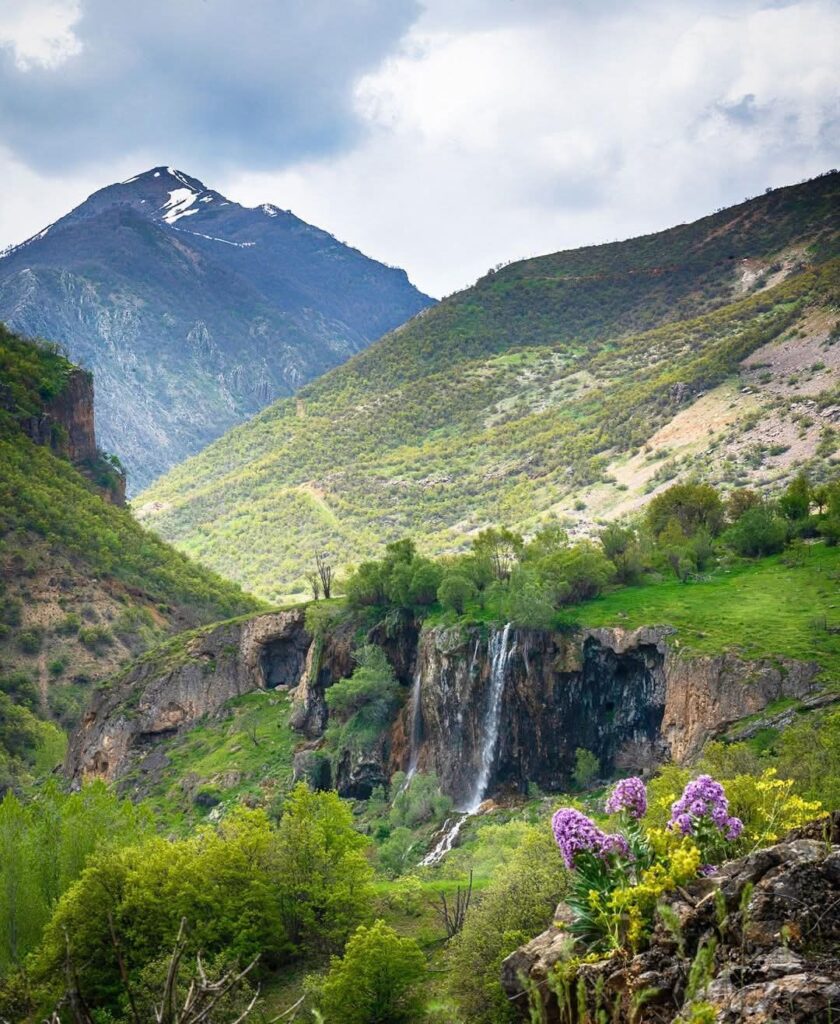
    Among such is, for example, the question of the interaction of ancient Armenian culture with the cultures of neighbouring peoples — emphasizing the independence and high development of ancient Armenian culture.

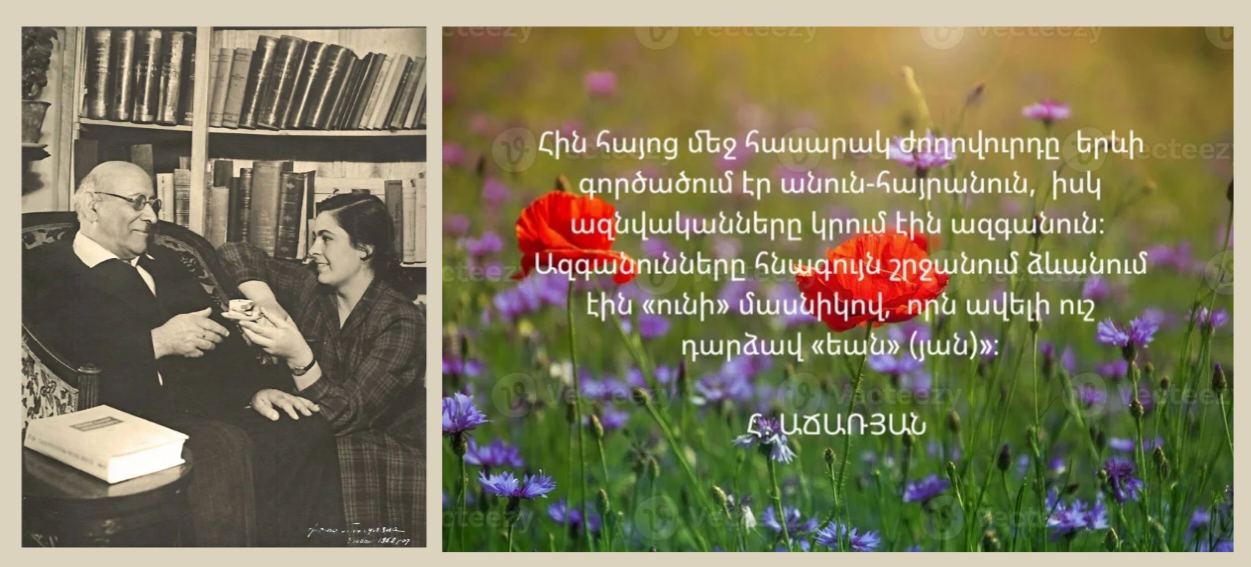
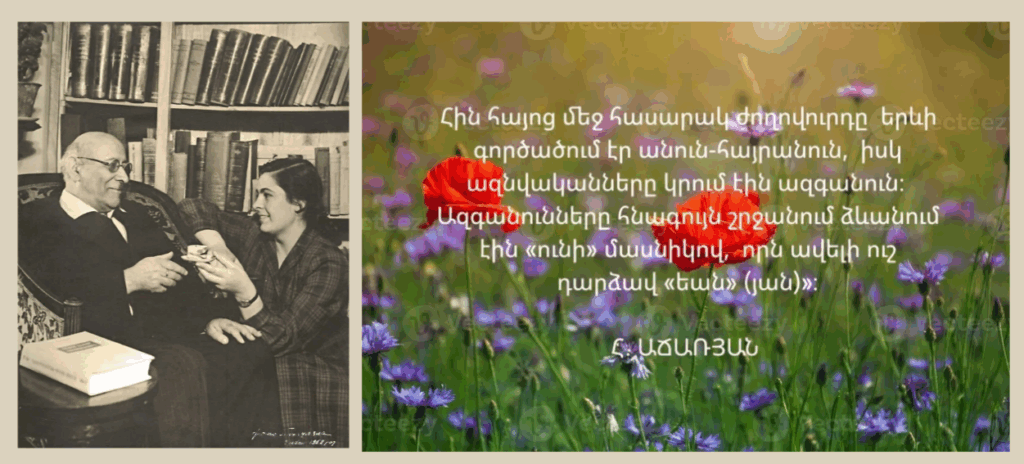
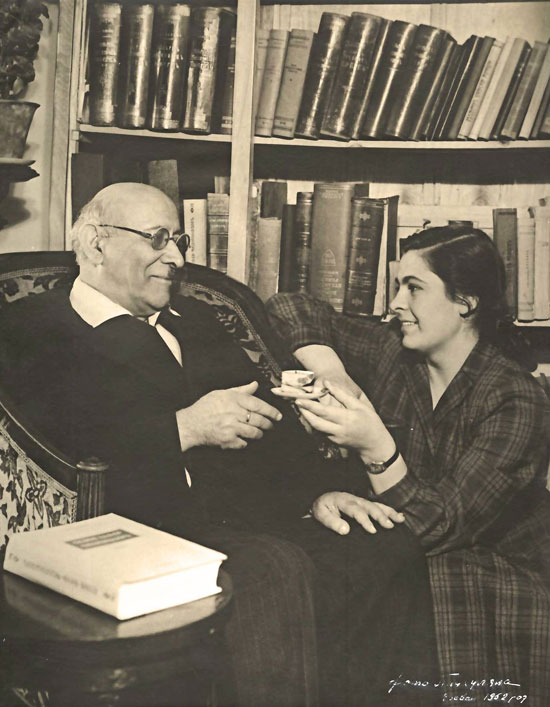
    In the photo — Hrachya Acharyan with his daughter — Knarik

  • «ARMENIAN PERSONAL NAMES»  (Part D) H. ACHARYAN

    «ARMENIAN PERSONAL NAMES» (Part D) H. ACHARYAN

    «ARMENIAN PERSONAL NAMES» (Part D)
    H. ACHARYAN

    The continuation of H. Acharyan’s article «Armenian personal names» — below (the beginning — in the three preceding posts).

    «Now I speak about surnames.
    When the community is small, the name is enough to distinguish the individual from the remaining members of the community.
    For example, in a village where there are only 10-20-30 householders, dividing the two sexes, only about half of it will be men and as many women.
    So if there are some 100 names, that number is enough; everyone will know who Karapet is, or who Grigor is.
    But when the community grows, the number of houses rises to 100s and
    1000s, those few names are no longer enough. So either the number of names must be increased, which they do, or they must add to the names a second distinguishing means. The first stage of this development is formed by the adjective. On the name they put an adjective. They take some characteristic point from the outward or inward character of the same individual. For example — one of the emperors of the Romans was called Julius; this was an ordinary name among the Romans; there were many Juliuses; so, to distinguish this Julius from the other Juliuses, they called him «Julius Caesar». What does «caesar» mean; «caesar» means «with belly cut open»: When Julius’s mother was in labour, the birth was very difficult; the doctors were forced to cut open the mother’s belly and bring the child out that way; Julius was called «Julius with belly cut open»: Thereafter Julius Caesar became a great emperor, and his epithet «Caesar» came to mean «great emperor»; this is the word «kaysr».
    Names with adjectives are very common both in history and in our ordinary life; for example — Lenk-Timur (Lame Timur), Ivan Grozny (Ivan the Terrible), Ashot the Merciful, Vahan the Wolf, Ashot the Iron, Vasil the Thief, Bullock Amram, Blind Tatos, One-armed Sargis, Paltara Martin, Naprasni Gordi and so on:
    After adjectives one can put the individual’s place, the city where he was born or lived; thus — we have Grigor Narekatsi, Grigor Tatevatsi, Movses Khorenatsi, Khachatur Taronatsi, Gevorg Skevratsi, Nerses Lambronatsi and so on:
    The third means is the use of the patronymic; thus — Grigor son of Hovhannes, Trdat son of Khosrov, Smbat son of Ashot: Among the Turks — Huseyn oghlu Ali, Ali oghlu Suleyman and so on: Among the Arabs — Hasan ibni Ali, Ali ibni Vehpi, Mehemmet ibni Suleyman: To all of us the custom accepted among the Russians is known, the patronymic as a title of respect: Nikola Aleksandrovich, Vladimir Sergevich, in the feminine — Anna Grigorievna, Sofia Gerasimovna and so on:
    All three of these means we can call individual, or rather nicknames, than surnames.

    A surname is that which is placed on the whole generation or generations of a family and can continue from century to century. Thus — Mamikonyan, Bagratuni, Artsruni, Gnuni, Slkuni, Khorkhoruni, Hovnuni, Dziwnakan and so on, the nakharar families of the ancient Armenians, which continued for long centuries and in the Arab period gradually came to an end.
    There are nations that stop at the patronymic and do not pass on to the surname; such were the Turks and the Persians, who knew only Huseyn oghlu Ali or Huseyn Puseri Ali; and only in the last twenty years, following European orders, did they pass to the surname:
    It is interesting, I think, to know how the Persians passed to the surname. It was in the year 1918; the Persian government announced that henceforth titles would be abolished and everyone must choose a surname for himself. Everyone fell into the depths of reflection and invented something from somewhere and
    announced in the newspaper that I am taking such and such a surname. No one else had the right to take that surname any more. Two years that operation lasted and every family or household became the owner of a different surname:
    The Arabs too have stopped at the patronymic, and since the patronymic alone was too little to distinguish the various members of the community from one another, they added to it also a nickname and the place that person is from:
    Among the Arabs there is also another strange custom, which is peculiar to the Arabs alone. Let us suppose a man named Hasan; let us suppose that he is the son of Huseyn, so he becomes Hasan-ibni-Huseyn; he is, let us say, from the city of Baghdad, so he becomes
    Hasan-ibni-Huseyn-el-Baghdadi; he has a nickname, let us suppose — Fattah; the whole becomes Hasan-ibni-Huseyn-el-Baghdadi-Fattah: But this much is little; he married, had a son named Ali; the father now takes upon himself apu-Ali, that is — the title «father of Ali» and becomes Hasan-ibni-Huseyn-el-Baghdadi-apu-Ali-Fattah: The sons multiplied; he had two more sons, one Mustafa and the other Suleyman. So that man became — Hasan-ibni-Huseyn-el-Baghdadi apu Ali-apu-Mustafa-apu- Suleyman-Fattah: In Arab history and literature we very often come across such yard-long names; for example — there is a poet whose name is — Izz-ed-din-Abdul-Futavel- Ardul-Vahap-Amad-ed-din. ibn-Ibrahim-el-Senjani: The secretary of one of the sultans of Egypt is Sheykh- ar – Rayis -Safi – ad- Davlav ibni – abu – Maali – ibni-Sharafi:
    One of the Arab travellers is called Abu – Abdallah – Muhammed-bin-Abdullah – bin-Muhammed-bin-Ibrahim-el-Vatiwed-Danji-ibni Batuta – Nemm – ed – Din: There is an Arab physician whose name is Zia-ed-din-apu-Muhammed-Ardallah – bin- Ahmed-en-Nubati-el-Malaqi: The Arab historian Ibn-Khallikan in his book «Vefayat el Aayan» (trans. G. Msrlyan, Cairo, 1935, p. 8), names one of the emirs of Khorasan thus: – El emir Kuteyba bin abi Salih Muslim bin Amr bin el Hoseyn bin Rabia bin Khalid bin Esid el Kheyr bin Kudayi bin Hilal bin Salama bin Saalaba bin Vail bin Maan bin Malik Aasar bin Saag bin Kays Aylan bin Modar bin Nizar bin Muadd bin Adnan el Bahili:
    This is the whole genealogy of that man. Ibn-Khallikan another time also gives the long name of a prince and then adds: «The rest I do not remember»:
    Unfortunately I too do not remember the page.
    Patronymics can be repeated, that is — putting the name of the grandfather and of the grandfather’s father, perhaps also of the grandfather’s grandfather.
    The Arab custom little by little or partly spread to subject or co-religionist tribes; for example — one of the kings of Madagascar is called Andrianampoinimerina:

    The Spaniards too love to form long names. There is a fable.
    «In South America a Spaniard has lost his way in the forest at night; forced, he knocks at the door of an Englishman and asks him to let him spend the night; the Englishman, opening the window in the dark, asks — who is it?
    The Spaniard answers: «Fernando-dellos-Vestos-Servalos-Minkos-Santa-kuzeno-Tikhonos»:
    Our house is small, there is no room for so many people, says the Englishman and closes the window»:

    To be continued…

  • «ARMENIAN PERSONAL NAMES», (Part C) H. ACHARYAN

    «ARMENIAN PERSONAL NAMES», (Part C) H. ACHARYAN

    «ARMENIAN PERSONAL NAMES», (Part C)
    H. ACHARYAN

    The continuation of H. Acharyan’s article «Armenian personal names» — below (the beginning in the previous two publications)…

    1. ARABIC NAMES
      Above we showed that personal names in general have a religious character and, accordingly, being taken from nations of the same religion — they spread together with their religion:
      Bearing in mind this universal phenomenon, strange, certainly, is the circumstance that the Armenians, even in the most brilliant years of Christianity, accepted the personal names of nations religiously hostile to them, such as the Arabs and the Turks: I do not know how this phenomenon should be explained: Certainly the Mohammedans did not compel us to accept their names by force: Probably this too is the result of the natural influence of the dominant element, an influence which in every form and every circumstance does its work, and draws to itself, unites to itself the small, conquered nations:
      Arabic names known in our ancient history are Ablkharip, Abusahl, Hamam, Mleh and so on: Some were also used in Armenian translation, such as Chnchghuk, which is the translation of the Arabic synonym Hamam:
    2. LATIN NAMES
      In the days of the Rubenids, with the growth of relations, the use of Latin names also increased, such as — Anton, Levon, Zapel, Alis, Hetum, Ogostinos and so on: With the fall of the Rubenid state the Latin names were wiped out and today barely a few of them are alive:
    3. ARMENIAN RELIGIOUS NAMES
      After the spread of Christianity, at the time of the flood of Hebrew and Greek names, a new idea arose among the Armenians, that is — to translate the foreign Christian names: Against the Greek name Anastas they set Harutiwn, against Apostol — Arakel, against Teodoros — Astuatsatur, against Stavri — Khachik, against the Hebrew Set — Mkhitar and so on: This phenomenon, certainly, was the work of the Hellenist fathers and an undertaking of national zeal among the Armenians: They did not pay attention to the circumstance whether the original form of these translated names was really in use among the Armenians or not: For example — Anastas, Teodoros and so on have been names known to the Armenians, but Apostol, Stavri and so on have not been in use among us: Parallel with the translation there entered also new names formed by analogy, all of them expressions of Christian life, words close and comprehensible to the mind and heart of the Armenian people, whereby the dictionary of our personal names was doubly enlarged: Such are — Hambardzum, Zatik, Galust, Margar, Tiratur, Khachatur, Kristostur, Khacheres, Tseron, Karapet, Mkrtich, Avetis, Avag, Makruhi, Srbuhi, Tiruhi and so on, and so on, which, from that day until now, are more or less in use among us:
      From the point of view of the history of our intellectual development it would be very interesting to determine when the time of the origin of these names is:

    11. ARMENIAN POPULAR NAMES
    Besides the Armenian religious names there are numerous other names, which, although they are names formed in Armenian, do not revolve around Christian beliefs, but by their meaning represent more real life and very often represent lovely secular poetic images: For example — Tukhtsam – black-haired, Shaghoski – who scatters gold, Vardit’er – rose petal, Heriknaz – enough of how much you coquet: Among the names of this series are — Zanazan, Varderes, Loysparon, Norarev, Vardympu, Andzrevard, Norvard, Nortikin, Vardmanuk, Knarik and so on:
    These are the native, genuine, self-made names of the Armenian common people, of the villager, which shine with exceptional brilliance within the circle of the religious names cherished by the ecclesiastical class and of the foreign names loved by the noble class:

    12. SELJUK-TATAR NAMES
    Almost contemporary with the Armenian popular names are those numerous personal names which the Armenian people borrowed from the Tatar, Seljuk and New Persian Mohammedan nations: The Armenian people in general knew those languages very well, whereby it very easily penetrated the inner meaning of the personal names and, charmed by the beautiful images seen in them — took and adopted them: For example — Aslan-lion, Jivanshir-young lion, Bahalu – precious, Bayrak-banner, Dulbahar-spring rose, Guldasta-bunch of roses, Gulmelik-queen of roses, Gulnigar-rose-painted, Hakhbanda-servant of God, Hakhnazar-God-seeing, Etar – it is enough, Tamam – perfect, Tangrighuli-servant of God, Turfanta – early first-fruit, Khutlu-melik (Tatar) happy or blessed king:

    13. EUROPEAN NAMES
    These are borrowings of an entirely new time, which were taken from French, Italian and English; they were in use exclusively among the Western Armenians, especially among the Catholic Armenians, such as — Zhozef or Juzepo (Hovsep), Jiwan (Hovhannes Italian Giovanni), Valandin, Alberd, Eduard, Viktoria, Ozhen, Verzhin, Atolf, Rotolf and so on, and so on:
    Of these the Italian forms have already disappeared among the Western Armenians, while the others are not much used now, except the female names, which have become dearer than the male ones because a rich store of female personal names is lacking among the Western Armenians: Recently European names have also entered the Caucasus, such as — Emma, Eleonora (shortened — Nora), Juleta, Ofelia, Valendina, Eduard, even — Napoleon, Hamled, Henri and so on:

      14. RUSSIAN NAMES
      Recently purely Russian names have begun to multiply in the Russian-Armenian world (the Caucasus and especially Russia): Some of the Russian Armenians seek and find a corresponding Russian name in place of their old name and use it in this form generally; thus — Nikoghos becomes Nikola, Gevorg — Georgi or Egor, Hovhannes — Ivan, Grigor — Grigoriy and so on:
      This work has gone so far that even entirely non-corresponding names are very often officially yoked together, it is enough that a similar-sounding letter or sound be found in the two words:
      Thus — Mkrtich becomes Nikit, Harutiwn — Artem or Artom, Sahak — Sava, Martiros — Martin, Vagharshak — Volodia, Arshak — Arkadi and so on, which have no connection whatsoever with each other: In this «art» the Armenians of Nor-Nakhijevan are especially notable:
      Particularly esteemed and usual are the endearing names, such as — Misha (Mikayel), Sasha (Agheksandr), Masha (Mariam), Todia (Teodoros), Liza (Eghisabet), Kolia (Nikoghayos), Katia (Katarine) and so on:
      New Russian names are — Vlatimir, Olga, Olia, Olinka, Dusia, Dunia, Marusia and so on:

      15. ARMENIAN NATIONAL NAMES
      Under this name I classify those Armenian personal names which began to be used among us after the awakening of Armenian national self-consciousness, that is in the last 80 years: This national self-consciousness, which, rejecting the purely religious and foreign names, brought out from the pages of history the almost forgotten Armenian historical names and put them into general use, was not satisfied with these alone and began to create proper names, all of them in the purely Armenian language and within the circle of Armenian national ideas.
      Here is a small list of such new names — Hayastan, Araksi, Masis, Ararat, Armenuhi, Haykuhi, Azat, Siranoysh, Varsanoysh, Hranoysh, Hrazdan, Hrayy, Hrachuhi, Berkruhi, Vshtik, Martik (not shortened from the word Martiros, but the Armenian martik — «fighter»), Haykazn, Haykaram, Aghavni, Artsvik, Yasmik, Knarik, Arpenik, Azniv, Sirakan, Lusik, Lusntag, Geghuhi, Azatuhi, Paylak and so on:

        Names also depend on place and circumstance: All the sections of the Armenian people, both in Armenia and in the colonies, have not always been subject to a single domination and, consequently, were not subjected to one influence: Pahlavi names could have been spread in the eastern parts of Armenia, while Greek names — in the more western parts, and Syriac names in the southern parts: The local difference is more definite at present: The Armenians of the Caucasus use Russian names, none of which has entered Western Armenia and the colonies:
        The Armenians of Hungary, Poland and Romania naturally have Hungarian, Polish and Romanian names, which have not at all entered among us:

        Circumstances too have a great influence on the spread of names:
        The upper class, as a lover of novelty and brilliance, usually soon forgets the old and the native, loves foreign names more and is their first borrower, whereas the common people is more faithful to what it has: Pahlavi names first entered the noble class; kings, princes and nakharars loved to be called by the names of the Arshakuni and Sasanian royal houses: Syriac, Hebrew and Greek names entered first the religious class and through it spread among the people:
        That is why, when someone takes a religious vocation, his secular name (especially if it is pagan) is removed and in its place is put a religious name, which is Greek, Hebrew or Syriac:
        Thus — when Trdat left the royal throne and became a hermit, he was called Hovhannes:
        When the sparapet Hetum of the Rubenids left the sword and entered a monastery, he was called Anton: This custom continues until now:
        The Armenian national names were invented mainly in Constantinople and little by little spread towards the East:
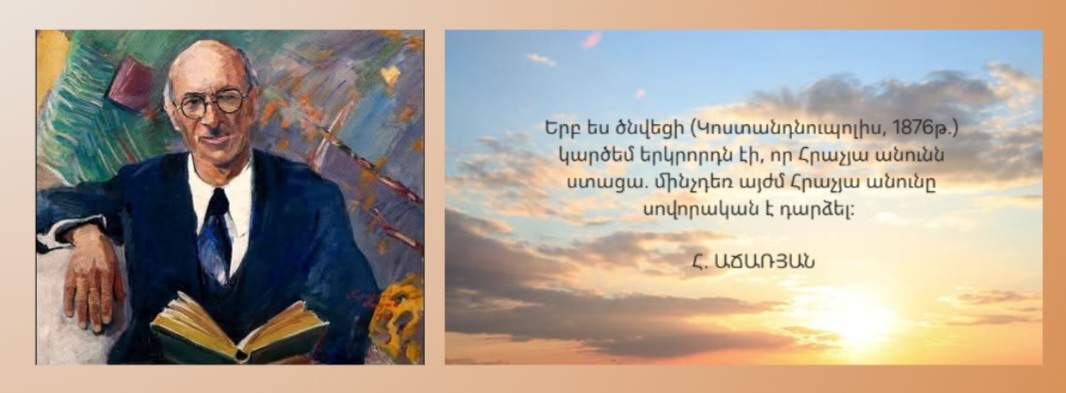
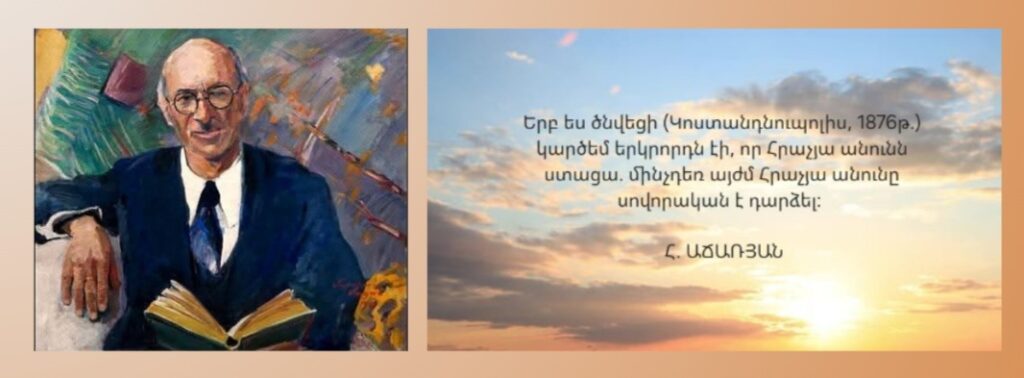
        When I was born (Constantinople, 1876) I was, I think, the second to receive the name Hracheay; whereas now the name Hracheay has become usual: If we go to a remote village, the usual names we hear will be the Hebrew, Greek and Turkish names, while the genuinely Armenian, Pahlavi, European, Russian and Armenian national names — hardly ever:
        Whereas in Constantinople, Yerevan and other educated centres (Tiflis, Smyrna), the former have already become disused, and rather these latter exist:

        In the previous article I spoke about the origin of names:
        The summary of what I said is this.

        The name is the means by which a member of society (the individual) is distinguished from the remaining members: Every name is a word that has its definite meaning:

        Names are often borrowed from nation to nation and become general:
        The Armenians, though they have their native own names, but these are very few:
        The names we use are for the most part foreign — Pahlavi, Persian, Greek, Hebrew, Turkish and in various European languages, among which we also place the Russian names:

        Now I speak about surnames…

        To be continued…

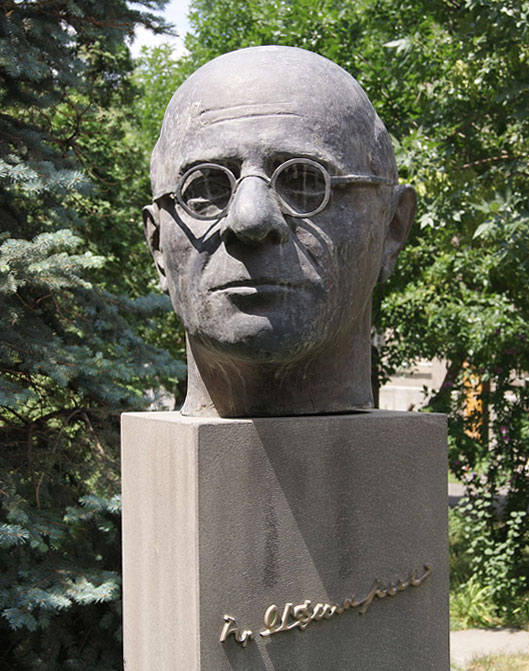
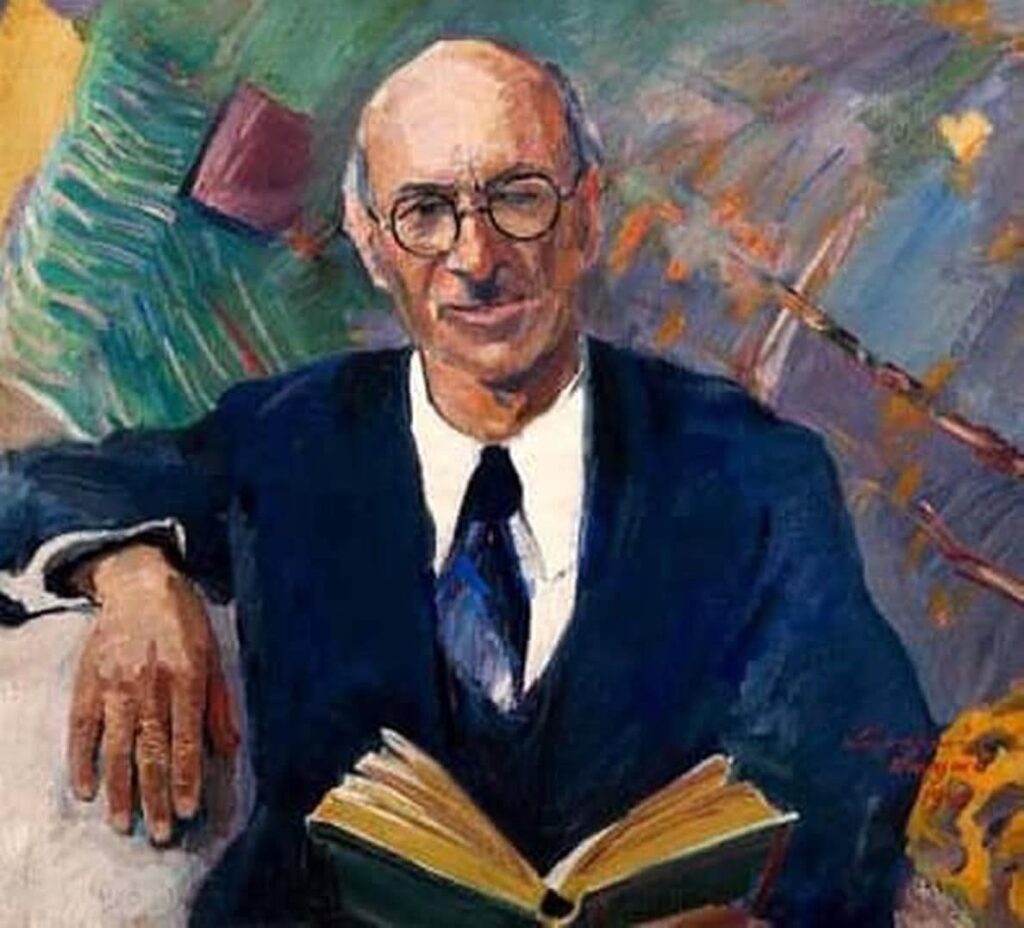
        Portrait of H. Acharyan (by Martiros Saryan)

      1. «ARMENIAN PERSONAL NAMES», (Part B) H. ACHARYAN

        «ARMENIAN PERSONAL NAMES», (Part B) H. ACHARYAN

        «ARMENIAN PERSONAL NAMES», (Part B)
        H. ACHARYAN

        The beginning — with the previous publication:

        «Any mountain, lake, sea and river has an eternal life; any city or village has a life of hundreds and thousands of years; consequently their name too is in general permanent and enduring: But the life of persons has a duration of at most one century:

        The generation passes, ideas change, influences change and the names too disappear together with them — giving way to ever new forms:

        The durability of personal names depends to a certain extent on a few circumstances, which are.

        1. The shortness of the word –
          Excessively long names are soon forgotten or at least are so shortened that they become unrecognizable any longer: Abednago, Agatangeghos because of their length did not find success or were soon, forgotten: As long as the first is Astuatsatur, which, though a very usual
          name, has nowhere been preserved in its original form, but with various shortenings has become — Asatur, Astur, Astik, Aso, Tsatur, Tsati:
          In general two-syllable names are loved; names having more than two syllables are shortened; this is why Martiros becomes Marto, Mrto, Martik.– Mkrtich becomes Mkyr, Mko, Mikit, Mikich, Mukuch.– Hripsime becomes Horop, Horom, Huri: – Eghisabet becomes Eghis, Ekhsa, Ekhso, Sabet, and in the European languages too — Eliz, Eliza, Liza, Izabella, Zabel, Bela and so on:
        2. The harmony of the word –
          According to the artistic taste of each nation and people, names considered harsh-sounding and ugly-sounding are naturally soon wiped out, while names having a pleasant sound are always more sought:
        3. The beauty of the meaning –
          A name considered meaningless or ugly grows old and withdraws from the arena sooner than a name beautiful in meaning… Varduhi is a very old name, it existed in the 5th century, it is mentioned in the Haysmavurk and will still live long: So also — Shushan or Shushanik: Equally pleasant are Manishak, Siranoysh, Hranoysh, Varsenik and so on, whereas Agapi, Evpraksia, Heghine, Katarine are already forgotten and disappearing names:
        4. The circumstance that the persons bearing that name happened to be famous and unforgettable people has caused those names to live long; thus Abgar, Vardan, Hayk, Nerses, Sahak, Mesrop are unforgettable names, because in our history we have had famous personalities called by these names: While Vasak, Yuda, Meruzhan — are dead, unusable names, because famous betrayers and traitors have been found with these names: The name itself has no significance here; the word Vasak is really more beautiful than Vardan; but the bad memory of the «apostate» Vasak has caused the beauty and harmony of that name to be forgotten: (In that war, which took place because of discord, Vasak — faithful to the national sources — inspired the sons of Hayk with the valiant deeds of the Armenian Ancestors, while Ghevond the priest — as a Christian, reminded the Armenian soldiers of the ancestors of another nation — Abraham, Isaac… K. A.)
        5. Religious or national ideas.– These are according to the bent of the time: There was a time when religious feeling was the chief guide of life; at that time names were more religious, such as — Astuatsatur, Toros, Kirakos, Markos, Ghukas, Matteos, Petros, Poghos and so on: Religious feeling passed away and gave way to the purely national period: That was in the middle of the last century: At that time religious names became unpleasant and in their place began the Armenian national names – Vardan, Eruand, Zareh, Gurgen, Artashes, Hracheay, Zarmayr, Paroyr and so on:

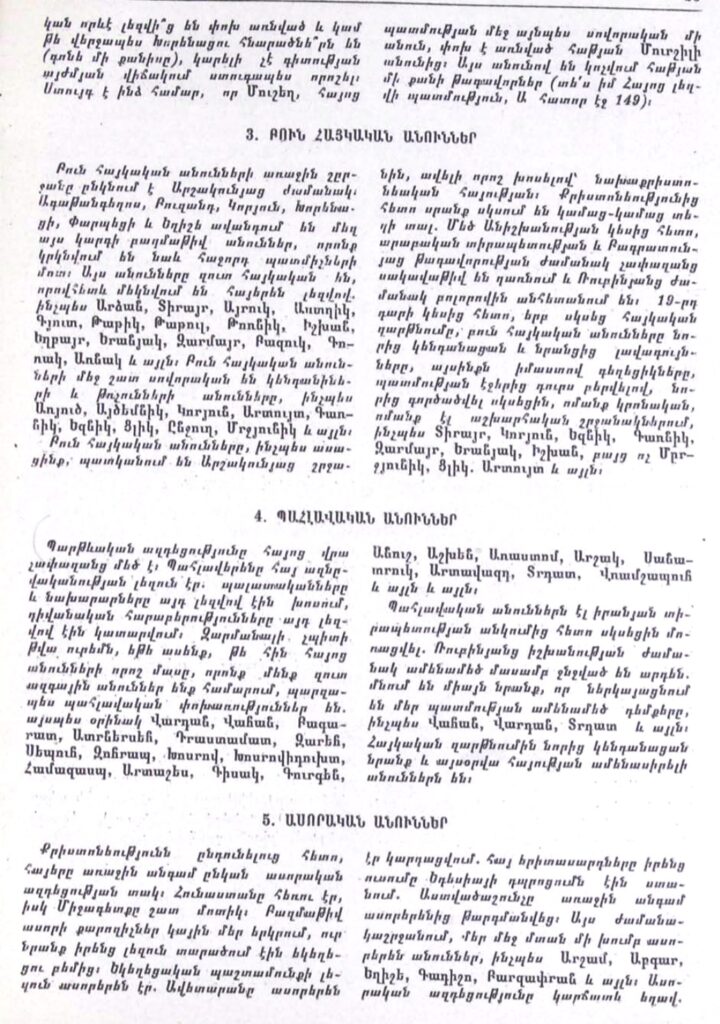
        If we wish to arrange the Armenian personal names in their distinct groups and present the influences to which they have been subjected from our most ancient period until today, we will see that they form 15 groups, which correspond to 15 periods, which are the following — in chronological order.

        1. PRE-ARMENIAN NAMES
          The pre-Armenian names belong to that people which occupied Armenia: The Armenian language, certainly, took much from them; to this category belong our place names:
          It is almost certain that the place names of Armenia are for the most part pre-Armenian (Khaldian) borrowings; such as — Ararat, Van, Archesh, Karin, Masis and so on, and so on, which cannot be explained in Armenian at all: By the reasoning brought a little earlier — personal names are much fewer:
          Among these we can mention Aram and Manavaz: The first, certainly, comes from the name of the famous Khaldian king Arame (Between them there is a difference of almost one millennium, K. A.): The second sounds very similar to the royal name Menvas, but that is accidental and Manavaz is an Iranian name: We leave aside those numerous uncertain forms, particularly the nakharar clan names, which in the opinion of various authors — come from pre-Armenian Khaldian names:

        1. UNKNOWN NAMES
          Khorenatsi in Book I of his History gives us a group of Armenian names whose origin is entirely unknown: To this category belong Hayk, Armenak, Aramayis, Amasia, Harma, Ara, Dardos and so on, and so on, which are surely not Armenian, since they cannot be explained in Armenian: Whether these too belong to the Khaldian period, or are remnants of Hattian names, or are borrowed from some Phrygian language, or finally are inventions of Khorenatsi (at least some of them), cannot be determined with certainty in the present state of science: It is certain for me that Mushegh, so usual a name in Armenian history, is borrowed from the Hattian name Murshili: Several Hattian kings are called by this name (see my History of the Armenian Language, vol. I, p. 149):
        1. GENUINE ARMENIAN NAMES
          The first period of genuine Armenian names falls in the time of the Arshakunis: Agathangelos, Buzand, Koryun, Khorenatsi, Parpetsi and Eghishe hand down to us numerous names of this category, which are repeated also in the succeeding historians: These names are purely Armenian, because they are explained in the Armenian language; such as — Ardzan, Tirayr, Ayruk, Astghik, Giut, Tatik, Tatul, Tornik, Ishkhan, Eghbayr, Eraneak, Zarmayr, Bazuk, Gorak, Arnak and so on: Among genuine Armenian names the names of animals and birds are very usual, such as — Ariudz, Aytsemnik, Koriun, Artoyt, Garnik, Eznik, Tslik, Enjugh, Mrjiunik and so on:

        The genuine Armenian names, as we said, belong to the Arshakuni period, speaking more definitely — to pre-Christian Armenians: After Christianity these begin little by little to give way; after the middle of the Great Anarchy, at the time of the Arab domination and of the Bagratuni kingdom they become exceedingly few and in the time of the Rubenids they disappear entirely: After the middle of the 19th century, when the Armenian awakening began, the genuine Armenian names came alive again and the best of them, that is those beautiful in meaning, being brought out from the pages of history, began to be used again — some in religious, some in secular circles, such as — Tirayr, Koriun, Eznik, Garnik, Zarmayr, Eraneak, Ishkhan, but not Mrjiunik, Tslik, Artoyt and so on:

        1. PAHLAVI NAMES
          The Parthian influence on the Armenians is exceedingly great: Pahlavi was the language of the Armenian nobility; the courtiers and the nakharars spoke that language, chancery relations were conducted in that language: It should not seem astonishing, then, if we say that a certain part of the names of the ancient Armenians, which we consider purely national names, are simply Pahlavi borrowings; thus, for example, Vardan, Vahan, Bagarat, Atrnerseh,
          Drastamat, Zareh, Sepuh, Zohrap, Khosrov, Khosrovidukht, Hamazasp, Artashes, Gisak, Gurgen, Anoysh, Ashkhen, Arastom, Arshak, Sanatruk, Artavazd, Trdat, Vramshapuh and so on, and so on:
          The Pahlavi names too began to be forgotten after the fall of the Iranian domination: In the time of the Rubenid principality they are for the most part already wiped out; there remain only those which represent the greatest figures of our history, such as — Vahan, Vardan, Trdat and so on: With the Armenian awakening they came alive again and are the most beloved names of today’s Armenians:
        1. SYRIAC NAMES
          After accepting Christianity, the Armenians for the first time fell under Syriac influence: Greece was far, while Mesopotamia was very near: There were numerous Syrian preachers in our country, where they spread their language from the church pulpit: The language of church worship was Syriac: The Gospel was read in Syriac: Armenian young men received their education in the school of Edessa: The Bible was first translated from Syriac: In this period a group of Syriac names entered among us, such as — Arsham, Abgar, Eghishe, Gadisho, Barzapran and so on:
          The Syriac influence was short-lived; soon came the Greek and then the purely Armenian civilization, which stifled the Syriac: The Syriac names too were wiped out and of them barely one or two have life today; that is — Abgar and Eghishe, which live thanks to the circumstance that they represent the name of our first Christian king (according to tradition) and of our most beloved poet-historian:
        2. HEBREW NAMES
          Among the nations deeply influenced by Hebrew civilization we too are found: It is true that this influence is not the result of direct relations and has reached us through the Greeks, but it has been so strong that it would not have had a very different form if it had been the product of direct relations: Through Christianity and the Bible a great number of personal names has passed to us from Hebrew, which for 1600 years has filled our whole life:
          Adam, Eva, Abel, Abraham, Set, Sahak, Daniel, Gabriel, Davit, Esayi, Hakob, Zakaria, Soghomon and so on, and so on: They are names so familiar to all strata of the Armenian people, so usual, so Armenianized and to such a degree domestic, that they will still live for centuries and centuries; and one can hardly say that they will ever be able to be wiped out from among the Armenians and the world:
          The Hebrew names have passed to us through the translation of the Bible, and because our Bible was translated from Greek and not directly from Hebrew, these names too bear a Greek stamp: Here the most salient point is the following – in the Greek language there is no «sh» sound; so wherever Hebrew has «sh», the Greek puts «s»: We too, though we have the «sh» sound, following Greek — put «s»: Thus, for example — the Hebrew says «Yerushlim», while we say «Erusaghem»: This phenomenon is common to all European nations:
        1. GREEK NAMES
          The Greek has been the spreader of Christianity and the nurse of world
          civilization; there is no nation in this world which is not indebted to Greek civilization for something:

        Even the Chinese have words borrowed from Greek: Particularly our nation has been influenced by the Greeks to the greatest extent: If our pre-Christian civilization was entirely Parthian civilization, our post-Christian civilization too is fully Greek: A part of our literature is an imitation of the Greek; our first books were translated from Greek authors; and this thing continued
        until the Rubenid kingdom: The Bible, the Gospel, the Mashtots, the Lives of the Saints, the Haysmavurk, the Book of Mysteries — were translated from Greek or edited on the Greek model:
        The natural result of such a great influence is also an abundant number of proper names, which from the 4th century until today has dominated Armenian life; for example — Anastas (resurrection), Ghevond (lion), Vasil (king), Gevorg (farmer), Grigor (wakeful), Teodoros (God-given), Pilipos (horse-loving), Kirakos (of the Lord), Hripsime (fallen), Agapi (love), Stepan (crown) and so on»…

        To be continued…

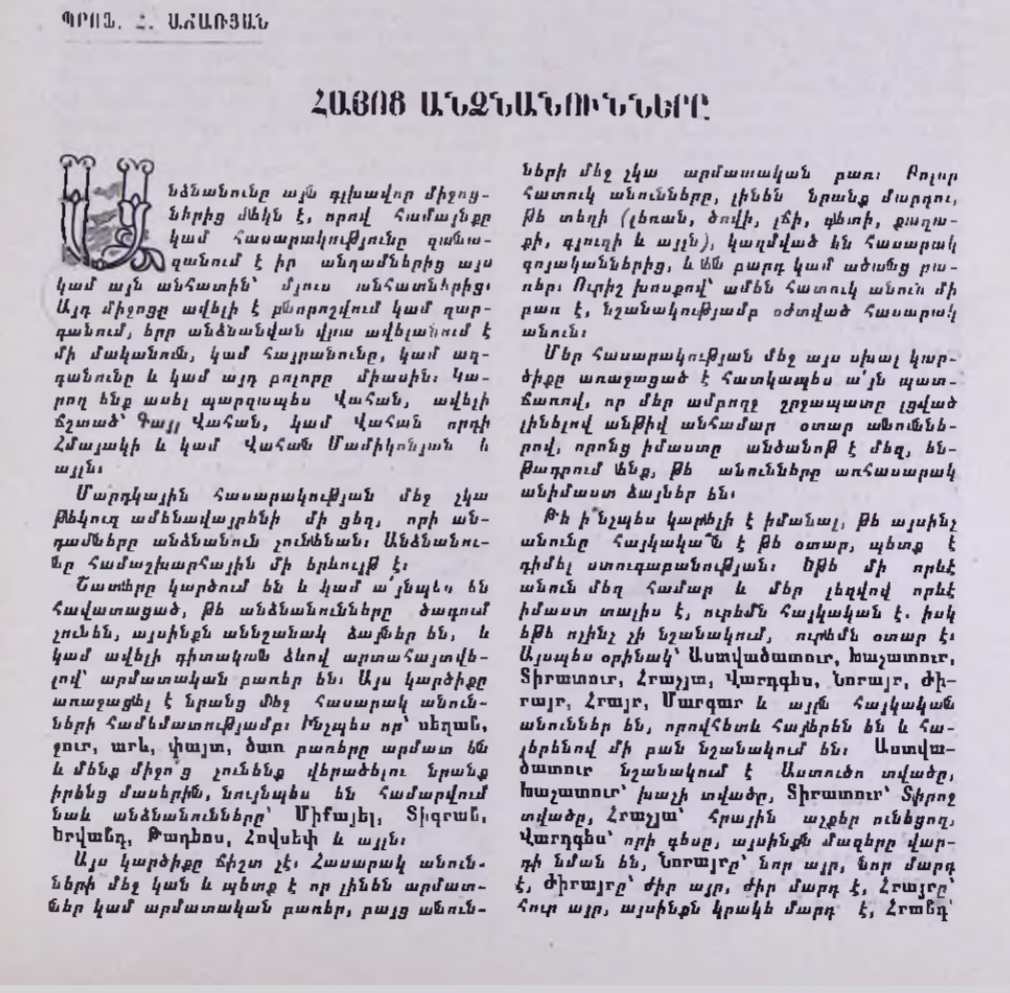
      2. «ARMENIAN PERSONAL NAMES» (Part A) (H. ACHARYAN)

        «ARMENIAN PERSONAL NAMES» (Part A) (H. ACHARYAN)

        «ARMENIAN PERSONAL NAMES» (Part A) (H. ACHARYAN)

        The history and culture of a given nation are reflected in personal names, surnames, place names.
        The study, the elucidation of the origin of the names and surnames of the Armenians, who over millennia, dictated by the political situation, «travelled a certain road» with various nations, reveals numerous genealogical pages — with the layers of the influences undergone.

        An excerpt from Hrachya Acharyan’s article «Armenian personal names» — below (Part A, the continuation — with the next publication)…

        «The personal name is one of the principal means by which the community or society distinguishes this or that individual among its members — from the other individuals: This means becomes more defined or develops when to the personal name is added a nickname, or the patronymic, or the surname – or all these together: We can say simply Vahan, more precisely — Gayl Vahan, or Vahan son of Hmayeak, or Vahan Mamikonean and so on:
        In human society there is not a single tribe, even the most savage,
        whose members do not have personal names:
        The personal name is a universal phenomenon:
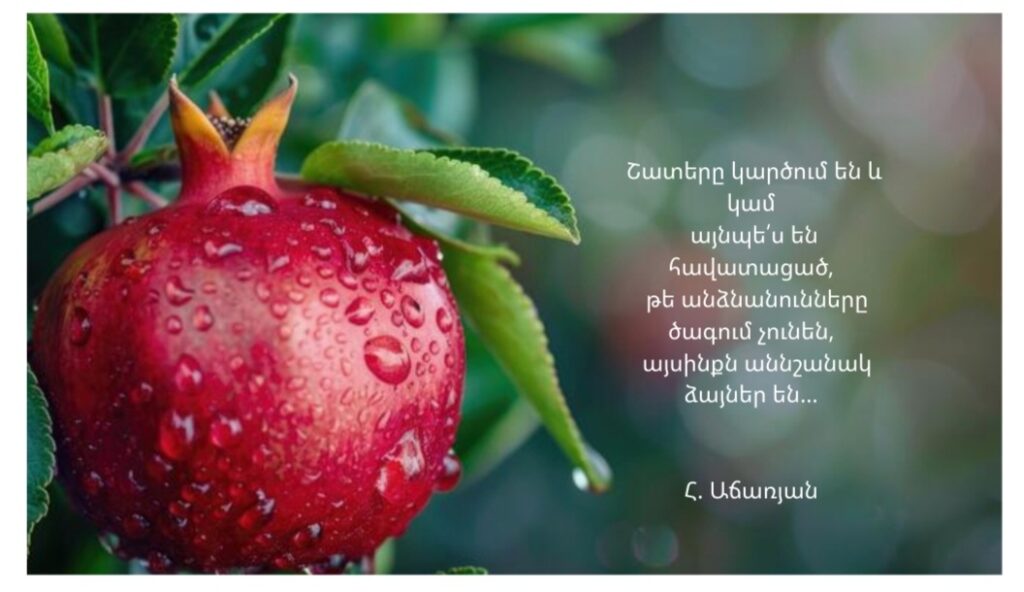
        Many think or are so convinced that personal names have no origin, that is, they are meaningless sounds, or, expressing it in a more scientific way — they are root words: This opinion arose among them by comparison with common nouns: Just as the words table, water, sun, wood, tree are roots and we have no means of reducing them to their parts, so too are considered the personal names — Mikayel, Tigran, Eruand, Tadeos, Yovsep and so on:

        This opinion is not correct: Among common nouns there are and must be roots or root words, but among names there is no root word: All proper names, whether they be of a man or of a place (of a mountain, a sea, a lake, a river, a city, a village and so on), are formed from common nouns, and are compound or derived words: In other words — every proper name is a word, a common noun given with a meaning:
        In our society this wrong opinion has arisen especially for this reason, that our whole surroundings being filled with countless, innumerable foreign names, whose meaning is unknown to us, we suppose that names in general are meaningless sounds:

        As to how one can know whether such-and-such a name is Armenian or foreign, one must turn to etymology: If some name gives some meaning for us and in our language, then it is Armenian; and if it means nothing, then it is foreign: Thus for example — Astvatsatur, Khachatur, Tiratur, Hracheay, Vardges, Norayr, Zhirayr, Hrayr, Margar — and so on are Armenian names, because they are Armenian and mean something in Armenian: Astvatsatur means given by God, Khachatur — given by the cross, Tiratur — given by the Lord, Hracheay — having fiery eyes, Vardges — whose ges, that is hair, is like a rose, Norayr — is a new man, a new person, Zhirayr — is an agile man, an agile person, Hrayr — is a fire man, that is a man of fire, Hrand — fire is there, there — in the heart a fire is kindled, Margar – is a prophet, a foreteller of the future, and so on:


        While Petros, Poghos, Levon, Gurgen, Grigor, Pilipos, Arzuman, Ruben, Alaverdi, Senekerim and so on have no meaning whatsoever in Armenian, consequently — they are not Armenian names.
        They are foreign names and each belongs to that nation in whose language it is etymologized or from which it was taken: Petros is Greek and in Greek Petros means «stone»… Poghos is Latin and Latin paulus or paullus means «little», Levon is Greek and Latin; in these two languages Leo, Leon means «lion»: Gurgen is Pahlavi or Persian and Persian or Pahlavi gurg, gurgen means «wolf, little wolf», Grigor is Greek and Greek Grigorios means «wakeful», Pilipos is Greek, because it comes from the Greek words philo «to love» and hippos «horse» and means «horse-lover, loving horses»:
        Arzuman is a Persian proper name, because it comes from the Persian word arzumend «longing, desiring», Alaverdi is a Turkish name, because it comes from the words Allah «God» and verdi «gave», Ruben ben is Hebrew and in Hebrew rau means «see, son»… Senekerim is Assyrian and in this language sin ahhe eriba means «God multiplied my brothers»:

        Female names have this advantage over male ones, that among them the Armenian ones are comparatively more numerous: Thus, for example, of Armenian origin are Siranoysh, Makruhi, Tiruhi, Taguhi, Srbuhi, Iskuhi, Yasmik, Manishak, Varduhi, Lusntag, Mayranoysh, Hamaspyur, Erjanik, Armenuhi, Arshaloys, Arevhat, Aregnazan, Nazenik, Varsenik and so on, and so on:
        This positive side of female names, however, is the result of a negative phenomenon – among the ancient Armenians giving a woman’s name was considered shameful, and instead of calling a woman by her own name, they said «the daughter of so-and-so»: From this arose Tigranuhi, Khosrovidukht, Sahakanoysh, Smbatuhi, Smbatanoysh and so on, which are not really names, as we mistakenly think, but mean «Tigran’s daughter, Khosrov’s daughter, Sahak’s daughter» and so on:
        Trdat’s sister was called Khosrovidukht, because she was the daughter of Khosrov the Great; the two daughters of Smbat Bagratuni were called Smbatanoysh and Smbatuhi: Even now in the villages of Karabakh or Zangezur women and maidens are called in the same way. «Balasan’s daughter», instead of saying Arusyak and so on:

        The phenomenon is not very different from that custom of the European countries, by which every maiden is called by her father’s surname and every woman by her husband’s surname, without mention of her birth name: Among the French giving a woman’s own name is the greatest insult; only street women are called so: This is why our old literature too is exceedingly stingy with regard to female names:
        In Armenian history there is no female name: The positive result of this negative phenomenon was that when in the middle of the last century the awakening of Armenian self-consciousness began, owing to having no Armenian female names a free field opened for word-formation and they began to compose new female names of every kind:
        Among the Armenians a considerable part of the genuinely Armenian names is foreign: Almost in the same situation are also our surrounding nations; thus, among the Russians, beside Vsevolod, Vladimir, Svyatoslav, Yaroslav, Lyudmila and other names of purely Russian or Slavic origin there are — Ivan, Sergey, Nikola, Dmitri, Aleksandr, Pyotr, Pavel, Serafim, Yakov, Khristafor and other foreign names:

        Among the Persians native Iranian names are now very few, thus — Khusrev, Gurgen and so on, while Ahmed, Ali, Hasan, Huseyin, Suleyman, Abbas and so on are foreign: So it is also among the Turks, the Georgians, the Kurds:
        Not so, however, are the Arabs, the Indians, the Chinese, the Hebrews; nor were the ancient Greeks, the Latins and so on:
        All Arabic names — Ali, Osman, Omar, Hasan, Huseyin, Abbas and so on are purely Arabic and have their meaning in the Arabic language; Ali means «high«, Hasan means «beautiful», Huseyin — «pretty» and so on:
        All the names of the Indians are Indian, and among them there is no foreign name:
        Chinese names are always trisyllabic, as, for example — Kon Fu-Tsi, Li Hunk-Chank, Sun Yan-Tsen and so on; among these the first syllable is the surname, the other two name and patronymic:

        The phenomenon of having one’s own or foreign names is connected with the fact of having one’s own religion: The Hebrew has his own religion, which is Mosaism, and keeps his own names — Movses, Abraham, Isahak, Davit, Soghomon and so on:
        The Arab has his own religion, which is Mohammedanism, and keeps his Arabic names: The Indian, the Chinese have their own religions — Brahmanism, Buddhism, Confucianism, Laotseanism and so on, and therefore they keep their own names:
        And those nations which accepted the religion of another people, accepted their names too:
        The Turks, the Kurds, the Afghans accepted Mohammedanism, which is the religion of the Arabs, so they have no names of their own; their names are all Arabic:

        The Persians, in ancient times, when they followed their own Zoroastrian or Mazdean religion, had purely Persian (Iranian) names, while from the day when they accepted the Mohammedan religion and until now, they use only Arabic names:
        In this respect an interesting example is given by the Parsis, that is — the present-day fire-worshipping Persians of Persia and India, who until today keep the pure old Persian (Iranian) names:

        Europe anciently had two parts; the north and the east were barbarian, while the south and the west were held by the Greeks and the Romans, who had created a very old and very advanced culture: Both of these had their own names, the Greeks — purely Greek and the Romans — purely Latin:
        1900 years before us, in these two worlds Christianity began to be preached, which finally became the common religion and dominated in all Europe and in the western part of Asia, from Spain to the eastern border of Armenia:
        When the Greeks and the Latins accepted Christianity, together with the Gospel they had to accept also the Old Testament, which formed the pedestal of Christianity and was the sacred book of the Jews: For this reason those Jewish names which were usual in the Old Testament became current also among the Greeks and the Latins: But the Greeks and the Latins, having also their own great civilization, a rich language and a very rich old literature, could not renounce all this and together with the new kept also the old:

        Thus, in Christianity were accepted, on the one hand — Jewish (Hebrew) and, on the other hand Greek and Latin names: And all those nations (Armenian, Georgian, Russian, German, Hungarian, English and so on), which accepted Greco-Latin Christianity, accepted also the Jewish, Greek and Latin names: Wherever there were names proper to the old life, they were wiped out to the greatest extent — as remnants
        of idolatry, giving way to the Greek, Latin and Hebrew names brought by the new religion — Christianity:

        Now let us particularize our discourse about the names used by the Armenians:
        Nothing represents so faithfully the various ups and downs of our historical life, the influences we have undergone from foreign peoples, as well as our inner aspirations, as proper names:

        We know that proper names are of two kinds — place names and
        personal names: Place names have a more lasting, stable and enduring character than personal names:

        Any mountain, lake, sea and river has an eternal life; any city or village has a life of hundreds and thousands of years; consequently their name too is in general permanent and enduring: But the life of persons has a duration of at most one century:

        The generation passes, ideas change, influences change and the names too disappear together with them — giving way to ever new forms»…

        To be continued…

      3. «…AND THEY CALLED IT DARBNAKAR»…

        «…AND THEY CALLED IT DARBNAKAR»…

        «…AND THEY CALLED IT DARBNAKAR»…

        Thanks to the study of literary, archaeological, epigraphic and other sources, certain episodes of the history of the past arise.
        Researchers try to restore the history of settlements, of cities bearing the traces of millennia, the level of economic and cultural development of countries, the way of life of the population…

        In the manuscript books are the testimonies of times favourable and harsh, disastrous for the development of the economy, of culture… According to the report of Ghevond the priest, as a result of the extremely heavy Arab taxation the precious metals were entirely exhausted in the land of the Armenians — «…he made an end of the finding of silver in this land»…
        Agriculture, cattle-breeding, craftsmanship are among the important guarantees of the level of a country’s might.
        Of enormous significance too is the natural wealth of the country, metallurgy.
        The Armenian Highland has in its mountains, in their depths, rich mines, which were renowned since the most ancient times. The iron of the Armenian mountains was exported both to the south — to Assyria, and to the north — to the Scythian world.
        The finds discovered from excavations prove the high level the Armenian Ancestors had in the field of metalworking.

        According to Strabo’s mention, «There are gold mines in Syspiritis (Speri, K. A.) — at Caballa, whither Menon was sent by Alexander with troops, but was strangled by the inhabitants.
        There are also other mines, such as that of the so-called sandyx, which is also called «Armenian colour» and is like the kalkhe (=purple shell)».


        «In old Armenian literature too there are testimonies concerning the extraction of metals, and still more, their working, the making of various things, objects from them.
        From the sources it appears that the mountains of Rshtunik were rich in iron ore, where the extraction of iron had been developed since ancient times.
        According to Pavstos Buzand, Hakob of Nisibis, coming to Armenia, «reached the mountain of the iron-cutters and lead-cutters… in Rshtunik» (P. Buzand, History, p. 38).
        So, this mountain was famous for its iron and lead mines, and because for a long time iron and lead had been extracted here, for that reason it had received the fame of «Mountain of the iron-cutters and lead-cutters».
        It is told by tradition that the apostle Bartholomew, coming to Armenia, in the south of the country — in the land of Andzevatsik comes upon the «Smiths’ Rock», that is — such a famous place of iron-working, which was very well known, and Buzand does not consider it necessary to give explanations, while «Smiths’ Rock» could have been the name of the iron-stone or the iron mine.
        Ghazar Parpetsi — praising the Ararat plain, mentions the gold, copper, iron and precious stones of its depths»,- writes Babken Arakelyan («Cities and crafts in Armenia in the 9th-13th centuries», Yerevan, 1958, 52-53):
        Among the mentions in numerous sources about the important metal mines of the various regions of Hayk are also, among the riches noted in Anania Shirakatsi’s «Ashkharhatsuyts», the iron mines of Turuberan and Aghdznik.
        Among the provinces of the Vaspurakan land of Greater Hayk is Andzevatsik — the province of Andzevatsik rich in caves, which the locals usually called «Kargah», «Karpah» — in the eastern section of the Armenian Taurus, with its mountains spread south-east of Lake Van, with the fortress-stronghold of Kangvar — of Darbnakar.

        «Such mixed, natural and unnatural phenomena and feelings are made to be divined in the south-western parts of the land of Van — in the province of Andzevatsik (which already means a land of ages), at the beginning of the era of Christianity — at the time of the mission of St. Bartholomew, by the area mentioned between the mountains called Kangvar and Ravens’ Rock, where there is a special rock or cave, and according to the transmitter of the tradition — «Many devs (let us say also the demon-deceivers- Gh. A.) dwelt in that Rock, and deceived the people of the place, giving from that place potions of disease… with the hammer-sounds of smiths, they worked with terrible wonders and horrors; to which the people of the land, being accustomed — wandered there by the Cave (or by the Furnace- Gh. A.)… having named the name of that place Darbnats-kar. The holy apostle, having arrived — drove away the smiths — the workers of evil, and smashed the idols which were in the name of Anahat».

        «The thing truly worshipped or dreaded was the hammer-sound of the crafty smiths and that cave or furnace, which also means the smelting-place of the smiths, the deep place of the mines and stones, the materials extracted from the depths.
        Very similar to this was also the mountainside called «But» situated a little further away, where they worshipped both fire, and water, and idol, and there were dragon-inhabited caves, from which those deceived by the devs and the possessed «worked something enormous, and visions and flashes, voices and rumblings and crashes», which too the holy apostle silenced and in their place, according to the old tradition of our nation, set the image of the Mother of the Lord not made by hands and appointed newly believing virgins for the guarding of that place, which St. Illuminator confirmed again. And the monastery became a great place of pilgrimage and, though rather humble — such it is to this day», – writes Gh. Alishan.

        In poetic quatrains Nerses Mokatsi (~1575-1625) sounded the echoes of the clash and din of the hammers of the Smiths’ Rock.
        «…Having come to the land of Andzevatsik —
        At the fame of a certain rock,
        In which the fox was fortified in a den,
        It dwelt with the Lady Anahit —
        Man-terrifying, hammer-clanging:

        For the lightning having fallen down,
        Having struck into the smiths’ furnaces,
        The potion, which it compounded mixed with disease,
        Congealed into amulet-beads:

        As the historical discourse too
        Teaches us with one accord,
        And the old engine of the dragon
        Cyprian, a holy man:

        For the old dragon nested there
        And was in harmony with the hammer.
        With the clash of the din it cast fear,
        Ever hindering them from remembrance:

        And the men of the place as if mad
        Thronged there wandering,
        Taking a pus-dripping bundle
        And they called it Darbnakar:

        To which place the apostle having come
        Speedily put a stop to the work,
        To the din of the smithy’s clash,
        Of those who were the workers of the matter,
        And he shattered the Dits-Mother»…

        «This famous, very mountain-enclosed place, surrounded by heaven-gazing rocks» — the «Ravens’ Rock» — near the fortress of Kangvar, where «was the great drop of the Tigris» and the temple of the Dits-Mother Anahit —

        Near the great fortress of Kangnavor
        Which «they called Ravens’ Rock»,

        where the smiths with their terribly-resounding hammers forged the weapons securing the might of the Armenian land — glorifying Ayr Aramazd, Lady Anahit, Invincible Mihr and Victorious-armed Vahagn, was destroyed to its foundations at the time of the spread of Christianity.

        The «din and crash of the smithy’s clash» fell silent, and on the spot the Hogvots monastery was founded…
        Instead of the weapon — the cross and the convent…

        «Oh, if only, awakening again from these caves, they would come forth and resound on the high plateau of Bagrevand, with the memories of Hayk and Trdat…»,- wrote Ghevond Alishan with the longing to see again the memories of the past awakened from the caves…

        In memory of the Dits Mihr, patron of the Smiths — a present-day Yerevan smith — accompanied by a sculpture symbolizing the Dits-Mother Anahit adorning the same facade: To the author of the photographs of the said sculptures — arlephoto — with great gratitude…

      4. «WHICH IS THE GLORY OF OUR NATION AND ITS LIFE-GIVER»…

        «WHICH IS THE GLORY OF OUR NATION AND ITS LIFE-GIVER»…

        «WHICH IS THE GLORY OF OUR NATION AND ITS LIFE-GIVER»…

        The natural philosophers of the ancient world trained their senses to decipher the hidden mysteries of the universe, sharpened their ears «to distinguish from one another the sounds of atomic motions», to understand their meaning… And they glorified the power of the ray of the Sun, sang the praise of the one who bestows light, plenty and well-being on the Earth, blessed the Life born under the influence of its warmth and through the interaction of the other elements of Nature.

        In the deeply mysterious past the wise Kurms spoke and communicated with Nature, and also «made speak» splendid Nature and the boundless Universe.
        The ancient truths today enlighten mankind anew.
        And the age-old feasts and rites, with the interpretations of the Kurms of the Haykian Brotherhood, rise again in their true meaning — each with its own particularities.

        Man is a harmonious particle of Nature.
        By the instinct of self-preservation he is inclined to secure his existence — avoiding all that threatens his life. Naturally, he prefers to develop his strength and well-being — as the guarantee of health and of the best living conditions.

        Being a rational being — since time immemorial Man has tried to find explanations for interpreting the phenomena taking place in the world surrounding him.
        The changes arising in the Universe, in Nature, as a result of the combination and decomposition of substances, the origin of Life, he tried to explain with natural, rational, logical foundations.
        To see, to study, to know, to comprehend the essence of phenomena and the cause-and-effect connection of their changes and, in that chain, the place and role of Man — as virtuous, creating, producing good things…
        The age-old rites and feasts are the manifestation of the unity and interconnectedness of Man and Nature; they sing the praise of the eternal cycles of Nature, and consequently of the perpetuation of Life.

        The newly arriving, green-adorned, verdant spring announces the renewal — the restoration anew — of Nature wondrously blossoming «with new-budding plants and flowers».
        The «verdure-bearing roots, plants, herbs» of the newly clad — newly sprouting, newly blossoming earth shoot up again, the seeds germinate, blossom — turn green and herald the coming fruitfulness of the soil — its flowering and prosperity.

        «The many-coloured plants have turned green with life»,- the joyful glad tidings resound and are passed on from generation to generation…

        Photo by: Arle

        Strengthened by the wisdom of the Haykazuns, our Ancestors — «Men of hidden mind and deep thought», developed various means of bequeathing the Haykian value system to their generations.
        «As treasures hidden away» they continued to immortalize «the guardian of the Armenian nation and of mankind», «the Spotless and Immaculate Goddess Anahit, who is the Glory and Life-giver of the land of the Armenians» — patroness of fertilization, of procreation, of agriculture, of animals and vegetation, of the Waters, and at the same time also patroness of War and of Armenian statehood.

        The TEMPLE OF ANAHIT in Pteria

        (photo — by Charles Texier , 1882)

        Under the patronage of «the Great Lady» — Dits-Mother Anahit, during the feasts, the Kurms, the kings with their retinues, the many thousands of pilgrims stretching from various places of the world of the Armenians towards the sacred places of worship took part in the enthusiastic festivities around the richly treasured Anahitian temples…

        According to the interpretation of the Kurms of the Haykian Brotherhood — under the patronage of Golden-mother — Gold-born and Gold-cast Dits-Mother Anahit are celebrated —

        1. the feast of Motherhood — on the day of Anahit of the month of Areg (on April 8),
        2. the feast of Mother Nature — on the day of Lusnak of the month of Ahekan (on May 13),
        3. the Blessing of the Grapes — on the day of Astghik of the month of Sahmi (on August 24),
        4. the Blessing of the Bread — on the day of Anahit of the month of Sahmi (on September 5):

        «AS TREASURES HIDDEN AWAY» — today too in the heart of the present capital of the Armenians — in the mother-city Yerevan — in her image of defender of Armenian statehood, from a wondrous height, sword in hand, «MOTHER ARMENIA» watches over her children — with the majesty of DITS-MOTHER ANAHIT.

        As the Goddess who ensures yield, abundant fruitfulness and well-being — holding in her hands the good things bestowed by the Armenian soil, she rises sublime in various places of the world of Armenia — for the glorification and for the perpetuation of the Haykian generation…

        P.S. For the choice photos of the colourful flowers of the Armenian fields, of the wonderful high relief symbolizing the image of Dits-Mother Anahit and of K. Nurijanyan’s sculpture located in Dilijan, great thanks to the gifted author — Arle.

      5. «WHY NAGORNO-KARABAKH (ARTSAKH), ACCORDING TO INTERNATIONAL LAW, DOES NOT BELONG TO THE REPUBLIC OF AZERBAIJAN»

        «WHY NAGORNO-KARABAKH (ARTSAKH), ACCORDING TO INTERNATIONAL LAW, DOES NOT BELONG TO THE REPUBLIC OF AZERBAIJAN»

        «WHY NAGORNO-KARABAKH (ARTSAKH), ACCORDING TO INTERNATIONAL
        LAW, DOES NOT BELONG TO THE REPUBLIC OF AZERBAIJAN»

        IN VOLUME 3 (SEPTEMBER-DECEMBER) OF THE YEAR 2023 OF THE FOUR-MONTHLY JOURNAL «HERALD OF SOCIAL SCIENCES» OF THE NATIONAL ACADEMY OF SCIENCES OF THE REPUBLIC OF ARMENIA was published the article of Doctor of Philosophical, Sciences Alexander Manasyan —
        «WHY NAGORNO-KARABAKH (ARTSAKH), ACCORDING TO INTERNATIONAL LAW, DOES NOT BELONG TO THE REPUBLIC OF AZERBAIJAN», from which we quote small fragments.

        «Introduction

        The Karabakh problem in the trap of false stereotypes
        In political circles the opinion is widely spread that Nagorno-Karabakh (NK) by international law belongs
        to Azerbaijan:
        Without turning to the foundations of the problem, it is by this supposedly self-evident idea that the OSCE was guided in the negotiations on Artsakh conducted under its auspices for about thirty years — seeking such a solution of the problem that the territorial integrity of Azerbaijan would not be violated, and that somehow the right of the people of Artsakh to self-determination within its borders would be ensured:
        In the course of the negotiations the OSCE, contrary to the letter and spirit of the UN Charter and of the Helsinki Final Act, regarded the territorial integrity of states as paramount:

        We will not examine the political motives of that approach:
        Our task is to show that from the point of view of law Nagorno-Karabakh does not belong to Azerbaijan, and that the principle of territorial integrity does not concern it:
        That truth, clear as light, recorded in internationally known documents, and its legal consequences are not visible to all, since they have remained closed in the legal package of the problem, which the OSCE never opened:
        Any researcher who undertakes the study of that package must start from the clarification of the concept of Republic of Azerbaijan, since under that «hat» there are three different Azerbaijans, and often it is not clear in the name of which one Baku is speaking»…

        «Conclusions

        There is no legal basis whatsoever to assert that Nagorno-Karabakh (Artsakh) in the 20th century was/is part of any of the three states called «Azerbaijani» in Transcaucasia:
        The ADR founded by the Turks, having received a refusal of membership in the League of Nations, left history without established or recognized borders — without Artsakh:

        Artsakh was also not the sovereign territory of the Az.SSR founded by the 11th Red Army of Soviet Russia, since —

        1. the Az.SSR was not a sovereign state, 

        2. Artsakh found itself within its borders by the not adopted, but executed «decision» of July 5, 1921 of the Caucasian Bureau of the Communist Party of Soviet Russia, when it had already been proclaimed part of Soviet Armenia, 

        3. Baku acknowledged that the Az.SSR was an illegal formation by the constitutional act of 1991 on the independence of the Az.R, from which also follows the illegality of the Kavburo «decision» to bring Artsakh into the borders of that unlawful formation: 

        From the point of view of international law Artsakh also does not belong to the present-day Republic of Azerbaijan, which appeared in 1991 in the course of the dissolution of the USSR, which restored the ADR founded by the Turks, which existed in 1918-1920, to which Artsakh did not belong: 

        On December 10, 1991, by referendum, Artsakh gained independence in territories not belonging to the present-day Az.R: 

        In 1991 Europe ignored this and, disregarding international law, decided to recognize the ADR together with Artsakh, when it was known that in the XX century not a single «state» that appeared under the name «Azerbaijan», including the Az.R, had come onto the scene by an act of self-determination (by a referendum on independence)»:

        «Summary

        In the 20th century in Transcaucasia three illegal formations under the name «Azerbaijan» laying claim to Artsakh/Nagorno-Karabakh (NK) appeared:
        The first was the Azerbaijan Democratic Republic founded by the Turks (1918-1920), which the League of Nations in 1920 did not recognize as a state, and which left history without de facto established or recognized borders, without Artsakh:

        In the same 1918-1920 Artsakh was a de facto independent formation and had legitimate authorities in the person of the Congress of Plenipotentiary Representatives of Nagorno-Karabakh (NK CPR) and of the People’s Government:
        On April 28, 1920 the NK CPR declared Nagorno-Karabakh an inalienable part of the Republic of Armenia (RA):

        The second illegal formation under the name «Azerbaijan» — the Azerbaijan Soviet Socialist Republic (Az.SSR) was founded by the XI Red Army of Soviet Russia on April 28, 1920 — as a non-national, international republic of a new type having no titular nation:
        Within the borders of the latter NK, already proclaimed part of Soviet Armenia, was brought in by the not adopted, but executed decision of the Caucasian Bureau (Kavburo) of the Communist (Bolshevik) Party of Russia:

        To give the annexation a legal appearance, a part of NK alienated from Soviet Armenia had within the borders of that non-national republic the status of an autonomous oblast, and after the formation of the USSR — like all autonomies, also of a subject of the national-state system of the USSR:

        During the USSR Artsakh periodically demanded by mass petitions to correct the injustice committed against it in 1921: In 1988 this took on the character of a nationwide movement:

        The third illegal formation under the name «Azerbaijan» — the Republic of Azerbaijan came onto the scene in the course of the dissolution of the USSR:
        By the constitutional act on State independence of October 18, 1991 Baku characterized the sovietization of Azerbaijan as its occupation by Soviet Russia:

        On December 10, 1991 the referendum on the independence of the Republic of Artsakh took place in those territories not belonging to the present-day Az.R where Baku had not managed to complete the ethnic cleansing:
        Europe «did not notice» the NK Republic, which had proclaimed independence in a manner irreproachable from the point of view of international law:
        In December 1991, when the process of the dissolution of the USSR had approached its final line, the European Community decided to recognize the Republic of Azerbaijan with unknown status and borders, where until then there had been no act of self-determination and no referendum on independence:

        In the thirty years of negotiations on the settlement of the Az.R – NKR conflict under its auspices, contrary to irrefutable legal facts, Europe «did not see» that the NK Republic had been established in territories not belonging to the Az.R., in its structures, and giving the genocidal Azerbaijan a passport for admission to the UN:
        As a result of the aggression unleashed against the Republic of Artsakh in 2020-2023, Artsakh today is a territory occupied by the Az.R
        »: